Center for Health Research and Development, Society for Applied Studies, New Delhi, India.
Department of Physiology, St John's Medical College, Bengaluru, India.
Am J Clin Nutr. 2021 Apr 6;113(4):884-894. doi: 10.1093/ajcn/nqaa383.
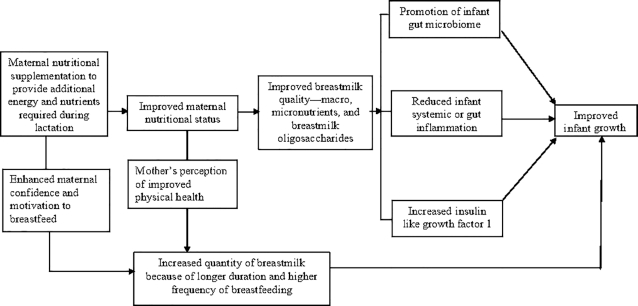
In lower-middle-income settings, growth faltering in the first 6 mo of life occurs despite exclusive breastfeeding.
The aim was to test the efficacy of an approach to improve the dietary adequacy of mothers during lactation and thus improve the growth of their infants.
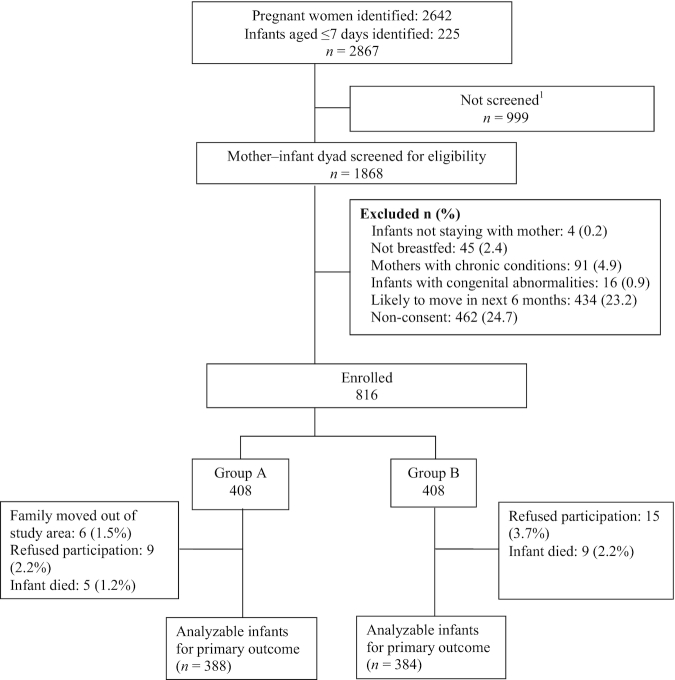
Eligible mother-infant dyads (infants ≤7 d of age) were randomly assigned to either intervention or control groups. Mothers in the intervention group received snacks that were to be consumed daily, which provided 600 kcal of energy-with 25-30% of energy derived from fats (150-180 kcal) and 13% of energy from protein (80 kcal). Micronutrients were supplemented as daily tablets. We provided counseling on breastfeeding and infant-care practices to mothers in both groups. The primary outcome was attained infant length-for-age z scores (LAZ) at 6 mo of age. Secondary outcomes included exclusive breastfeeding proportion reported by the mother, maternal BMI and midupper arm circumference (MUAC), hemoglobin concentrations in mothers and infants, and the proportion of anemic infants at 6 mo of age.
We enrolled 816 mother-infant dyads. The intervention did not achieve a significant effect on LAZ at 6 mo (adjusted mean difference: 0.09; 95% CI: -0.03, 0.20). Exclusive breastfeeding at 5 mo was higher (45.1% vs. 34.5%; RR: 1.31; 95% CI: 1.04, 1.64) in the intervention group compared with the controls. There were no significant effects on mean hemoglobin concentration or the proportion of anemic infants at 6 mo of age compared with the control group. We noted significant effects on maternal nutritional status (BMI, MUAC, hemoglobin concentration, and proportion anemic).
Postnatal supplementation of 600 kcal energy, 20 g protein, and multiple micronutrients daily to lactating mothers did not affect infant LAZ at age 6 mo. Such supplementation may improve maternal nutritional status. This trial was registered at Clinical Trials Registry-India as CTRI/2018/04/013095.
在中低收入国家,尽管实行了纯母乳喂养,但婴儿在生命的头 6 个月仍会出现生长迟缓。
本研究旨在检验一种改善哺乳期母亲饮食充足性的方法的效果,从而改善婴儿的生长状况。
合格的母婴二人组(婴儿≤7 天)被随机分配到干预组或对照组。干预组的母亲每天接受提供 600 千卡能量的零食,其中 25-30%的能量来自脂肪(150-180 千卡),13%的能量来自蛋白质(80 千卡)。微量营养素以每日片剂形式补充。我们向两组母亲提供母乳喂养和婴儿护理实践方面的咨询。主要结局是在 6 个月时获得婴儿的身长年龄 Z 评分(LAZ)。次要结局包括母亲报告的纯母乳喂养比例、母亲的 BMI 和中臂围(MUAC)、母亲和婴儿的血红蛋白浓度,以及在 6 个月时贫血婴儿的比例。
我们纳入了 816 对母婴二人组。干预措施对 6 个月时的 LAZ 没有显著影响(调整后的平均差异:0.09;95%CI:-0.03,0.20)。与对照组相比,干预组在 5 个月时的纯母乳喂养比例更高(45.1%比 34.5%;RR:1.31;95%CI:1.04,1.64)。与对照组相比,6 个月时母亲的平均血红蛋白浓度或贫血婴儿的比例没有显著影响。我们注意到对母亲营养状况(BMI、MUAC、血红蛋白浓度和贫血比例)有显著影响。
对哺乳期母亲每天补充 600 千卡能量、20 克蛋白质和多种微量营养素,不会影响婴儿在 6 个月时的 LAZ。这种补充可能会改善母亲的营养状况。本试验在印度临床试验注册处注册,注册号为 CTRI/2018/04/013095。