The George Institute for Global Health, University of New South Wales, Sydney, NSW, Australia.
School of Health Sciences, Faculty of Health and Medicine, and Priority Research Centre in Physical Activity and Nutrition, The University of Newcastle, Callaghan, NSW, Australia.
Am J Clin Nutr. 2021 May 8;113(5):1241-1255. doi: 10.1093/ajcn/nqaa370.
To inform the interpretation of dietary data in the context of sex differences in diet-disease relations, it is important to understand whether there are any sex differences in accuracy of dietary reporting.
To quantify sex differences in self-reported total energy intake (TEI) compared with a reference measure of total energy expenditure (TEE).
Six electronic databases were systematically searched for published original research articles between 1980 and April 2020. Studies were included if they were conducted in adult populations with measures for both females and males of self-reported TEI and TEE from doubly labeled water (DLW). Studies were screened and quality assessed independently by 2 authors. Random-effects meta-analyses were conducted to pool the mean differences between TEI and TEE for, and between, females and males, by method of dietary assessment.
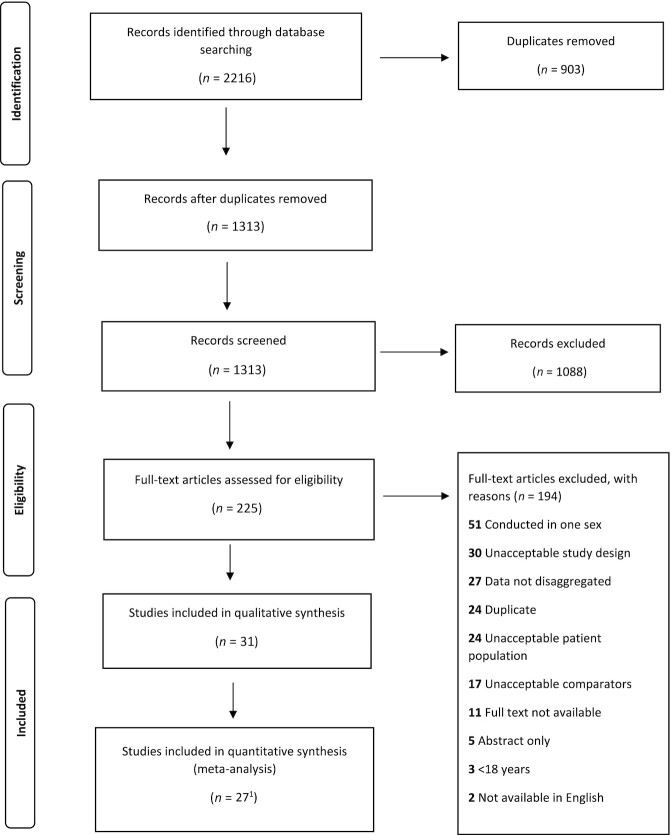
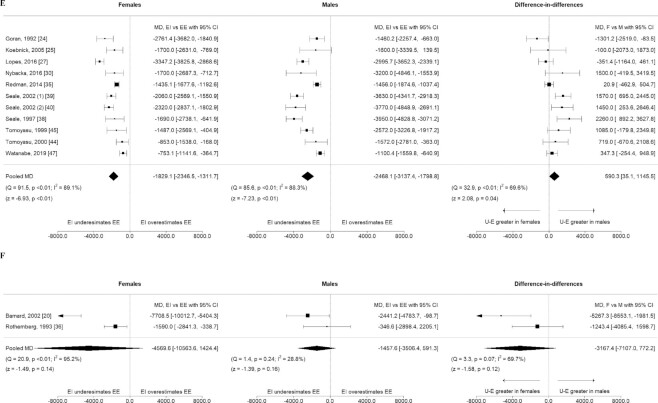
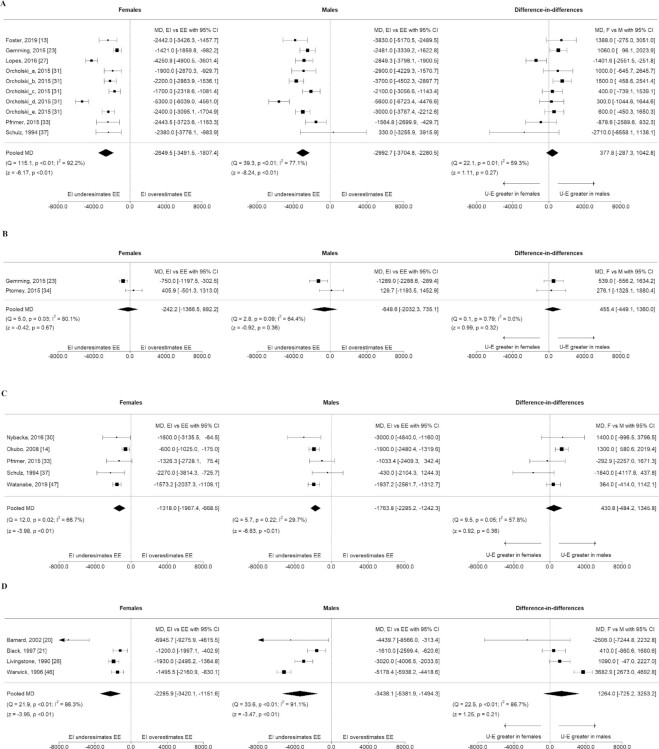
From 1313 identified studies, 31 met the inclusion criteria. The studies collectively included information on 4518 individuals (54% females). Dietary assessment methods included 24-h recalls (n = 12, 2 with supplemental photos of food items consumed), estimated food records (EFRs; n = 11), FFQs (n = 10), weighed food records (WFRs, n = 5), and diet histories (n = 2). Meta-analyses identified underestimation of TEI by females and males, ranging from -1318 kJ/d (95% CI: -1967, -669) for FFQ to -2650 kJ/d (95% CI: -3492, -1807) for 24-h recalls for females, and from -1764 kJ/d (95% CI: -2285, -1242) for FFQ to -3438 kJ/d (95% CI: -5382, -1494) for WFR for males. There was no difference in the level of underestimation by sex, except when using EFR, for which males underestimated energy intake more than females (by 590 kJ/d, 95% CI: 35, 1,146).
Substantial underestimation of TEI across a range of dietary assessment methods was identified, similar by sex. These underestimations should be considered when assessing TEI and interpreting diet-disease relations.
为了在饮食与疾病关系中性别差异的背景下解释饮食数据,了解饮食报告的准确性是否存在任何性别差异非常重要。
定量比较自我报告的总能量摄入(TEI)与总能量消耗(TEE)的参考测量值之间的性别差异。
系统检索了 1980 年至 2020 年 4 月期间发表的原始研究文章的六个电子数据库。如果研究中包括女性和男性的 TEI 和 TEE 测量值,并且使用双标水(DLW)进行了饮食评估,则纳入研究。由两位作者独立进行研究筛选和质量评估。使用膳食评估方法,对女性和男性的 TEI 和 TEE 之间以及之间的平均差异进行了随机效应荟萃分析。
从 1313 项已识别的研究中,有 31 项符合纳入标准。这些研究总共包含了 4518 个人的信息(54%为女性)。饮食评估方法包括 24 小时回顾(n=12,其中 2 项有食物摄入照片补充)、估计食物记录(EFR;n=11)、FFQ(n=10)、称重食物记录(WFR,n=5)和饮食史(n=2)。荟萃分析确定女性和男性的 TEI 存在低估,范围从女性的 FFQ 为-1318 kJ/d(95%CI:-1967,-669)到 24 小时回顾为-2650 kJ/d(95%CI:-3492,-1807),男性的 FFQ 为-1764 kJ/d(95%CI:-2285,-1242)到 WFR 为-3438 kJ/d(95%CI:-5382,-1494)。除了 EFR 之外,不同性别之间的低估程度没有差异,EFR 中男性的能量摄入比女性低估了 590 kJ/d(95%CI:35,1146)。
在一系列饮食评估方法中都发现了 TEI 的大量低估,性别之间的低估程度相似。在评估 TEI 和解释饮食与疾病关系时,应考虑这些低估。