Gordan Lucio, Chang Melody, Lafeuille Marie-Hélène, Romdhani Hela, Paramasivam Fuad, Maiese Eric M, McKay Caroline
Florida Cancer Specialists, Gainesville, FL, USA.
Analysis Group, Inc., 1190 avenue des Canadiens-de-Montreal, Tour Deloitte Suite 1500, Montreal, QC, H3B 0G7, Canada.
Drugs Real World Outcomes. 2021 Jun;8(2):187-195. doi: 10.1007/s40801-020-00226-3. Epub 2021 Feb 9.
Some institutions have implemented a daratumumab intravenous rapid-infusion protocol in which patients with multiple myeloma (MM) receive their third and subsequent infusions within ~ 90 min instead of ≥ 3 h.
This study sought to understand the utilization, effectiveness, and infusion reactions (IRs) observed in patients with MM who received daratumumab rapid infusions.
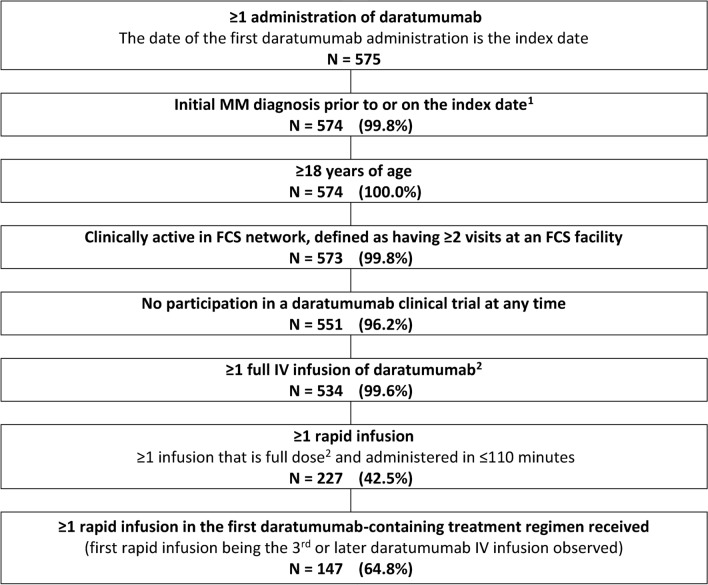
Electronic medical records from Florida Cancer Specialists & Research Institute were used. Adult patients with MM who received one or more rapid daratumumab infusion (full dose in ≤ 110 min) at their third or later infusion of the first daratumumab-containing regimen (index date: 16 November 2015 to 15 March 2019) were included. IRs included events that (1) occurred ≤ 24 h post-daratumumab infusion or (2) were stated as an IR in the patient charts. Non-IR adverse events (AEs) were events attributed to daratumumab in patient charts that did not meet the IR definition.
In total, 147 patients received one or more rapid infusion in their first daratumumab-containing regimen. Median time from initial MM diagnosis to index date was 2.5 years. Non-IR AEs occurred in 10.2% of patients during treatment, and 36.7% experienced one or more IR after receiving a daratumumab infusion. No IRs occurred after a rapid infusion. The overall response rate was 91.1% (after rapid infusions only: 71.3%).
This study provides real-world evidence on the practice patterns of daratumumab rapid infusions in a large community-based oncology clinic system. These results suggest that treatment regimens including daratumumab rapid infusions at the third infusion or later were well-tolerated, and their effectiveness was comparable to that observed in clinical trials.
一些机构已实施了达雷妥尤单抗静脉快速输注方案,即多发性骨髓瘤(MM)患者在约90分钟内接受第三次及后续输注,而非≥3小时。
本研究旨在了解接受达雷妥尤单抗快速输注的MM患者的使用情况、有效性及输注反应(IRs)。
使用佛罗里达癌症专家与研究所的电子病历。纳入在首个含达雷妥尤单抗方案的第三次或更晚输注时接受一次或多次快速达雷妥尤单抗输注(全剂量,≤110分钟)的成年MM患者(索引日期:2015年11月16日至2019年3月15日)。IRs包括:(1)在达雷妥尤单抗输注后≤24小时发生的事件;或(2)在患者病历中被列为IR的事件。非IR不良事件(AEs)是患者病历中归因于达雷妥尤单抗但不符合IR定义的事件。
共有147例患者在首个含达雷妥尤单抗方案中接受了一次或多次快速输注。从MM初始诊断到索引日期的中位时间为2.5年。10.2%的患者在治疗期间发生非IR AEs,36.7%的患者在接受达雷妥尤单抗输注后发生一次或多次IR。快速输注后未发生IRs。总体缓解率为91.1%(仅快速输注后:71.3%)。
本研究为大型社区肿瘤诊所系统中达雷妥尤单抗快速输注的实践模式提供了真实世界证据。这些结果表明,包括在第三次或更晚输注时进行达雷妥尤单抗快速输注的治疗方案耐受性良好,其有效性与临床试验中观察到的相当。