Geisinger Neuroscience Institute, Geisinger Health System, Danville, Pennsylvania, United States of America.
Phenomic Analytics and Clinical Data Core, Geisinger Health System, Danville, Pennsylvania, United States of America.
PLoS One. 2021 Feb 10;16(2):e0246877. doi: 10.1371/journal.pone.0246877. eCollection 2021.
Obesity is an established risk factor for ischemic stroke but the association of increased body mass index (BMI) with survival after ischemic stroke remains controversial. Many studies have shown that increased BMI has a "protective" effect on survival after stroke while other studies have debunked the "obesity paradox". This study aimed at examining the relationship between BMI and all-cause mortality at one year in first-time ischemic stroke patients using a large dataset extracted from different resources including electronic health records.
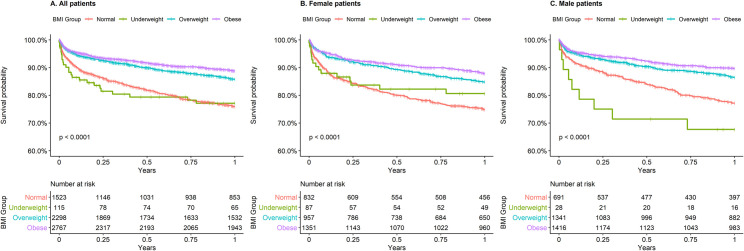
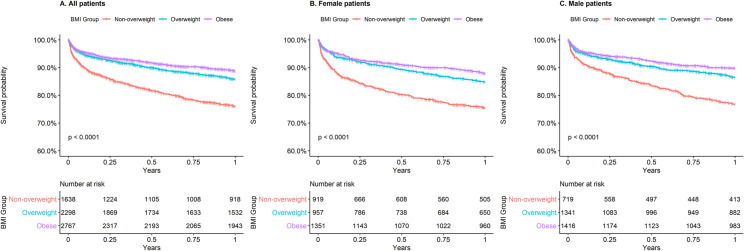
This was a retrospective cohort study of consecutive ischemic stroke patients captured in our Geisinger NeuroScience Ischemic Stroke (GNSIS) database. Survival in first-time ischemic stroke patients in different BMI categories was analyzed using Kaplan Meier survival curves. The predictors of mortality at one-year were assessed using a stratified Cox proportional hazards model.
Among 6,703 first-time ischemic stroke patients, overweight and obese patients were found to have statistically decreased hazard ratio (HR) compared to the non-overweight patients (overweight patients- HR = 0.61 [95% CI, 0.52-0.72]; obese patients- HR = 0.56 [95% CI, 0.48-0.67]). Predictors with a significant increase in the hazard ratio for one-year mortality were age at the ischemic stroke event, history of neoplasm, atrial fibrillation/flutter, diabetes, myocardial infarction and heart failure.
Our study results support the obesity paradox in ischemic stroke patients as shown by a significantly decreased hazard ratio for one-year mortality among overweight and obese patients in comparison to non-overweight patients.
肥胖是缺血性中风的一个既定危险因素,但体重指数(BMI)升高与缺血性中风后生存的关系仍存在争议。许多研究表明,BMI 升高对中风后生存有“保护”作用,而其他研究则驳斥了“肥胖悖论”。本研究旨在使用从电子健康记录等不同资源中提取的大型数据集,检查首次缺血性中风患者 BMI 与一年内全因死亡率之间的关系。
这是一项连续缺血性中风患者的回顾性队列研究,纳入了我们的 Geisinger 神经科学缺血性中风(GNSIS)数据库。使用 Kaplan-Meier 生存曲线分析不同 BMI 类别中首次缺血性中风患者的生存情况。使用分层 Cox 比例风险模型评估一年死亡率的预测因素。
在 6703 例首次缺血性中风患者中,超重和肥胖患者的死亡风险比非超重患者显著降低(超重患者-风险比[HR] = 0.61 [95%置信区间,0.52-0.72];肥胖患者-HR = 0.56 [95%置信区间,0.48-0.67])。与一年死亡率显著增加相关的预测因素包括缺血性中风事件时的年龄、肿瘤史、心房颤动/扑动、糖尿病、心肌梗死和心力衰竭。
我们的研究结果支持缺血性中风患者中的肥胖悖论,与非超重患者相比,超重和肥胖患者的一年死亡率风险比显著降低。