Fukushima Masayoshi, Ohtomo Nozomu, Noma Michita, Kumanomido Yudai, Nakarai Hiroyuki, Tozawa Keiichiro, Yoshida Yuichi, Sakamoto Ryuji, Miyahara Junya, Anno Masato, Kawamura Naohiro, Higashikawa Akiro, Takeshita Yujiro, Inanami Hirohiko, Tanaka Sakae, Oshima Yasushi
Spine Center, Toranomon Hospital, Tokyo 105-8470, Japan.
University of Tokyo Spine Group (UTSG), Tokyo 113-8655, Japan.
Medicina (Kaunas). 2021 Feb 8;57(2):150. doi: 10.3390/medicina57020150.
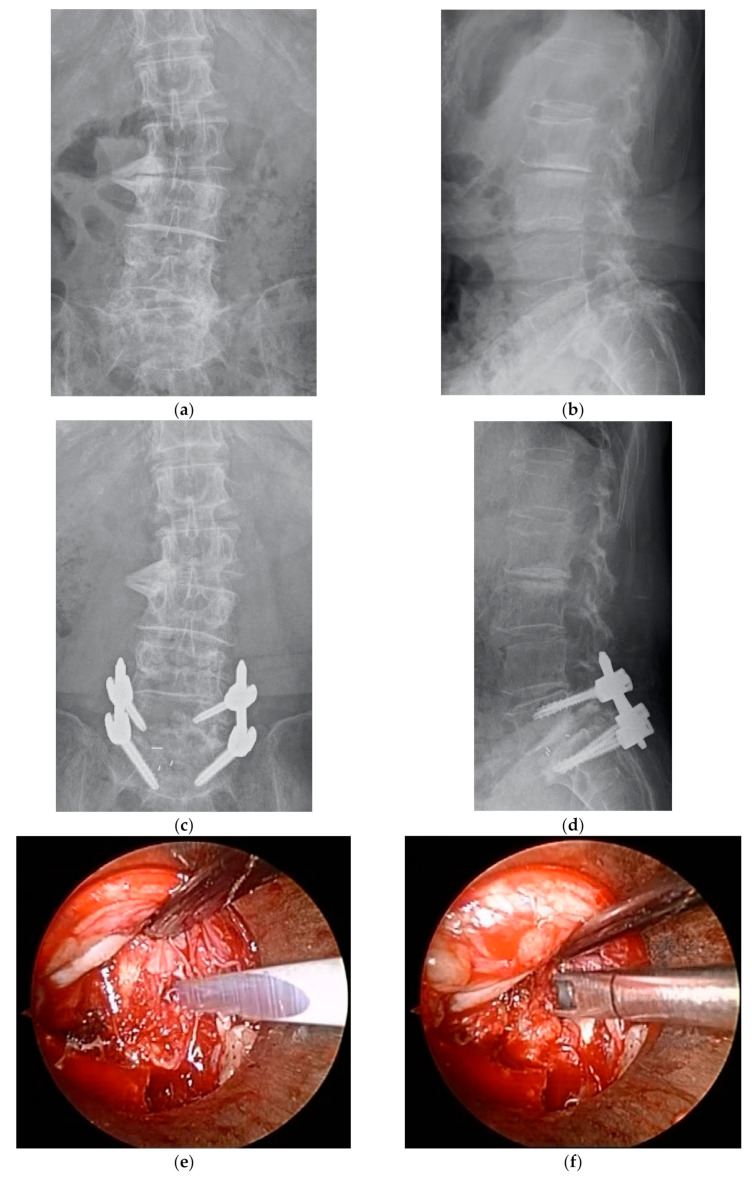
: Minimally invasive surgery has become popular for posterior lumbar interbody fusion (PLIF). Microendoscope-assisted PLIF (ME-PLIF) utilizes a microendoscope within a tubular retractor for PLIF procedures; however, there are no published reports that compare Microendoscope-assisted to open PLIF. Here we compare the surgical and clinical outcomes of ME-PLIF with those of open PLIF. : A total of 155 consecutive patients who underwent single-level PLIF were registered prospectively. Of the 149 patients with a complete set of preoperative data, 72 patients underwent ME-PLIF (ME-group), and 77 underwent open PLIF (open-group). Clinical and radiographic findings collected one year after surgery were compared. : Of the 149 patients, 57 patients in ME-group and 58 patients in the open-group were available. The ME-PLIF procedure required a significantly shorter operating time and involved less intraoperative blood loss. Three patients in both groups reported dural tears as intraoperative complications. Three patients in ME-group experienced postoperative complications, compared to two patients in the open-group. The fusion rate in ME-group at one year was lower than that in the open group ( = 0.06). The proportion of patients who were satisfied was significantly higher in the ME-group ( = 0.02). ME-PLIF was associated with equivalent post-surgical outcomes and significantly higher rates of patient satisfaction than the traditional open PLIF procedure. However, the fusion rate after ME-PLIF tended to be lower than that after the traditional open method.
微创外科手术已在腰椎后路椎间融合术(PLIF)中广泛应用。显微内镜辅助PLIF(ME-PLIF)在PLIF手术中利用管状牵开器内的显微内镜;然而,尚无已发表的报告对显微内镜辅助PLIF与开放PLIF进行比较。在此,我们比较了ME-PLIF与开放PLIF的手术及临床结果。
前瞻性登记了155例连续接受单节段PLIF的患者。在149例有完整术前数据的患者中,72例接受了ME-PLIF(ME组),77例接受了开放PLIF(开放组)。比较了术后一年收集的临床和影像学结果。
在149例患者中,ME组有57例患者,开放组有58例患者可供分析。ME-PLIF手术所需的手术时间明显更短,术中失血更少。两组均有3例患者报告术中出现硬脊膜撕裂并发症。ME组有3例患者出现术后并发症,而开放组有2例。ME组一年时的融合率低于开放组(P = 0.06)。ME组患者的满意度显著更高(P = 0.02)。ME-PLIF与传统开放PLIF手术相比,术后结果相当,患者满意度显著更高。然而,ME-PLIF后的融合率往往低于传统开放方法。