Brune Magdalena M, Juskevicius Darius, Haslbauer Jasmin, Dirnhofer Stefan, Tzankov Alexandar
Institute of Medical Genetics and Pathology, University Hospital Basel, Schönbeinstrasse 40, CH 4031 Basel, Switzerland.
Cancers (Basel). 2021 Feb 8;13(4):682. doi: 10.3390/cancers13040682.
Hodgkin lymphoma (HL) is predominantly composed of reactive, non-neoplastic cells surrounding scarcely distributed tumor cells, that is, so-called Hodgkin and Reed-Sternberg (HRS) or lymphocyte predominant (LP) cells. This scarcity impeded the analysis of the tumor cell genomes for a long time, but recently developed methods (especially laser capture microdissection, flow cytometry/fluorescence-activated cell sorting) facilitated molecular investigation, elucidating the pathophysiological principles of "Hodgkin lymphomagenesis".
We reviewed the relevant literature of the last three decades focusing on the genomic landscape of classic and nodular lymphocyte predominant HL (NLPHL) and summarized molecular cornerstones.
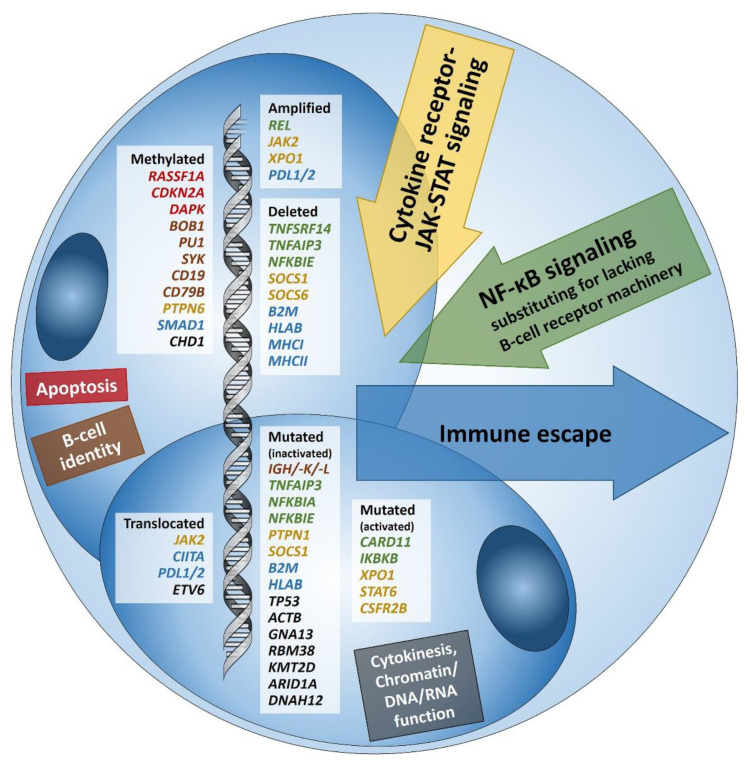
Firstly, the malignant cells of HL evade the immune system by altered expression of , and MHC class I and II due to various genetic alterations. Secondly, tumor growth is promoted by permanently activated JAK/STAT signaling due to pervasive mutations of multiple genes involved in the pathway. Thirdly, apoptosis of neoplastic cells is prevented by alterations of NF-κB compounds and the PI3K/AKT/mTOR axis. Additionally, Epstein-Barr virus infection can simultaneously activate JAK/STAT and NF-κB, similarly leading to enhanced survival and evasion of apoptosis. Finally, epigenetic phenomena such as promoter hypermethylation lead to the downregulation of B-lineage-specific, tumor-suppressor and immune regulation genes.
The blueprint of HL genomics has been laid, paving the way for future investigations into its complex pathophysiology.
霍奇金淋巴瘤(HL)主要由围绕分布稀少的肿瘤细胞的反应性、非肿瘤性细胞组成,即所谓的霍奇金和里德-斯特恩伯格(HRS)细胞或淋巴细胞为主型(LP)细胞。这种稀少性长期阻碍了对肿瘤细胞基因组的分析,但最近开发的方法(尤其是激光捕获显微切割、流式细胞术/荧光激活细胞分选)促进了分子研究,阐明了“霍奇金淋巴瘤发生”的病理生理原理。
我们回顾了过去三十年的相关文献,重点关注经典型和结节性淋巴细胞为主型HL(NLPHL)的基因组格局,并总结了分子基石。
首先,HL的恶性细胞由于各种基因改变,通过改变 、 和MHC I类和II类分子的表达来逃避免疫系统。其次,由于该通路中多个基因的普遍突变,JAK/STAT信号通路持续激活,从而促进肿瘤生长。第三,通过改变NF-κB复合物和PI3K/AKT/mTOR轴来防止肿瘤细胞凋亡。此外,爱泼斯坦-巴尔病毒感染可同时激活JAK/STAT和NF-κB,同样导致存活率提高和凋亡逃避。最后,启动子高甲基化等表观遗传现象导致B细胞谱系特异性、肿瘤抑制和免疫调节基因的下调。
HL基因组学的蓝图已经绘制完成,为未来对其复杂病理生理学的研究铺平了道路。