Maarof Nian N N, Alsalahi Abdulsamad, Abdulmalek Emilia, Fakurazi Sharida, Tejo Bimo Ario, Abdul Rahman Mohd Basyaruddin
Integrated Chemical BioPhysics Research, Department of Chemistry, Faculty of Science, Universiti Putra Malaysia, Serdang 43400, Selangor, Malaysia.
Department of Chemistry, College of Education, University of Sulaimani, Sulaimani 46001, Iraq.
Cancers (Basel). 2021 Feb 8;13(4):688. doi: 10.3390/cancers13040688.
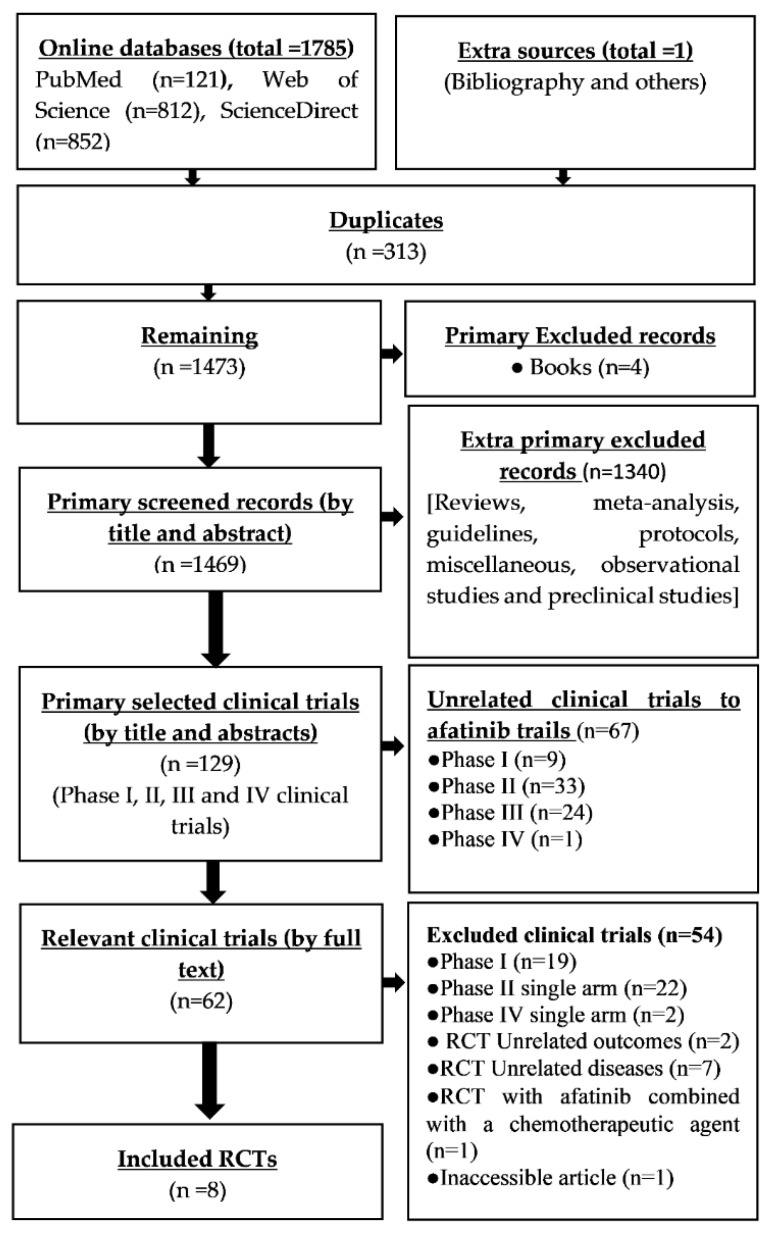
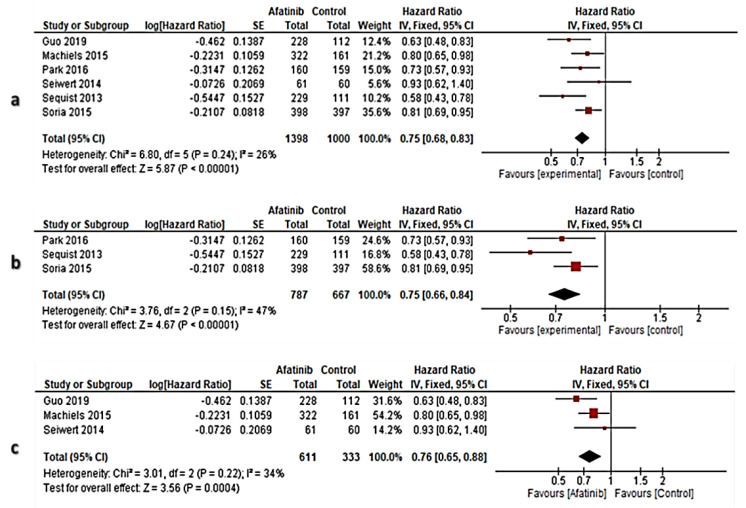
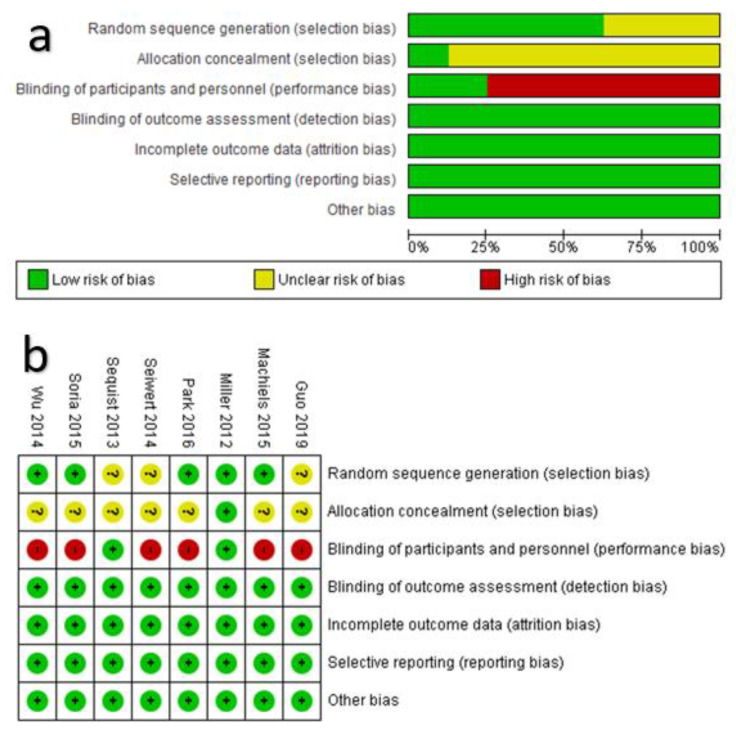
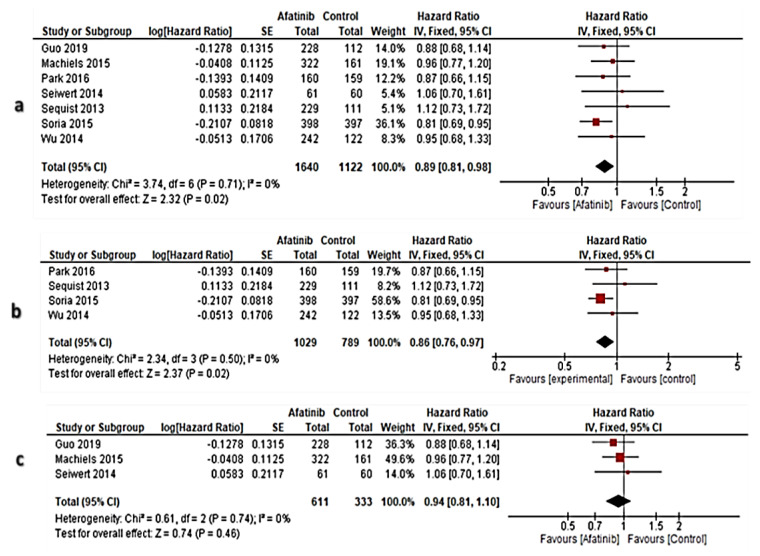
Several randomized controlled trials (RCTs) evaluated the afatinib efficacy in patients with advanced non-small cell lung cancer (NSCLC) and recurrent/metastatic head and neck squamous cell carcinoma (R/M HNSCC). This review systemically outlined and meta-analyzed the afatinib efficacy in NSCLC and R/M HNSCC in terms of overall survival (OS) and progression-free survival (PFS) endpoints. Records were retrieved from PubMed, Web of Science, and ScienceDirect from 2011 to 2020. Eight afatinib RCTs were included and assessed for the risk of bias. In meta-analysis, overall pooled effect size (ES) of OS in afatinib group (AG) significantly improved in all RCTs and NSCLC-RCTs [hazard ratios (HRs): 0.89 (95% CI: 0.81-0.98, = 0.02); I = 0%, = 0.71/ 0.86 (95% CI: 0.76-0.97; = 0.02); I = 0%, = 0.50, respectively]. ES of PFS in AG significantly improved in all RCTs, NSCLC-RCTs, and HNSCC-RCTs [HRs: 0.75 (95% CI: 0.68-0.83; < 0.00001); I = 26%, = 0.24; 0.75 (95% CI: 0.66-0.84; < 0.00001); I = 47%, = 0.15/0.76 (95% CI: 0.65-88; = 0.0004); I = 34%, = 0.0004, respectively]. From a clinical viewpoint of severity, interstitial lung disease, dyspnea, pneumonia, acute renal failure, and renal injury were rarely incident adverse events in the afatinib group. In conclusion, first- and second-line afatinib monotherapy improved the survival of patients with NSCLC, while second-line afatinib monotherapy could be promising for R/M HNSCC. The prospective protocol is in PROSPERO (ID = CRD42020204547).
多项随机对照试验(RCT)评估了阿法替尼在晚期非小细胞肺癌(NSCLC)患者以及复发性/转移性头颈部鳞状细胞癌(R/M HNSCC)患者中的疗效。本综述系统地概述并荟萃分析了阿法替尼在NSCLC和R/M HNSCC中关于总生存期(OS)和无进展生存期(PFS)终点的疗效。从2011年至2020年在PubMed、科学网和科学Direct数据库中检索记录。纳入了八项阿法替尼RCT,并评估了偏倚风险。在荟萃分析中,在所有RCT以及NSCLC-RCT中,阿法替尼组(AG)的OS总体合并效应量(ES)显著改善[风险比(HR):0.89(95%置信区间:0.81 - 0.98,P = 0.02);I² = 0%,τ² = 0.71/0.86(95%置信区间:0.76 - 0.97;P = 0.02);I² = 0%,τ² = 0.50,分别]。在所有RCT、NSCLC-RCT和HNSCC-RCT中,AG的PFS的ES显著改善[HR:0.75(95%置信区间:0.68 - 0.83;P < 0.00001);I² = 26%,τ² = 0.24;0.75(95%置信区间:0.66 - 0.84;P < 0.00001);I² = 47%,τ² = 0.15/0.76(95%置信区间:0.65 - 0.88;P = 0.0004);I² = 34%,τ² = 0.0004,分别]。从临床严重程度的角度来看,间质性肺疾病、呼吸困难、肺炎、急性肾衰竭和肾损伤在阿法替尼组中是罕见的不良事件。总之,一线和二线阿法替尼单药治疗改善了NSCLC患者的生存期,而二线阿法替尼单药治疗对R/M HNSCC可能有前景。前瞻性方案在国际前瞻性系统评价注册库(PROSPERO)中(标识符 = CRD42020204547)。