Department of Neurology, Shanghai Fifth People's Hospital, Fudan University, No. 801, Heqing Road, Shanghai, 200240, China.
Jiangchuan Community Health Service Center of Minhang District, Shanghai, China.
BMC Neurol. 2021 Feb 10;21(1):62. doi: 10.1186/s12883-021-02097-9.
Persistent inflammation is an important driver of disease progression and affects prognosis. Some indicators of inflammation predict short-term outcomes. The relationship between prognosis, especially mortality, and persistent inflammation in massive stroke has not been studied, and this has been the subject of our research.
From April 1, 2017 to February 1, 2020, consecutive patients were prospectively enrolled. Clinical data, laboratory data, imaging data and follow-up infections morbidity were compared between 2 groups according to modified Rankin scale (mRS) scores (mRS < 3 and ≥ 3) at 1 month. The binomial logistic analysis was used to determine independent factors of 1-month prognosis. Short-term functional outcome, mortality and infection rates in massive stroke with and without persistent inflammation were compared.
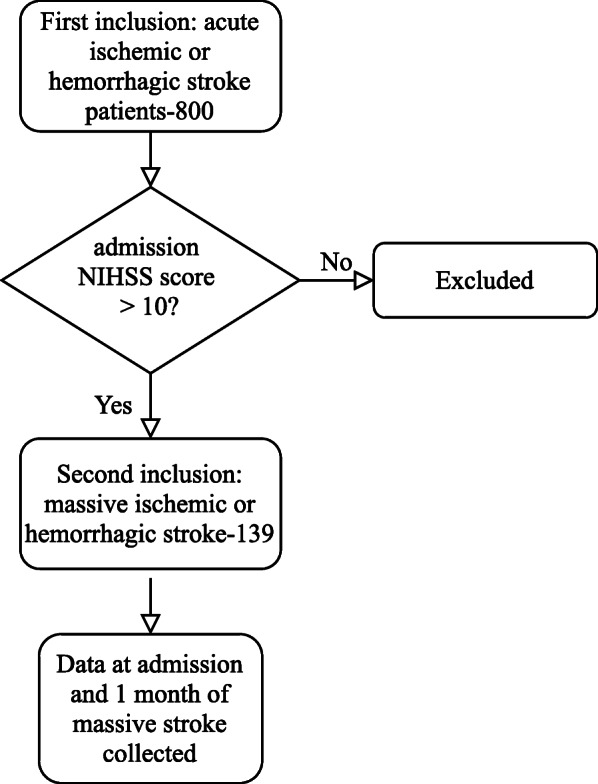
One hundred thirty-nine patients with massive stroke were included from 800 patients. We found that admission blood glucose levels (p = 0.005), proportions of cerebral hemispheric (p = 0.001), posterior circulatory (p = 0.035), and lacunar (p = 0.022) ischemia were higher in poor outcome patients; neutrophil-to-lymphocyte ratio (odd ratio = 1.87, 95%CI 1.14-3.07, p = 0.013) and blood glucose concentrations (odd ratio = 1.34, 95%CI 1.01-1.79, p = 0.043) can independently predict the short-term prognosis in massive stroke patients. We also found that the incidence of pulmonary infection (p = 0.009), one-month mortality (p = 0.003) and adverse outcomes (p = 0.0005) were higher in patients with persistent inflammation.
This study suggested that persistent inflammation is associated with poor prognosis, 1-month mortality and the occurrence of in-hospital pulmonary infection and that higher baseline inflammation level predicts short-term poor outcomes in massive stroke.
持续性炎症是疾病进展的重要驱动因素,影响预后。一些炎症指标可预测短期结局。尚未研究过巨大卒中患者的预后(尤其是死亡率)与持续性炎症之间的关系,这是我们研究的主题。
本研究前瞻性连续纳入 2017 年 4 月 1 日至 2020 年 2 月 1 日的患者。根据 1 个月时改良 Rankin 量表(mRS)评分(mRS<3 分和≥3 分)将两组间的临床数据、实验室数据、影像学数据和随访感染发病率进行比较。使用二项逻辑回归分析确定 1 个月预后的独立因素。比较巨大卒中伴和不伴持续性炎症患者的短期功能结局、死亡率和感染率。
从 800 例患者中纳入了 139 例巨大卒中患者。我们发现预后不良患者的入院血糖水平(p=0.005)、大脑半球(p=0.001)、后循环(p=0.035)和腔隙性(p=0.022)缺血的比例较高;中性粒细胞与淋巴细胞比值(比值比 1.87,95%置信区间 1.14-3.07,p=0.013)和血糖浓度(比值比 1.34,95%置信区间 1.01-1.79,p=0.043)可独立预测巨大卒中患者的短期预后。我们还发现持续性炎症患者的肺部感染发生率(p=0.009)、1 个月死亡率(p=0.003)和不良结局(p=0.0005)较高。
本研究表明,持续性炎症与不良预后、1 个月死亡率以及院内肺部感染的发生有关,较高的基线炎症水平预示着巨大卒中患者短期预后不良。