Saidu Yauba, Vouking Marius, Njoh Andreas Ateke, Bachire Hassan Ben, Tonga Calvin, Mofor Roberts, Bayiha Christain, Ewane Leonard, Cornelius Chebo, Mbida Ndi Daniel Daddy, Abizou Messang Blandine, Njie Victor Mbome, Nzuobontane Divine
Clinton Health Access Initiative, Cameroon Country Office, Third floor, Y-building, Rue 1775, Nouvelle Route Bastos, Yaoundé, Cameroon.
Institute for Global Health, University of Siena, Siena, Italy.
Confl Health. 2021 Feb 10;15(1):8. doi: 10.1186/s13031-021-00341-0.
Civil strife has long been recognized as a significant barrier in the fight against vaccine preventable diseases in several parts of the world. However, little is known about the impact of the ongoing civil strife on the immunisation system in the Northwest (NW) and Southwest (SW) regions of Cameroon, which erupted in late 2016. In this paper, we assessed the effect of the conflict on key immunisation outcomes in the North West and South West regions of Cameroon.
Data were obtained from the standard EPI data reporting tool, the District Vaccine and Data Management Tool (DVDMT), from all the districts in the two regions. Completed forms were then reviewed for accuracy prior to data entry at central level. Summary statistics were used to estimate the variables of interest for each region for the years 2016 (pre-conflict) and 2019 (during conflict).
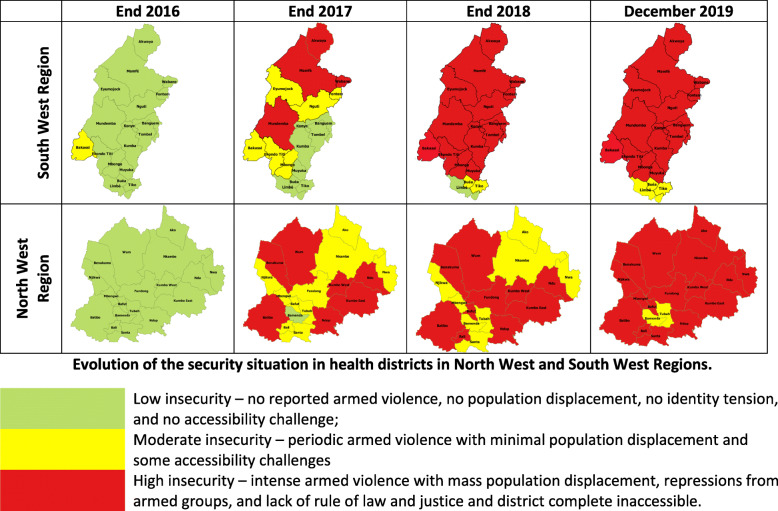
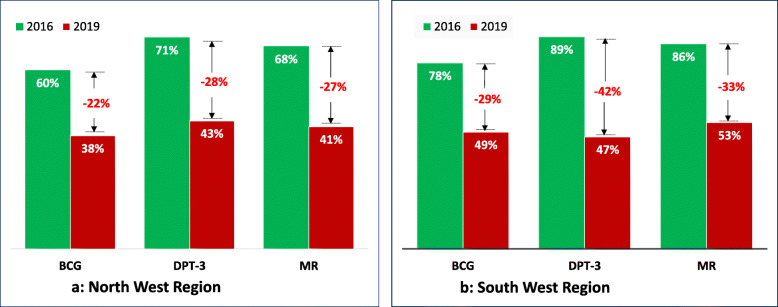
In the two regions, the security situation has deteriorated in almost all districts, which in turn has disrupted basic healthcare delivery in those areas. A total of 26 facilities were destroyed and 11 healthcare workers killed in both regions. Reported immunisation coverage rates for key antigens including, BCG, DPT-3 and MR, witnessed a dramatic decline between 2016 and 2019, ranging from 22% points decline for BCG in the NW and to 42% points decline for DPT-3 in the SW. Similarly, the proportion of districts with DPT-3 coverage of at least 80% dropped from 75% in 2016 to 11% in 2019 in the NW. In the SW this proportion dropped from 16% in 2016 to 0 % in 2019.
Our data demonstrates the marked negative impact of the ongoing civil strife on key immunisation outcomes in the two regions and the country at large. This decline could amplify the risk of vaccine preventable diseases vaccine preventable diseases outbreaks in the two regions. Besides the ongoing actions to contain the crises, effective strategies for reaching children in the conflict zones as well as the internally displaced population are needed. There is also the need to rebuild destroyed facilities as well as to protect health facilities and staff from targeted violence.
长期以来,内乱一直被视为世界上一些地区抗击疫苗可预防疾病的重大障碍。然而,对于2016年末爆发的喀麦隆西北部和西南部地区持续内乱对免疫接种系统的影响,人们知之甚少。在本文中,我们评估了冲突对喀麦隆西北部和西南部地区关键免疫接种结果的影响。
数据来自标准的扩大免疫规划(EPI)数据报告工具——地区疫苗与数据管理工具(DVDMT),涵盖这两个地区的所有区。在中央层面进行数据录入之前,先对填写完整的表格进行准确性审核。使用汇总统计数据来估计2016年(冲突前)和2019年(冲突期间)这两个年份各地区的相关变量。
在这两个地区,几乎所有区的安全形势都有所恶化,进而扰乱了这些地区的基本医疗服务。两个地区共有26个设施被摧毁,11名医护人员丧生。包括卡介苗(BCG)、三联疫苗(DPT-3)和麻疹疫苗(MR)在内的关键抗原的报告免疫接种覆盖率在2016年至2019年间大幅下降,西北部地区卡介苗覆盖率下降了22个百分点,西南部地区三联疫苗覆盖率下降了42个百分点。同样,三联疫苗覆盖率至少达到80%的区的比例,在西北部地区从2016年的75%降至2019年的11%。在西南部地区,这一比例从2016年的16%降至2019年的0%。
我们的数据表明,持续的内乱对这两个地区乃至整个国家的关键免疫接种结果产生了显著的负面影响。这种下降可能会加大这两个地区疫苗可预防疾病爆发的风险。除了当前控制危机的行动外,还需要采取有效策略,为冲突地区以及境内流离失所人口中的儿童提供免疫服务。此外,还需要重建被摧毁的设施,并保护医疗设施和工作人员免受针对性暴力的侵害。