Akpertey Abraham, Padi Francis K, Meinhardt Lyndel, Zhang Dapeng
Cocoa Research Institute of Ghana, New Tafo Akyem, Ghana.
Sustainable Perennial Crops Laboratory, Agricultural Research Service, United States Department of Agriculture, Beltsville, MD, United States.
Front Plant Sci. 2021 Jan 25;11:612593. doi: 10.3389/fpls.2020.612593. eCollection 2020.
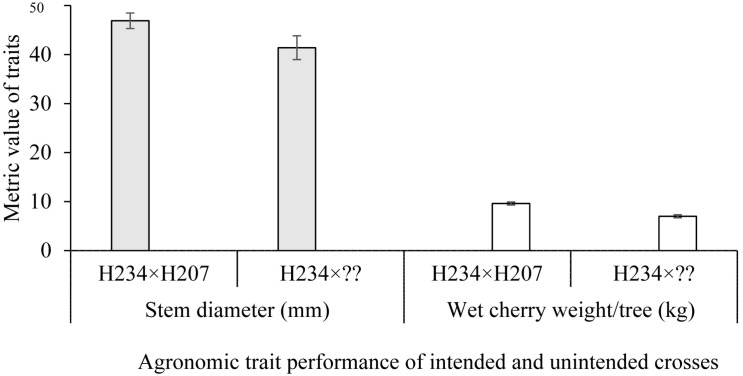
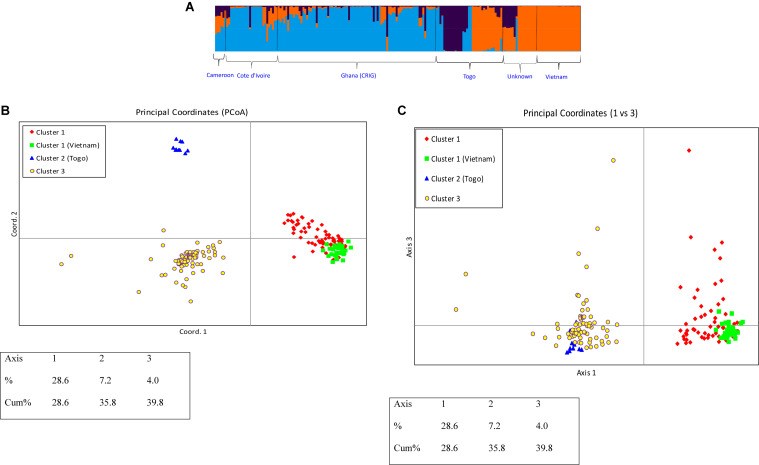
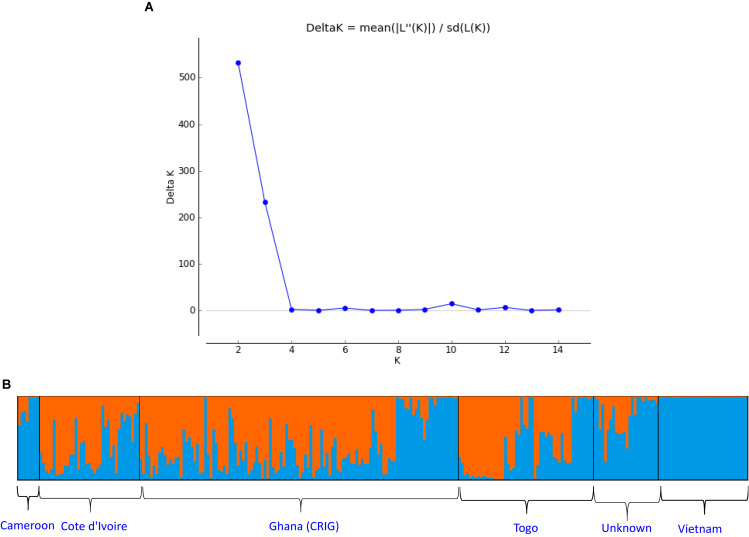
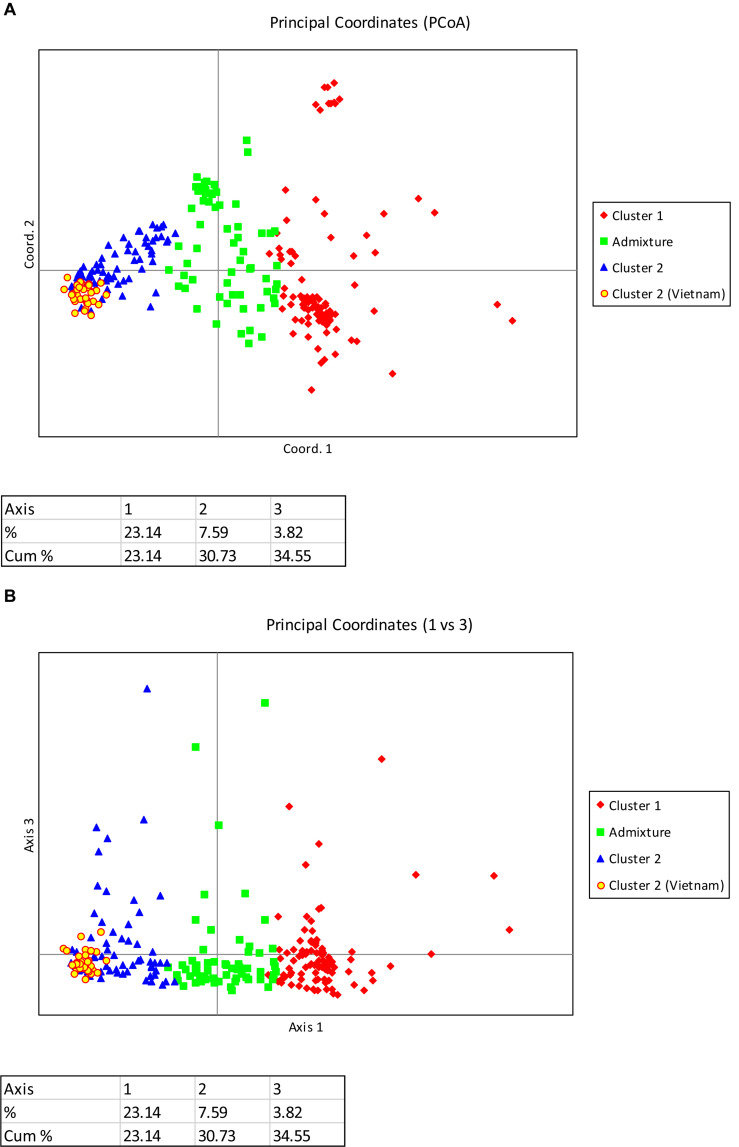
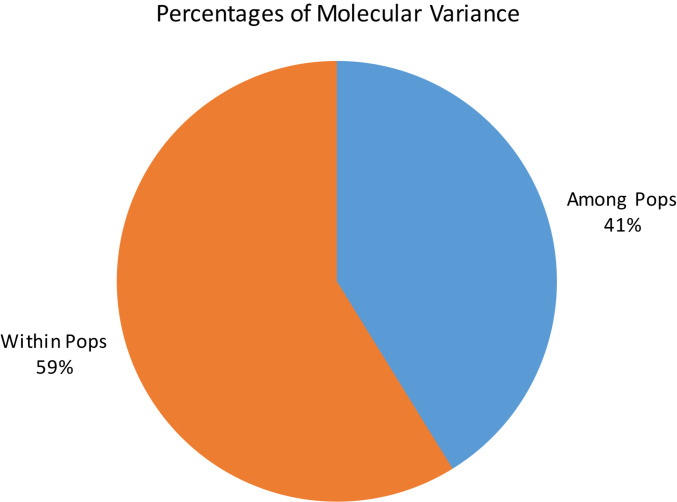
Accurate genotype identification is imperative for effective use of L. germplasm to breed new varieties with tolerance or resistance to biotic and abiotic stresses (including moisture stress and pest and disease stresses such as coffee berry borer and rust) and for high yield and improved cup quality. The present study validated 192 published single nucleotide polymorphism (SNP) markers and selected a panel of 120 loci to examine parentage and labeling errors, genetic diversity, and population structure in 400 accessions assembled from different coffee-producing countries and planted in a field gene bank in Ghana. Of the 400 genotypes analyzed, both synonymous (trees with same SNP profiles but different names, 12.8%) and homonymous (trees with same name but different SNP profiles, 5.8%) mislabeling were identified. Parentage analysis showed that 33.3% of the progenies derived from controlled crossing and 0% of the progenies derived from an open pollinated biclonal seed garden had parentage (both parents) corresponding to breeder records. The results suggest mislabeling of the mother trees used in seed gardens and pollen contamination from unwanted paternal parents. After removing the duplicated accessions, Bayesian clustering analysis partitioned the 270 unique genotypes into two main populations. Analysis of molecular variance (AMOVA) showed that the between-population variation accounts for 41% of the total molecular variation and the genetic divergence was highly significant (st = 0.256; < 0.001). Taken together, our results demonstrate the effectiveness of using the selected SNP panel in gene bank management, varietal identification, seed garden management, nursery verification, and coffee bean authentication for breeding programs.
准确的基因型鉴定对于有效利用咖啡种质资源培育具有耐生物和非生物胁迫(包括水分胁迫以及诸如咖啡果小蠹和锈病等病虫害胁迫)能力的新品种、实现高产并改善杯品质量而言至关重要。本研究验证了192个已发表的单核苷酸多态性(SNP)标记,并挑选了一组120个位点,以检查从不同咖啡生产国收集并种植在加纳田间基因库中的400份种质的亲子关系和标记错误、遗传多样性及群体结构。在分析的400个基因型中,发现了同义错误标记(具有相同SNP谱但名称不同的植株,占12.8%)和同名错误标记(名称相同但SNP谱不同的植株,占5.8%)。亲子关系分析表明,来自控制杂交的后代中有33.3%、来自开放授粉双克隆种子园的后代中有0%的亲子关系(父母双方)与育种者记录相符。结果表明种子园中母树存在标记错误以及存在来自不需要的父本的花粉污染。去除重复的种质后,贝叶斯聚类分析将270个独特基因型分为两个主要群体。分子方差分析(AMOVA)表明,群体间变异占总分子变异的41%,遗传分化极显著(Fst = 0.256;P < 0.001)。综上所述,我们的结果证明了使用选定的SNP标记组在基因库管理、品种鉴定、种子园管理、苗圃核查以及用于育种计划的咖啡豆鉴定方面的有效性。