Dong Xuesi, He Jieyu, Lin Lijuan, Zhu Ying, Chen Chao, Su Li, Zhao Yang, Zhang Ruyang, Wei Yongyue, Chen Feng, Christiani David C
Department of Biostatistics, Center for Global Health, School of Public Health, Nanjing Medical University, Nanjing, China.
Department of Environmental Health, Harvard T.H. Chan School of Public Health, Boston, MA, USA.
Transl Lung Cancer Res. 2021 Jan;10(1):392-401. doi: 10.21037/tlcr-20-414.
Chemoprevention of cancer with aspirin is controversial as a primary prevention strategy. We sought to investigate the association between aspirin frequency and risk of lung cancer in The Prostate, Lung, Colorectal and Ovarian (PLCO) Cancer Screening Trial.
Using data from 101,722 participants in PLCO, we used a Cox regression model coupling with propensity score to detect the association between aspirin frequency and lung cancer risk.
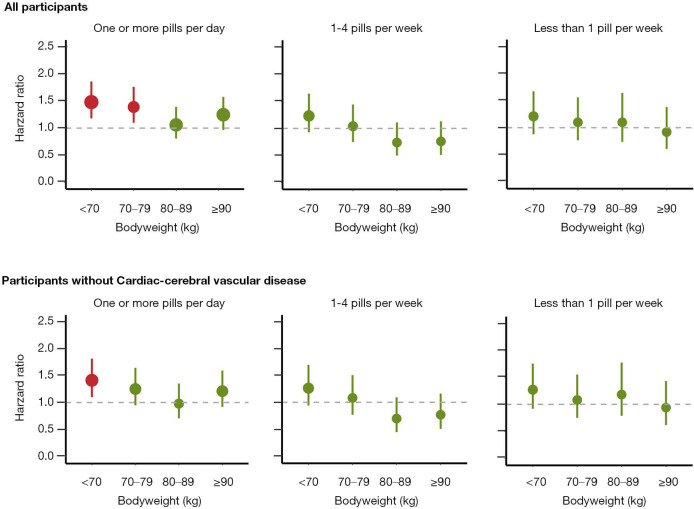
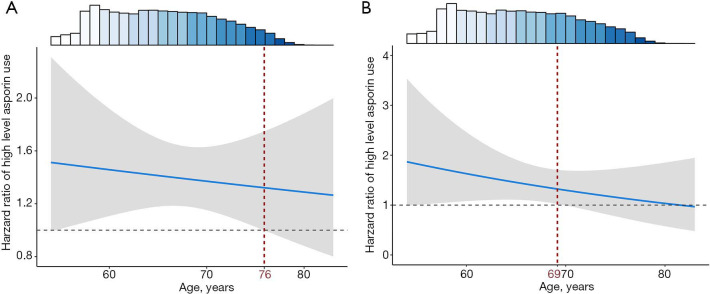
High-frequency aspirin use significantly increased risk of lung cancer by 28% compared to no use (HR =1.28; 95% CI, 1.14-1.45; P=3.37×10), especially for current smoker (HR =1.30; 95% CI, 1.07-1.57; P=6.82×10). However, the increased lung cancer risk due to high-frequency aspirin use significantly decreased with increasing bodyweight (HR =0.96; 95% CI, 0.94-0.99; P=1.26×10). Further, for participants with bodyweight <80 kg, high-frequency aspirin use showed an elevated risk at <76 years of age (HR =1.47; 95% CI, 1.25-1.73; P=3.81×10). Our study used propensity score under various confounding and stratification analyses by cardio-cerebrovascular status, which all presented similar evidences.
High-frequency aspirin use is associated with the increased risk of lung cancer. Current smoker or people with age <76 years and bodyweight <80 kg should be more cautious to high-frequency aspirin use for lung cancer chemoprevention. This study provides a new insight for lung cancer chemoprevention.
阿司匹林用于癌症化学预防作为一种一级预防策略存在争议。我们试图在前列腺、肺、结直肠和卵巢(PLCO)癌筛查试验中研究阿司匹林服用频率与肺癌风险之间的关联。
利用PLCO中101722名参与者的数据,我们使用Cox回归模型结合倾向得分来检测阿司匹林服用频率与肺癌风险之间的关联。
与不使用阿司匹林相比,高频使用阿司匹林显著增加了28%的肺癌风险(风险比[HR]=1.28;95%置信区间[CI],1.14 - 1.45;P = 3.37×10),尤其是对于当前吸烟者(HR = 1.30;95% CI,1.07 - 1.57;P = 6.82×10)。然而,由于高频使用阿司匹林导致的肺癌风险增加随着体重增加而显著降低(HR = 0.96;95% CI,0.94 - 0.99;P = 1.26×10)。此外,对于体重<80 kg的参与者,高频使用阿司匹林在年龄<76岁时显示出风险升高(HR = 1.47;95% CI,1.25 - 1.73;P = 3.81×10)。我们的研究在各种混杂因素下使用倾向得分,并按心脑血管状况进行分层分析,所有分析都呈现出类似的证据。
高频使用阿司匹林与肺癌风险增加相关。当前吸烟者或年龄<76岁且体重<80 kg的人在使用高频阿司匹林进行肺癌化学预防时应更加谨慎。本研究为肺癌化学预防提供了新的见解。