Department of Radiology, Seoul National University Bundang Hospital, Seongnam, Korea.
Seoul National University College of Medicine, Seoul, Korea.
Korean J Radiol. 2021 May;22(5):742-750. doi: 10.3348/kjr.2020.0723. Epub 2021 Jan 29.
To assess the safety and clinical efficacy of percutaneous transhepatic enteral stent placement for recurrent malignant obstruction in patients with surgically altered bowel anatomy.
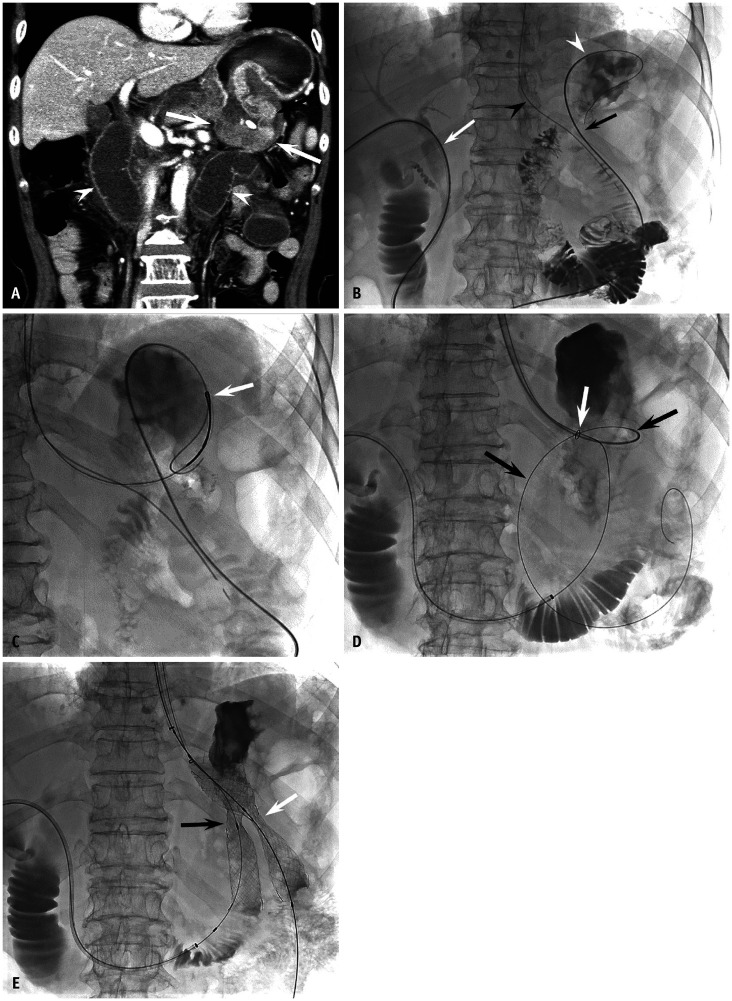
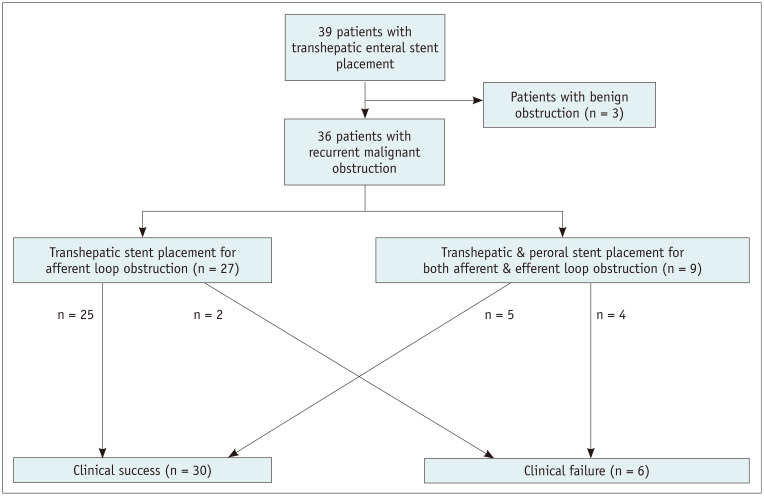
Between July 2009 and May 2019, 36 patients (27 men and 9 women; mean age, 62.7 ± 12.0 years) underwent percutaneous transhepatic stent placement for recurrent malignant bowel obstruction after surgery. In all patients, conventional endoscopic peroral stent placement failed due to altered bowel anatomy. The stent was placed with a transhepatic approach for an afferent loop obstruction (n = 27) with a combined transhepatic and peroral approach for simultaneous stent placement in afferent and efferent loop obstruction (n = 9). Technical and clinical success, complications, stent patency, and patient survival were retrospectively evaluated.
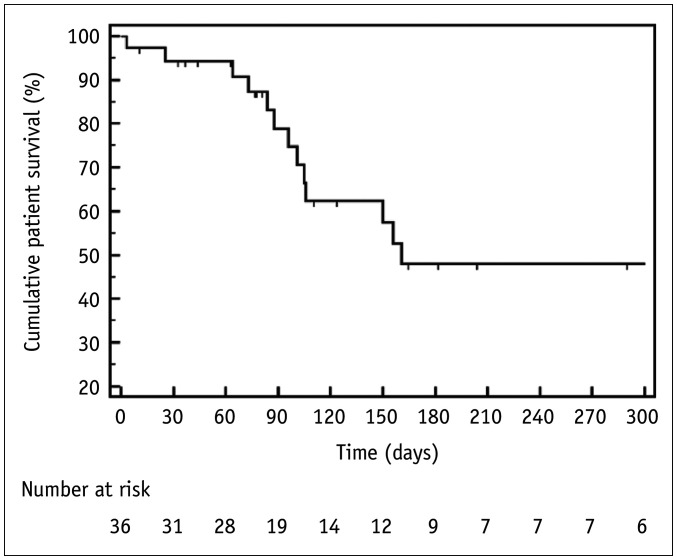
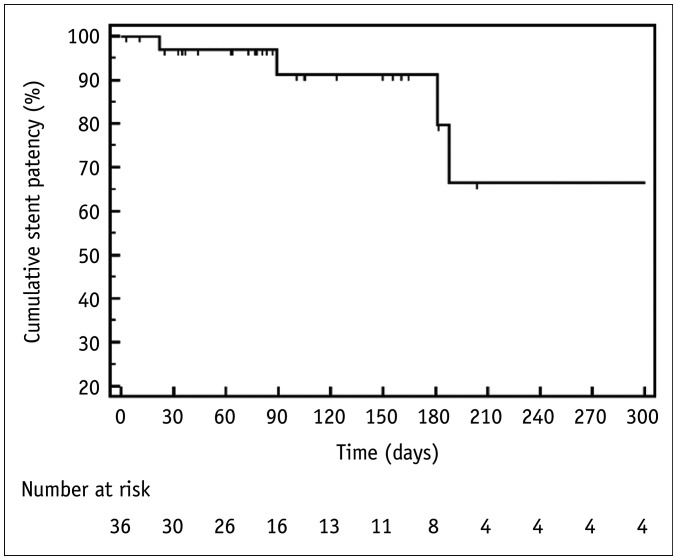
The stent placement was technically successful in all patients. Clinical success was achieved in 30 patients (83.3%). Three patients required re-intervention (balloon dilatation [n = 1] and additional stent placement [n = 2] for insufficient stent expansion). Major complications included transhepatic access-related perihepatic biloma (n = 2), hepatic artery bleeding (n = 2), bowel perforation (n = 1), and sepsis (n = 1). The 3- and 12-months stent patency and patient survival rates were 91.2%, 66.5% and 78.9%, 47.9%, respectively.
Percutaneous enteral stent placement using transhepatic access for recurrent malignant obstruction in patients with surgically altered bowel anatomy is safe and clinically efficacious. Transhepatic access is a good alternative route for afferent loop obstruction and can be combined with a peroral approach for simultaneous afferent and efferent loop obstruction.
评估经皮经肝肠内支架置入术治疗肠吻合术后改变解剖结构的复发性恶性肠梗阻的安全性和临床疗效。
2009 年 7 月至 2019 年 5 月,36 例(男 27 例,女 9 例;平均年龄 62.7±12.0 岁)因肠吻合术后复发性恶性肠梗阻而行经皮经肝肠内支架置入术。所有患者均因解剖结构改变而经内镜经口支架置入术失败。对于输入袢梗阻(n=27)采用经肝途径放置支架,对于同时存在输入袢和输出袢梗阻的患者(n=9)采用经肝和经口联合途径放置支架。回顾性评估技术和临床成功率、并发症、支架通畅性和患者生存率。
所有患者支架置入均获技术成功。30 例(83.3%)患者获得临床成功。3 例患者需要再次介入治疗(1 例因支架扩张不足行球囊扩张,2 例行额外支架置入)。主要并发症包括经肝入路相关肝周胆汁瘤(n=2)、肝动脉出血(n=2)、肠穿孔(n=1)和脓毒症(n=1)。3 个月和 12 个月的支架通畅率和患者生存率分别为 91.2%、66.5%和 78.9%、47.9%。
经皮经肝肠内支架置入术治疗肠吻合术后改变解剖结构的复发性恶性肠梗阻是安全且有效的。经肝入路是治疗输入袢梗阻的一种良好替代方法,也可与经口途径联合用于同时治疗输入袢和输出袢梗阻。