Department of Microbiology, University of Tennessee, Knoxville, TN, USA.
Department of Pathology, Microbiology and Immunology, Vanderbilt University, Nashville, TN, USA.
Metallomics. 2021 Jan 16;13(1). doi: 10.1093/mtomcs/mfaa002.
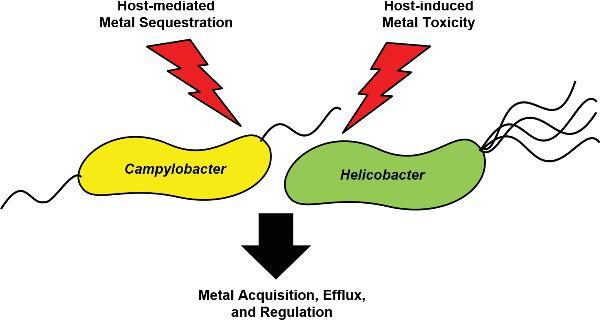
Epsilonproteobacteria are a diverse class of eubacteria within the Proteobacteria phylum that includes environmental sulfur-reducing bacteria and the human pathogens, Campylobacter jejuni and Helicobacter pylori. These pathogens infect and proliferate within the gastrointestinal tracts of multiple animal hosts, including humans, and cause a variety of disease outcomes. While infection of these hosts provides nutrients for the pathogenic Epsilonproteobacteria, many hosts have evolved a variety of strategies to either sequester metals from the invading pathogen or exploit the toxicity of metals and drive their accumulation as an antimicrobial strategy. As a result, C. jejuni and H. pylori have developed mechanisms to sense changes in metal availability and regulate their physiology in order to respond to either metal limitation or accumulation. In this review, we will discuss the challenges of metal availability at the host-pathogen interface during infection with C. jejuni and H. pylori and describe what is currently known about how these organisms alter their gene expression and/or deploy bacterial virulence factors in response to these environments.
变形菌门中的 ε 变形菌是一类多样化的真细菌,其中包括环境中脱硫细菌以及人类病原体空肠弯曲菌和幽门螺杆菌。这些病原体在包括人类在内的多种动物宿主的胃肠道中感染和增殖,并导致多种疾病结果。虽然这些宿主的感染为致病性 ε 变形菌提供了营养,但许多宿主已经进化出多种策略,要么将金属与入侵病原体隔离,要么利用金属的毒性并将其积累作为一种抗菌策略。因此,空肠弯曲菌和幽门螺杆菌已经发展出感知金属可用性变化的机制,并调节其生理机能,以应对金属限制或积累。在这篇综述中,我们将讨论感染空肠弯曲菌和幽门螺杆菌时宿主-病原体界面处金属可用性的挑战,并描述目前已知的这些生物体如何改变其基因表达和/或部署细菌毒力因子来应对这些环境。