Wu Wenjun, Wang Weige, Franzen Carrie A, Guo Hui, Lee Jimmy, Li Yan, Sukhanova Madina, Sheng Dong, Venkataraman Girish, Ming Mei, Lu Pin, Gao Anhui, Xia Chunmei, Li Jia, Zhang Liang Leo, Jiang Vivian Changying, Wang Michael L, Andrade Jorge, Zhou Xiaoyan, Wang Y Lynn
Blood Cell Development and Function Program, Fox Chase Cancer Center, Philadelphia, PA.
Department of Pathology, Fudan University Shanghai Cancer Center, Shanghai, China.
Blood Adv. 2021 Jan 12;5(1):185-197. doi: 10.1182/bloodadvances.2020001665.
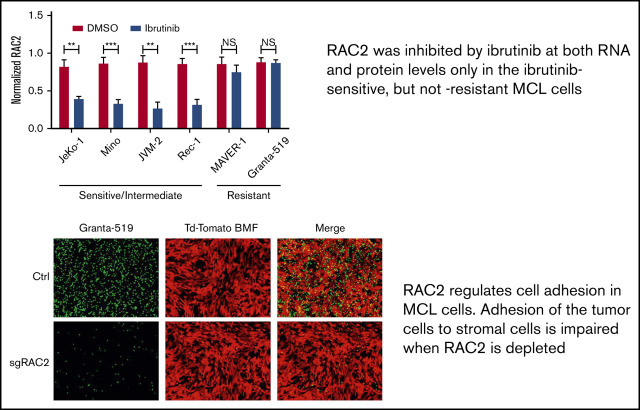
Inhibition of the B-cell receptor (BCR) signaling pathway is highly effective in B-cell neoplasia through Bruton tyrosine kinase inhibition by ibrutinib. Ibrutinib also disrupts cell adhesion between a tumor and its microenvironment. However, it is largely unknown how BCR signaling is linked to cell adhesion. We observed that intrinsic sensitivities of mantle cell lymphoma (MCL) cell lines to ibrutinib correlated well with their cell adhesion phenotype. RNA-sequencing revealed that BCR and cell adhesion signatures were simultaneously downregulated by ibrutinib in the ibrutinib-sensitive, but not ibrutinib-resistant, cells. Among the differentially expressed genes, RAC2, part of the BCR signature and a known regulator of cell adhesion, was downregulated at both the RNA and protein levels by ibrutinib only in sensitive cells. RAC2 physically associated with B-cell linker protein (BLNK), a BCR adaptor molecule, uniquely in sensitive cells. RAC2 reduction using RNA interference and CRISPR impaired cell adhesion, whereas RAC2 overexpression reversed ibrutinib-induced cell adhesion impairment. In a xenograft mouse model, mice treated with ibrutinib exhibited slower tumor growth, with reduced RAC2 expression in tissue. Finally, RAC2 was expressed in ∼65% of human primary MCL tumors, and RAC2 suppression by ibrutinib resulted in cell adhesion impairment. These findings, made with cell lines, a xenograft model, and human primary lymphoma tumors, uncover a novel link between BCR signaling and cell adhesion. This study highlights the importance of RAC2 and cell adhesion in MCL pathogenesis and drug development.
通过依鲁替尼抑制布鲁顿酪氨酸激酶,抑制B细胞受体(BCR)信号通路在B细胞肿瘤中具有高度有效性。依鲁替尼还会破坏肿瘤与其微环境之间的细胞黏附。然而,BCR信号如何与细胞黏附相联系在很大程度上尚不清楚。我们观察到套细胞淋巴瘤(MCL)细胞系对依鲁替尼的内在敏感性与其细胞黏附表型密切相关。RNA测序显示,在对依鲁替尼敏感而非耐药的细胞中,依鲁替尼可同时下调BCR和细胞黏附特征。在差异表达基因中,RAC2作为BCR特征的一部分以及已知的细胞黏附调节因子,仅在敏感细胞中,其RNA和蛋白质水平均被依鲁替尼下调。仅在敏感细胞中,RAC2与B细胞连接蛋白(BLNK,一种BCR衔接分子)发生物理相互作用。使用RNA干扰和CRISPR降低RAC2会损害细胞黏附,而RAC2过表达则可逆转依鲁替尼诱导的细胞黏附损害。在异种移植小鼠模型中,接受依鲁替尼治疗的小鼠肿瘤生长较慢,组织中RAC2表达降低。最后,RAC2在约65%的人类原发性MCL肿瘤中表达,依鲁替尼抑制RAC2会导致细胞黏附损害。这些在细胞系、异种移植模型和人类原发性淋巴瘤肿瘤中获得的发现,揭示了BCR信号与细胞黏附之间的新联系。本研究强调了RAC2和细胞黏附在MCL发病机制和药物开发中的重要性。