Kadri Sabah, Lee Jimmy, Fitzpatrick Carrie, Galanina Natalie, Sukhanova Madina, Venkataraman Girish, Sharma Shruti, Long Brad, Petras Kristin, Theissen Megan, Ming Mei, Kobzev Yuri, Kang Wenjun, Guo Ailin, Wang Weige, Niu Nifang, Weiner Howard, Thirman Michael, Stock Wendy, Smith Sonali M, Nabhan Chadi, Segal Jeremy P, Lu Pin, Wang Y Lynn
Department of Pathology.
Department of Medicine, and.
Blood Adv. 2017 May 2;1(12):715-727. doi: 10.1182/bloodadvances.2016003632. eCollection 2017 May 9.
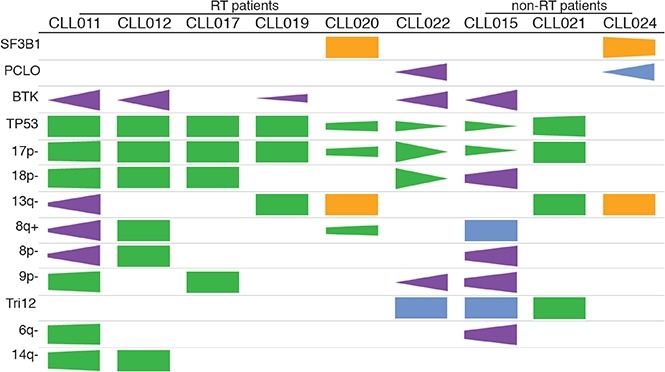
Ibrutinib has generated remarkable responses in patients with chronic lymphocytic leukemia (CLL), including those with an unfavorable cytogenetic profile. However, patients develop resistance, with poor outcomes and no established treatment options. Mutations in and have emerged as main mechanisms of drug resistance, but not all patients carry these mutations. Further understanding of mechanisms of resistance is urgently needed and will support rational development of new therapeutic strategies. To that end, we characterized the genomic profiles of serial samples from 9 patients with ibrutinib-relapsed disease, including 6 who had Richter transformation. Mutations, indels, copy-number aberrations, and loss of heterozygosity were assessed using next-generation sequencing and single-nucleotide polymorphism array. We found that 18p deletion (del(18p)), together with del(17p)/ mutations, was present in 5 of 9 patients before ibrutinib therapy. In addition to , we identified , a structurally novel mutation located in the SH2 domain of BTK. Minor clones with low allele frequencies were captured in addition to major clones. Although loss predisposes patients for relapse, clone size of loss may diminish during disease progression while mutant clone expands. In patients who had Richter transformation, we found that the transformed cells were clonal descendants of circulating leukemia cells but continued to undergo evolution and drifts. Surprisingly, transformed lymphoma cells in tissue may acquire a different mutation from that in the CLL leukemia cells. Collectively, these results provide insights into clonal evolution underlying ibrutinib relapse and prompt further investigation on genomic abnormalities that have clinical application potential.
依鲁替尼在慢性淋巴细胞白血病(CLL)患者中产生了显著疗效,包括那些细胞遗传学特征不佳的患者。然而,患者会产生耐药性,导致预后不良且尚无既定的治疗方案。BTK和TP53突变已成为耐药的主要机制,但并非所有患者都携带这些突变。迫切需要进一步了解耐药机制,这将有助于合理开发新的治疗策略。为此,我们对9例依鲁替尼复发疾病患者的系列样本进行了基因组分析,其中6例发生了Richter转化。使用二代测序和单核苷酸多态性阵列评估突变、插入缺失、拷贝数变异和杂合性缺失。我们发现,9例患者中有5例在接受依鲁替尼治疗前存在18p缺失(del(18p)),以及del(17p)/TP53突变。除了BTK,我们还鉴定出了一种位于BTK的SH2结构域的新型结构突变NT5C2。除了主要的BTK克隆外,还捕获到了低等位基因频率的次要克隆。虽然BTK缺失使患者易于复发,但在疾病进展过程中,BTK缺失的克隆大小可能会减小,而突变的NT5C2克隆会扩大。在发生Richter转化的患者中,我们发现转化细胞是循环白血病细胞的克隆后代,但仍在继续进化和漂移。令人惊讶的是,组织中的转化淋巴瘤细胞可能获得与CLL白血病细胞不同的NT5C2突变。总的来说,这些结果为依鲁替尼复发背后的克隆进化提供了见解,并促使对具有临床应用潜力的基因组异常进行进一步研究。