Baylor College of Medicine, Center for Cell Gene Therapy, Texas Children's Hospital, Houston Methodist Hospital, Houston, TX 77030, USA.
Baylor College of Medicine, Center for Cell Gene Therapy, Texas Children's Hospital, Houston Methodist Hospital, Houston, TX 77030, USA; Department of Pediatric Hematology and Oncology, University Children's Hospital Muenster, Muenster, Germany.
Mol Ther. 2021 May 5;29(5):1808-1820. doi: 10.1016/j.ymthe.2021.02.004. Epub 2021 Feb 9.
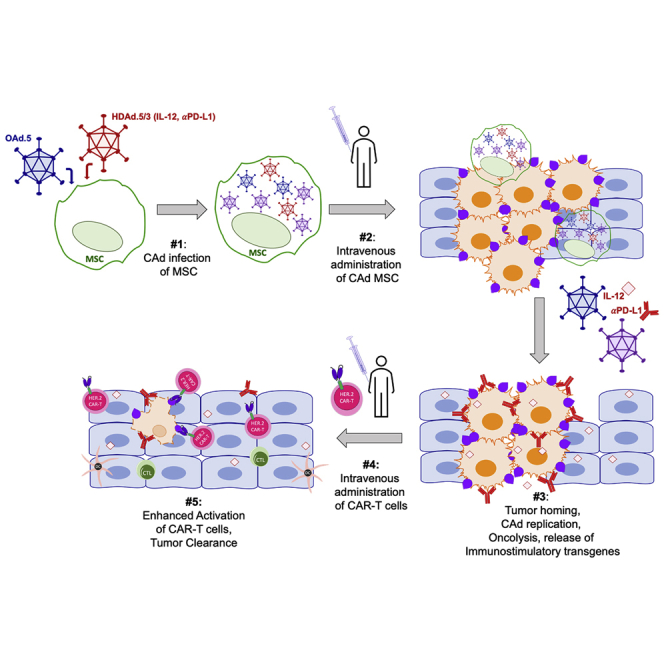
The immunosuppressive tumor microenvironment (TME) is a formidable barrier to the success of adoptive cell therapies for solid tumors. Oncolytic immunotherapy with engineered adenoviruses (OAd) may disrupt the TME by infecting tumor cells, as well as surrounding stroma, to improve the functionality of tumor-directed chimeric antigen receptor (CAR)-T cells, yet efficient delivery of OAds to solid tumors has been challenging. Here we describe how mesenchymal stromal cells (MSCs) can be used to systemically deliver a binary vector containing an OAd together with a helper-dependent Ad (HDAd; combinatorial Ad vector [CAd]) that expresses interleukin-12 (IL-12) and checkpoint PD-L1 (programmed death-ligand 1) blocker. CAd-infected MSCs deliver and produce functional virus to infect and lyse lung tumor cells while stimulating CAR-T cell anti-tumor activity by release of IL-12 and PD-L1 blocker. The combination of this approach with administration of HER.2-specific CAR-T cells eliminates 3D tumor spheroids in vitro and suppresses tumor growth in two orthotopic lung cancer models in vivo. Treatment with CAd MSCs increases the overall numbers of human T cells in vivo compared to CAR-T cell only treatment and enhances their polyfunctional cytokine secretion. These studies combine the predictable targeting of CAR-T cells with the advantages of cancer cell lysis and TME disruption by systemic MSC delivery of oncolytic virotherapy: incorporation of immunostimulation by cytokine and checkpoint inhibitor production through the HDAd further enhances anti-tumor activity.
免疫抑制性肿瘤微环境(TME)是过继性细胞疗法治疗实体瘤成功的一个巨大障碍。溶瘤免疫疗法联合工程化腺病毒(OAd)可以通过感染肿瘤细胞和周围基质来破坏 TME,从而改善肿瘤定向嵌合抗原受体(CAR)-T 细胞的功能,然而,有效的将 OAd 递送到实体瘤一直是一个挑战。在这里,我们描述了如何利用间充质基质细胞(MSCs)系统地递送电穿孔的包含有 OAd 和辅助依赖性腺病毒(HDAd;组合腺病毒载体[CAd]),其表达白细胞介素-12(IL-12)和检查点 PD-L1(程序性死亡配体 1)抑制剂。CAd 感染的 MSCs 传递并产生功能性病毒来感染和裂解肺肿瘤细胞,同时通过释放 IL-12 和 PD-L1 抑制剂刺激 CAR-T 细胞的抗肿瘤活性。这种方法与 HER.2 特异性 CAR-T 细胞联合应用可以消除体外 3D 肿瘤球体,并抑制体内两种原位肺癌模型中的肿瘤生长。与仅用 CAR-T 细胞治疗相比,CAd MSC 治疗增加了体内人 T 细胞的总数,并增强了它们的多功能细胞因子分泌。这些研究将 CAR-T 细胞的靶向性与 MSC 系统递送溶瘤病毒的肿瘤细胞裂解和 TME 破坏的优势相结合:通过 HDAd 产生细胞因子和检查点抑制剂的免疫刺激进一步增强了抗肿瘤活性。