Lux Cassia, Tilger Thomas, Geisler Ramsia, Soltwedel Olaf, von Klitzing Regine
Soft Matter at Interfaces, Department of Physics, Technical University of Darmstadt, Hochschulstraße 8, 64289 Darmstadt, Germany.
Polymers (Basel). 2021 Jan 29;13(3):435. doi: 10.3390/polym13030435.
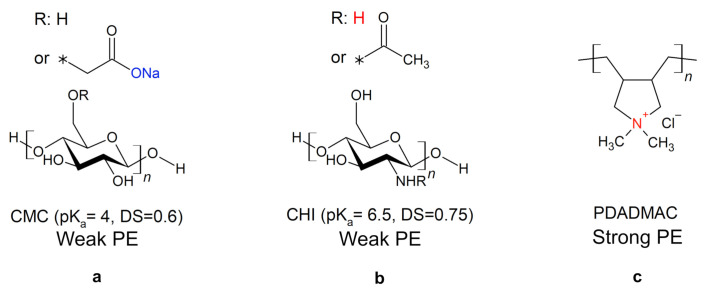
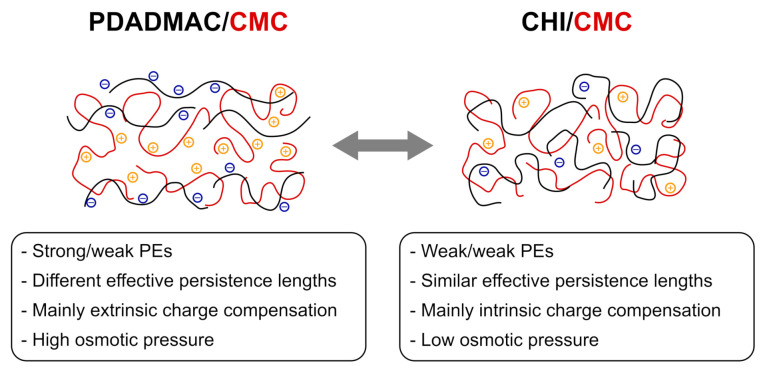
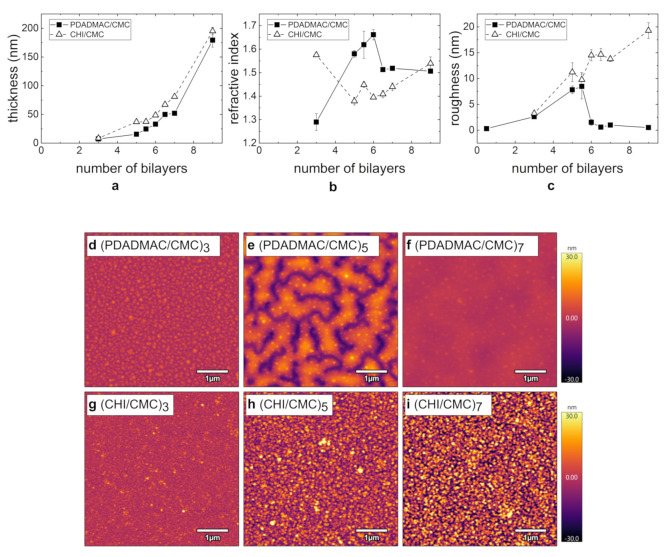
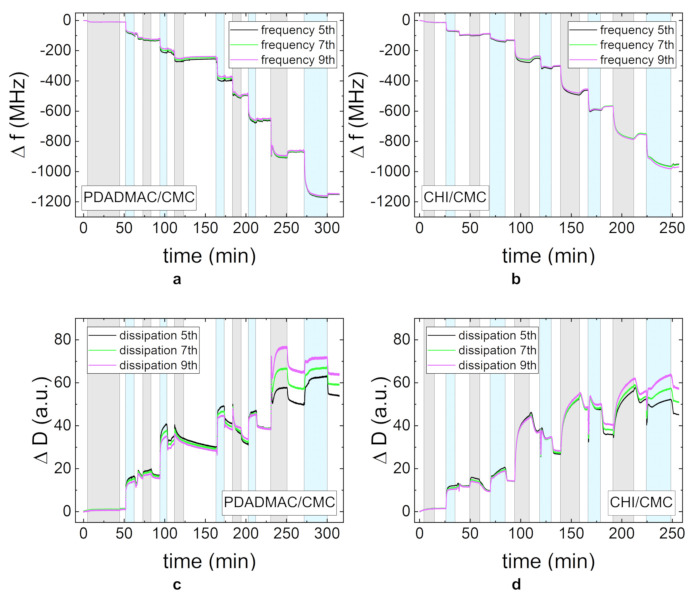
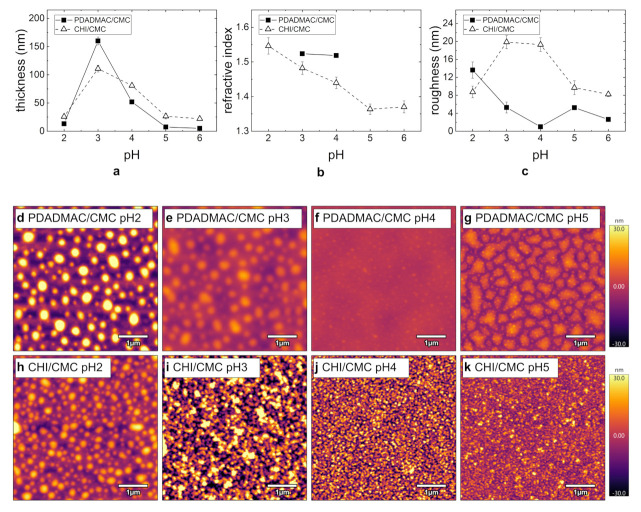
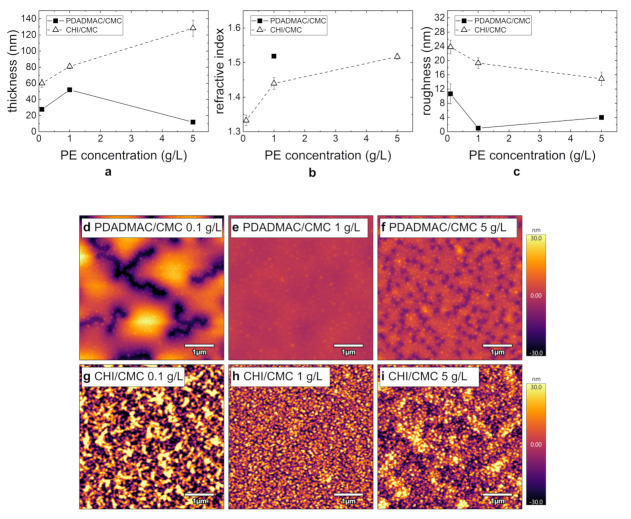
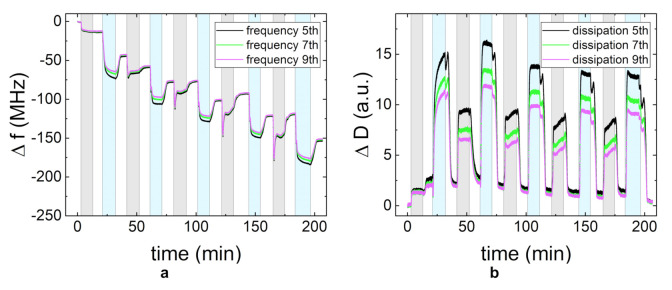
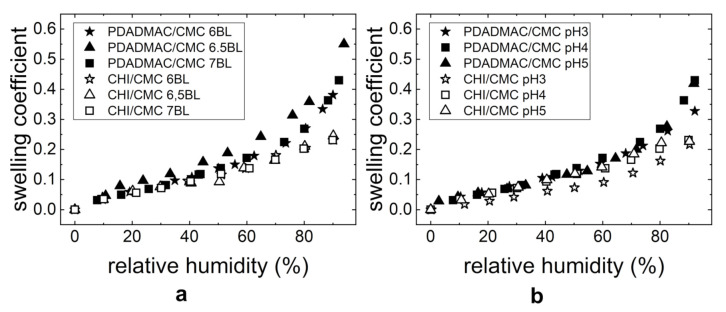
For tailored functionalization of cellulose based papers, the interaction between paper fibers and functional additives must be understood. Planar cellulose surfaces represent a suitable model system for studying the binding of additives. In this work, polyelectrolyte multilayers (PEMs) are prepared by alternating dip-coating of the negatively charged cellulose derivate carboxymethyl cellulose and a polycation, either polydiallyldimethylammonium chloride (PDADMAC) or chitosan (CHI). The parameters varied during PEM formation are the concentrations (0.1-5 g/L) and pH (pH = 2-6) of the dipping solutions. Both PEM systems grow exponentially, revealing a high mobility of the polyelectrolytes (PEs). The pH-tunable charge density leads to PEMs with different surface topographies. Quartz crystal microbalance experiments with dissipation monitoring (QCM-D) reveal the pronounced viscoelastic properties of the PEMs. Ellipsometry and atomic force microscopy (AFM) measurements show that the strong and highly charged polycation PDADMAC leads to the formation of smooth PEMs. The weak polycation CHI forms cellulose model surfaces with higher film thicknesses and a tunable roughness. Both PEM systems exhibit a high water uptake when exposed to a humid environment, with the PDADMAC/carboxymethyl cellulose (CMC) PEMs resulting in a water uptake up to 60% and CHI/CMC up to 20%. The resulting PEMs are water-stable, but water swellable model surfaces with a controllable roughness and topography.
为了实现纤维素基纸张的定制功能化,必须了解纸纤维与功能添加剂之间的相互作用。平面纤维素表面是研究添加剂结合的合适模型系统。在这项工作中,通过交替浸涂带负电荷的纤维素衍生物羧甲基纤维素和聚阳离子(聚二烯丙基二甲基氯化铵(PDADMAC)或壳聚糖(CHI))来制备聚电解质多层膜(PEMs)。在PEM形成过程中变化的参数是浸渍溶液的浓度(0.1 - 5 g/L)和pH值(pH = 2 - 6)。两种PEM系统均呈指数生长,表明聚电解质(PEs)具有高迁移率。pH可调的电荷密度导致具有不同表面形貌的PEMs。带有耗散监测的石英晶体微天平实验(QCM-D)揭示了PEMs显著的粘弹性。椭偏仪和原子力显微镜(AFM)测量表明,强电荷的聚阳离子PDADMAC导致形成光滑的PEMs。弱聚阳离子CHI形成具有更高膜厚度和可调粗糙度的纤维素模型表面。当暴露于潮湿环境时,两种PEM系统均表现出高吸水性,PDADMAC/羧甲基纤维素(CMC)PEMs的吸水量高达60%,CHI/CMC高达20%。所得的PEMs是水稳定但可水溶胀的模型表面,具有可控的粗糙度和形貌。