Cadel Lauren, Guilcher Sara J T, Kokorelias Kristina Marie, Sutherland Jason, Glasby Jon, Kiran Tara, Kuluski Kerry
Institute for Better Health, Trillium Health Partners, Mississauga, Ontario, Canada
Leslie Dan Faculty of Pharmacy, University of Toronto, Toronto, Ontario, Canada.
BMJ Open. 2021 Feb 11;11(2):e044291. doi: 10.1136/bmjopen-2020-044291.
The overarching objective of the scoping review was to examine peer reviewed and grey literature for best practices that have been developed, implemented and/or evaluated for delayed discharge involving a hospital setting. Two specific objectives were to review what the delayed discharge initiatives entailed and identify gaps in the literature in order to inform future work.
Scoping review.
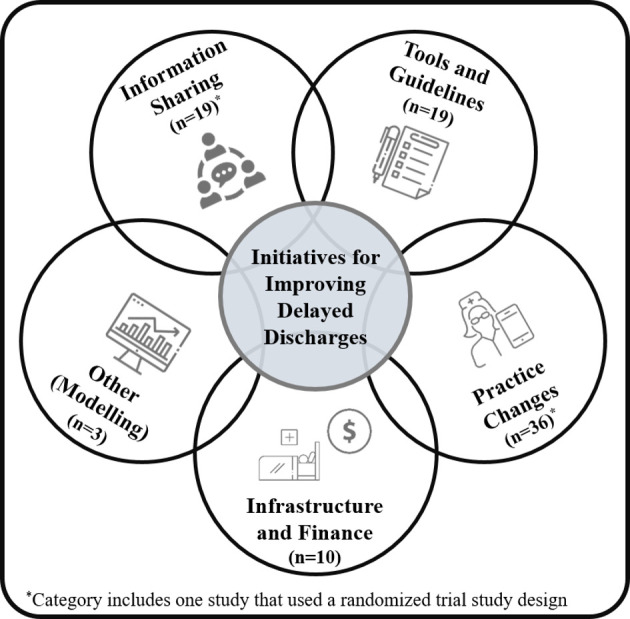
Electronic databases and websites of government and healthcare organisations were searched for eligible articles. Articles were required to include an initiative that focused on delayed discharge, involve a hospital setting and be published between 1 January 2004 and 16 August 2019. Data were extracted using Microsoft Excel. Following extraction, a policy framework by Doern and Phidd was adapted to organise the included initiatives into categories: (1) information sharing; (2) tools and guidelines; (3) practice changes; (4) infrastructure and finance and (5) other.
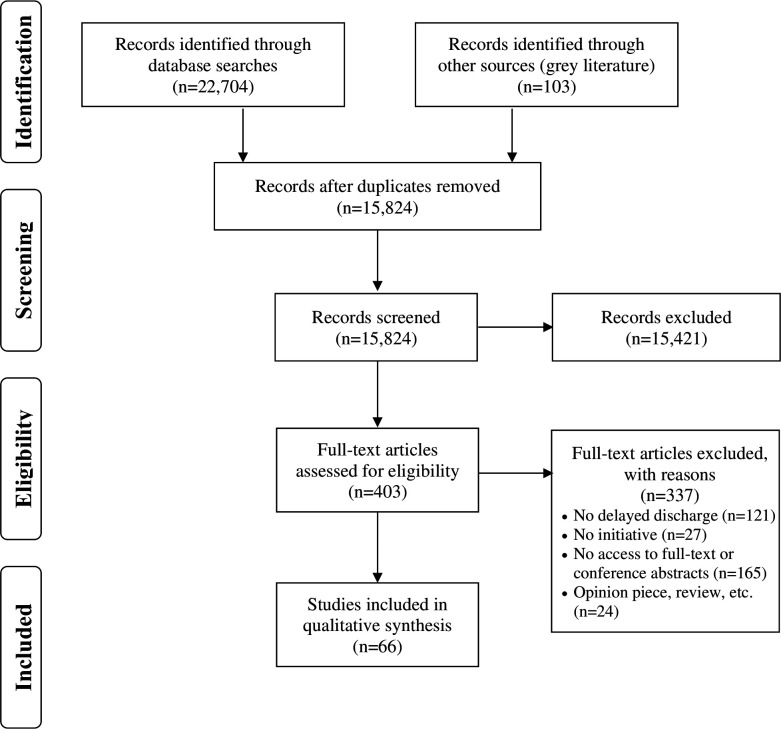
Sixty-six articles were included in this review. The majority of initiatives were categorised as practice change (n=36), followed by information sharing (n=19) and tools and guidelines (n=19). Numerous initiatives incorporated multiple categories. The majority of initiatives were implemented by multidisciplinary teams and resulted in improved outcomes such as reduced length of stay and discharge delays. However, the experiences of patients and families were rarely reported. Included initiatives also lacked important contextual information, which is essential for replicating best practices and scaling up.
This scoping review identified a number of initiatives that have been implemented to target delayed discharges. While the majority of initiatives resulted in positive outcomes, delayed discharges remain an international problem. There are significant gaps and limitations in evidence and thus, future work is warranted to develop solutions that have a sustainable impact.
本范围综述的总体目标是查阅同行评审文献和灰色文献,以寻找针对医院环境中延迟出院所制定、实施和/或评估的最佳实践。两个具体目标是回顾延迟出院举措的内容,并找出文献中的差距,以为未来工作提供参考。
范围综述。
在电子数据库以及政府和医疗保健组织的网站上搜索符合条件的文章。文章需包含一项专注于延迟出院的举措,涉及医院环境,并于2004年1月1日至2019年8月16日期间发表。使用Microsoft Excel提取数据。提取后,采用Doern和Phidd的政策框架将纳入的举措分为以下几类:(1)信息共享;(2)工具和指南;(3)实践变革;(4)基础设施和资金;(5)其他。
本综述纳入了66篇文章。大多数举措被归类为实践变革(n = 36),其次是信息共享(n = 19)和工具与指南(n = 19)。许多举措包含多个类别。大多数举措由多学科团队实施,并取得了改善的结果,如缩短住院时间和减少出院延迟。然而,患者及其家属的经历很少被报道。纳入的举措还缺乏重要的背景信息,而这对于复制最佳实践和扩大规模至关重要。
本范围综述确定了一些针对延迟出院实施的举措。虽然大多数举措取得了积极成果,但延迟出院仍然是一个国际性问题。证据存在重大差距和局限性,因此,有必要开展未来工作以制定具有可持续影响的解决方案。