Young Sean D, Zhang Qingpeng, Zhou Jiandong, Pacula Rosalie Liccardo
Department of Emergency Medicine, University of California, Irvine, CA, USA.
University of California Institute for Prediction Technology, Department of Informatics, University of California, Irvine, CA, USA.
NPJ Digit Med. 2021 Feb 11;4(1):21. doi: 10.1038/s41746-021-00392-w.
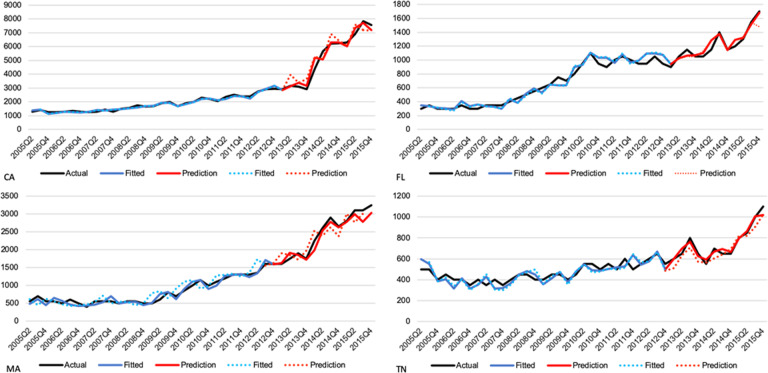
The primary contributors to the opioid crisis continue to rapidly evolve both geographically and temporally, hampering the ability to halt the growing epidemic. To address this issue, we evaluated whether integration of near real-time social/behavioral (i.e., Google Trends) and traditional health care (i.e., Medicaid prescription drug utilization) data might predict geographic and longitudinal trends in opioid-related Emergency Department (ED) visits. From January 2005 through December 2015, we collected quarterly State Drug Utilization Data; opioid-related internet search terms/phrases; and opioid-related ED visit data. Modeling was conducted using least absolute shrinkage and selection operator (LASSO) regression prediction. Models combining Google and Medicaid variables were a better fit and more accurate (R values from 0.913 to 0.960, across states) than models using either data source alone. The combined model predicted sharp and state-specific changes in ED visits during the post 2013 transition from heroin to fentanyl. Models integrating internet search and drug utilization data might inform policy efforts about regional medical treatment preferences and needs.
阿片类药物危机的主要促成因素在地理和时间上持续迅速演变,这阻碍了阻止这一日益严重的流行病的能力。为解决这一问题,我们评估了整合近实时社会/行为数据(即谷歌趋势)和传统医疗保健数据(即医疗补助处方药使用情况)是否可以预测与阿片类药物相关的急诊科就诊的地理和纵向趋势。从2005年1月到2015年12月,我们收集了季度州药物使用数据、与阿片类药物相关的互联网搜索词/短语以及与阿片类药物相关的急诊科就诊数据。使用最小绝对收缩和选择算子(LASSO)回归预测进行建模。与单独使用任一数据源的模型相比,结合谷歌和医疗补助变量的模型拟合度更好且更准确(各州的R值从0.913到0.960)。该组合模型预测了2013年后从海洛因转向芬太尼期间急诊科就诊的急剧且因州而异的变化。整合互联网搜索和药物使用数据的模型可能会为有关地区医疗治疗偏好和需求的政策努力提供信息。