Gu Yue-Yu, Lu Fu-Hua, Huang Xiao-Ru, Zhang Lei, Mao Wei, Yu Xue-Qing, Liu Xu-Sheng, Lan Hui-Yao
Department of Nephrology and State Key Laboratory of Dampness Syndrome of Chinese Medicine, Guangdong Provincial Hospital of Chinese Medicine, The Second Affiliated Hospital, Guangzhou University of Chinese Medicine, Guangzhou, China.
Department of Medicine and Therapeutics, Li Ka Shing Institute of Health Sciences, The Chinese University of Hong Kong, Hong Kong, China.
Front Pharmacol. 2021 Jan 26;11:583528. doi: 10.3389/fphar.2020.583528. eCollection 2020.
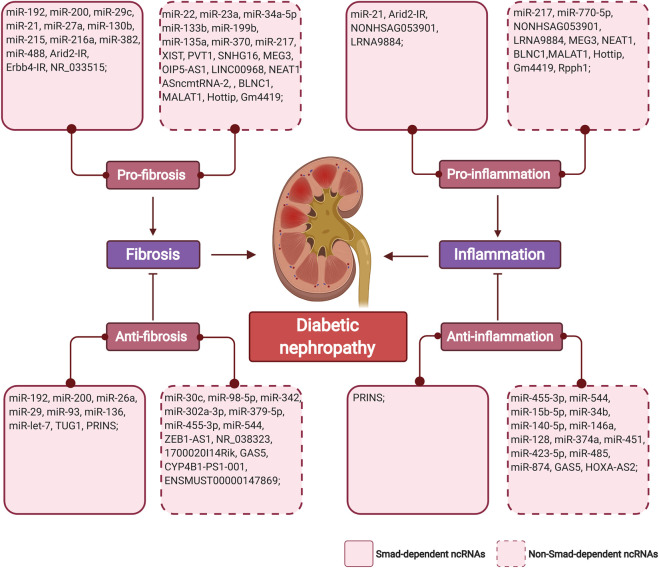
Diabetic kidney disease (DKD) is the most common diabetic complication and is a leading cause of end-stage kidney disease. Increasing evidence shows that DKD is regulated not only by many classical signaling pathways but also by epigenetic mechanisms involving chromatin histone modifications, DNA methylation, and non-coding RNA (ncRNAs). In this review, we focus on our current understanding of the role and mechanisms of ncRNAs, including microRNAs (miRNAs) and long non-coding RNAs (lncRNAs) in the pathogenesis of DKD. Of them, the regulatory role of TGF-β/Smad3-dependent miRNAs and lncRNAs in DKD is highlighted. Importantly, miRNAs and lncRNAs as biomarkers and therapeutic targets for DKD are also described, and the perspective of ncRNAs as a novel therapeutic approach for combating diabetic nephropathy is also discussed.
糖尿病肾病(DKD)是最常见的糖尿病并发症,也是终末期肾病的主要原因。越来越多的证据表明,DKD不仅受许多经典信号通路的调节,还受涉及染色质组蛋白修饰、DNA甲基化和非编码RNA(ncRNAs)的表观遗传机制的调节。在本综述中,我们重点关注目前对ncRNAs(包括微小RNA(miRNAs)和长链非编码RNA(lncRNAs))在DKD发病机制中的作用和机制的理解。其中,着重强调了TGF-β/Smad3依赖性miRNAs和lncRNAs在DKD中的调节作用。重要的是,还描述了miRNAs和lncRNAs作为DKD的生物标志物和治疗靶点,并讨论了ncRNAs作为对抗糖尿病肾病的新型治疗方法的前景。