Min Jin-Young, Choi Yeon-Soo, Lee Hyeong-Seong, Lee Sohyae, Min Kyoung-Bok
Veterans Medical Research Institute, Veterans Health Service Medical Center, Seoul, Republic of Korea.
Department of Statistics and Data Science, College of Commerce and Economics, Yonsei University, Seoul, Republic of Korea.
BMC Public Health. 2021 Feb 5;21(1):294. doi: 10.1186/s12889-020-09789-w.
Exposure to extremely or moderate low temperatures is associated with increased morbidity and mortality risk. Peripheral vascular disease (PVD) is a slow and progressive circulation disorder. Given that cold temperature causes constriction of the small arteries and veins in the skin, patients who suffer from peripheral circulation problems, like PVD, may be vulnerable to cold injuries. This study aimed to investigate the association between PVD and cold-induced injuries in the winter among Korean adults. We further analyzed the association stratified by body mass index (BMI) classification.
We used the 2002-2015 National Health Insurance Service-National Sample Cohort data and included a total of 535,186 adults as the study population. Patients with underlying PVD were identified by ICD-10 code I73. Cold-related illnesses were defined by ICD-10 codes (T690, T691, T698, T699, T330 ~ T339, T340 ~ T349, and T350 ~ T357). Body mass index (BMI) was categorized into underweight, normal weight, overweight, and obese.
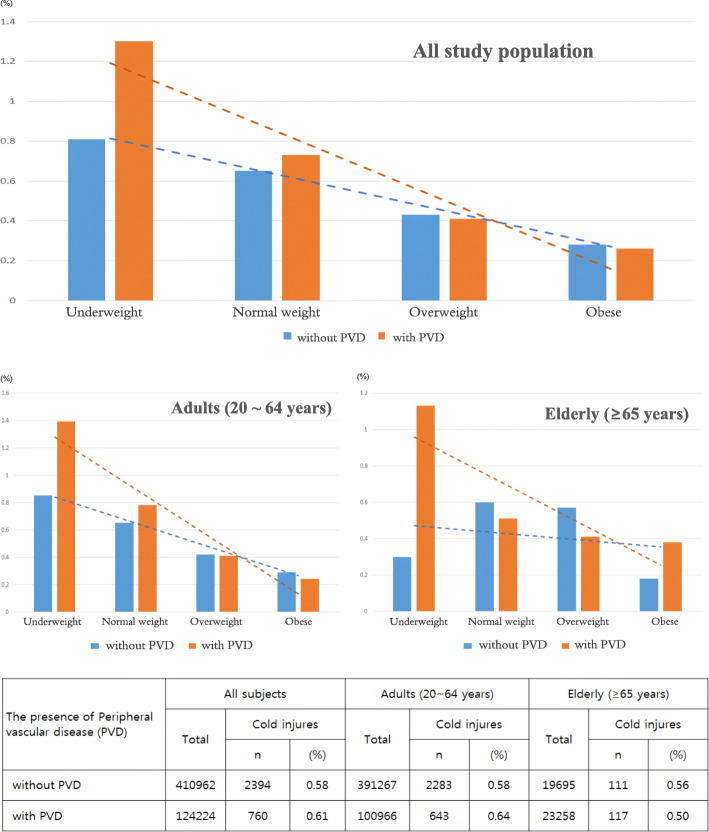
A total of 23.21% (n = 124,224) were PVD patients, and 0.59% (n = 3154) had cold-induced injuries. PVD patients were more likely to be diagnosed with cold injuries, but it was valid only in the underweight or normal weight groups. After adjusting for age, sex, income, cigarette smoking, alcohol consumption, regular exercise, high blood pressure, and hyperglycemia, PVD patients had a significantly increased odds ratio (OR) for cold injuries [adjusted OR = 1.11; 95% confidence intervals (95% CI): 1.01-1.21]. Increased OR for cold injuries in PVD patients was also observed in adults (adjusted OR = 1.14; 95% CI: 1.03-1.25 in Model 2), but not in the elderly. When we classified study subjects into the four BMI groups, the adjusted OR of cold injuries in PVD patients was significant in the underweight group (OR = 1.83; 95% CI, 1.26-2.66) and normal weight group (OR = 1.15; 95% CI, 1.03-1.27), not in those with overweight and obese. In adults, a consistent result was found in adults in the underweight group (OR = 1.63; 95% CI, 1.08-2.47 in Model 2) and normal weight group (OR = 1.19; 95% CI, 1.07-1.33 in Model 2). In the elderly, the adjusted OR for cold injuries was only significant in the underweight group (OR = 3.37; 95% CI, 1.08-10.53 in Model 2).
We found a significant association between PVD and cold-induced injuries in the general population. BMI modified the association. Thus, the association observed appears to be clinically applicable to PVD patients being low to normal BMI.
暴露于极低或中度低温环境与发病和死亡风险增加有关。外周血管疾病(PVD)是一种缓慢进展的循环系统疾病。鉴于寒冷会导致皮肤中小动脉和静脉收缩,患有外周循环问题(如PVD)的患者可能易受冷损伤。本研究旨在调查韩国成年人冬季外周血管疾病与冷诱导损伤之间的关联。我们还按体重指数(BMI)分类进一步分析了这种关联。
我们使用了2002 - 2015年国家健康保险服务 - 全国样本队列数据,共纳入535,186名成年人作为研究人群。通过ICD - 10编码I73识别潜在的外周血管疾病患者。冷相关疾病由ICD - 10编码定义(T690、T691、T698、T699、T330~T339、T340~T349和T350~T357)。体重指数(BMI)分为体重过轻、正常体重、超重和肥胖。
共有23.21%(n = 124,224)为外周血管疾病患者,0.59%(n = 3154)有冷诱导损伤。外周血管疾病患者更易被诊断为冷损伤,但仅在体重过轻或正常体重组中有效。在调整年龄、性别、收入、吸烟、饮酒、规律运动、高血压和高血糖后,外周血管疾病患者冷损伤的比值比(OR)显著增加[调整后的OR = 1.11;95%置信区间(95%CI):1.01 - 1.21]。在成年人中也观察到外周血管疾病患者冷损伤的OR增加(模型2中调整后的OR = 1.14;95%CI:1.03 - 1.25),但在老年人中未观察到。当我们将研究对象分为四个BMI组时,外周血管疾病患者冷损伤的调整后OR在体重过轻组(OR = 1.83;95%CI,1.26 - 2.66)和正常体重组(OR = 1.15;95%CI,1.03 - 1.27)中显著,在超重和肥胖组中不显著。在成年人中,体重过轻组(模型2中OR = 1.63;95%CI,1.08 - 2.47)和正常体重组(模型2中OR = 1.19;95%CI,1.07 - 1.33)得到了一致的结果。在老年人中,冷损伤的调整后OR仅在体重过轻组中显著(模型2中OR = 3.37;95%CI,1.08 - 10.53)。
我们发现普通人群中外周血管疾病与冷诱导损伤之间存在显著关联。BMI改变了这种关联。因此,观察到的这种关联似乎在临床上适用于BMI较低至正常的外周血管疾病患者。