Tollemache Nicholas, Shrewsbury Duncan, Llewellyn Carrie
Department of Primary Care and Public Health, Brighton and Sussex Medical School, Falmer, Sussex, Brighton, BN19PU, UK.
BMC Med Educ. 2021 Feb 12;21(1):100. doi: 10.1186/s12909-021-02532-y.
Lesbian, Gay, Bisexual, and Transgender (LGBT) individuals are more likely to have negative healthcare experiences and worse health outcomes when compared with their heterosexual and cisgender counterparts. A key recommendation of the 2018 Stonewall-commissioned "LGBT in Britain" report was that the curricula, standards, and training provided by medical schools should be reviewed in order to encompass mandatory teaching about LGBT health inequalities and discrimination, LGBT-inclusive care and the use of appropriate language. The aim of our study was to conduct an in-depth national review of the content of LGBT teaching within the curricula of UK Medical Schools.
Course leads at all 37 UK Medical Schools with students currently enrolled in a primary undergraduate medical training course were asked between December 2019-March 2020 to complete a cross-sectional online survey comprised of 30 questions; divided into three sections relating to the current LGBT teaching (Part 1), any planned or future LGBT teaching (Part 2), and the opinions of the survey respondent about the coverage of LGBT topics (Part 3) at their institution. Responses were analysed using descriptive statistics.
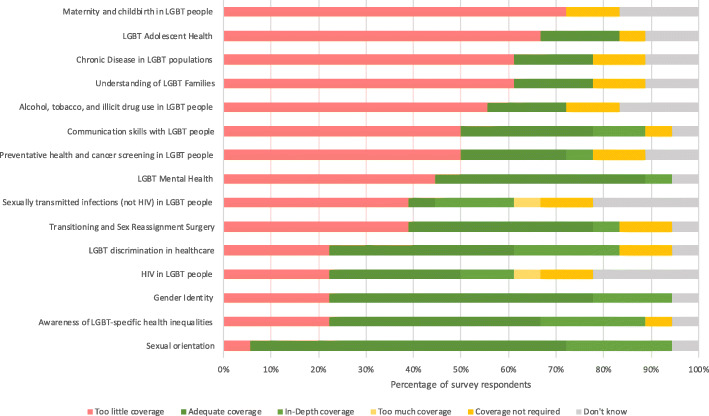
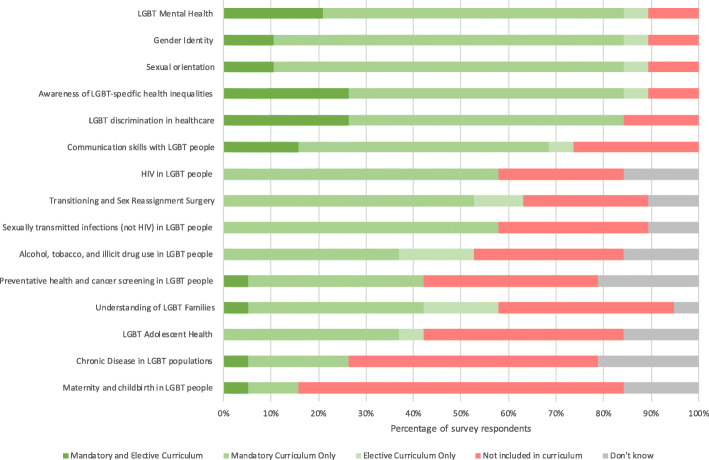
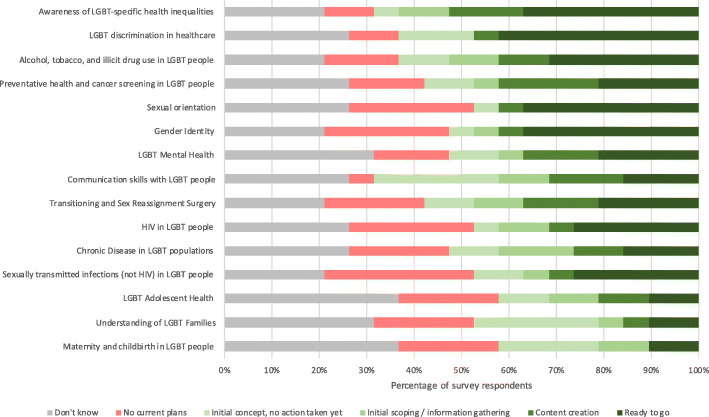
Questionnaires were received from 19/37 institutions (response rate: 51%). The median estimated number of hours of LGBT-teaching across the entire undergraduate course was 11.0 (IQR: 12.25). Teaching on LGBT mental health, gender identity, sexual orientation, awareness of LGBT-health inequalities, and LGBT discrimination in healthcare were reported by almost all respondents, whilst maternity and childbirth, chronic disease and LGBT adolescent health were least represented within the curriculum. Almost all (18 medical schools; 95%) responding institutions were considering implementing new LGBT teaching within the next three academic years. A lack of space within the curriculum is a universally reported barrier to the implementation of LGBT teaching. Only 5 (26%) survey respondents consider their institution's current coverage of LGBT topics to be "Good" or "Very good".
Our study demonstrates a significant variation in the amount and breadth of content within the undergraduate curricula of UK medical schools. Recommendations for increasing the quantity and quality of LGBT content are provided, based upon areas of good practice.
与异性恋和顺性别者相比,女同性恋、男同性恋、双性恋和跨性别者(LGBT)更有可能有负面的医疗体验和更差的健康结果。2018年石墙委托发布的《英国的LGBT》报告的一项关键建议是,医学院校提供的课程、标准和培训应进行审查,以便纳入关于LGBT健康不平等和歧视、LGBT包容性护理以及使用恰当语言的强制性教学内容。我们研究的目的是对英国医学院校课程中LGBT教学内容进行深入的全国性审查。
在2019年12月至2020年3月期间,向所有37所英国医学院校中目前有学生参加本科医学基础培训课程的课程负责人发送了一份包含30个问题的横断面在线调查问卷;问卷分为三个部分,分别涉及当前的LGBT教学(第1部分)、任何计划中的或未来的LGBT教学(第2部分)以及调查对象对其所在院校LGBT主题覆盖情况的看法(第3部分)。使用描述性统计方法对回复进行分析。
收到了19所院校(共37所)的问卷(回复率:51%)。整个本科课程中LGBT教学的估计中位数时长为11.0小时(四分位间距:12.25)。几乎所有受访者都报告了关于LGBT心理健康、性别认同、性取向、LGBT健康不平等意识以及医疗保健中的LGBT歧视的教学内容,而妇产科、慢性病和LGBT青少年健康在课程中提及最少。几乎所有(18所医学院校;95%)回复的院校都在考虑在未来三个学年内实施新的LGBT教学。课程中缺乏空间是普遍提到的LGBT教学实施障碍。只有5名(26%)调查对象认为其所在院校目前对LGBT主题的覆盖情况为“良好”或“非常好”。
我们的研究表明,英国医学院校本科课程内容的数量和广度存在显著差异。基于良好实践领域,提出了增加LGBT内容数量和质量的建议。