Pediatric Neurology Unit, Fondazione Policlinico A Gemelli -IRCCS, Università Cattolica del Sacro Cuore, Largo Gemelli 8, 00168, Rome, Italy.
Centro Clinico Nemo, Fondazione Policlinico Universitario Agostino Gemelli -IRCCS, Rome, Italy.
Ital J Pediatr. 2021 Feb 12;47(1):29. doi: 10.1186/s13052-021-00975-z.
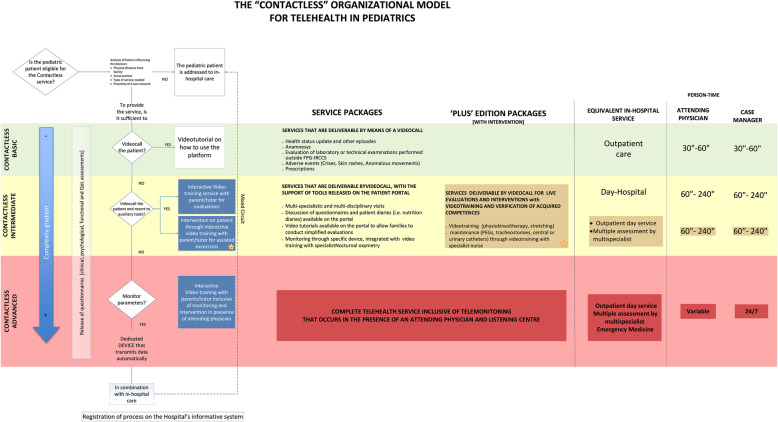
Suspending ordinary care activities during the COVID-19 pandemic made it necessary to find alternative routes to comply with care recommendations not only for acute health needs but also for patients requiring follow-up and multidisciplinary visits. We present the 'Contactless' model, a comprehensive operational tool including a plurality of services delivered remotely, structured according to a complexity gradient, aimed to cover diagnostic procedures and monitor disease progression in chronic pediatric patients.
A multidisciplinary and multiprofessional project team was recruited, in collaboration with patients' associations, to map a panel of available Evidence-Based solutions and address individual needs in full respect of the concept of personalized medicine. The solutions include a number of services from videoconsultations to more structure videotraining sessions.
A modular framework made up of four three Macro-levels of complexity - Contactless Basic, Intermediate and Advanced - was displayed as an incremental set of services and operational planning establishing each phase, from factors influencing eligibility to the delivery of the most accurate and complex levels of care.
The multimodal, multidisciplinary 'Contactless' model allowed the inclusion of all Units of our Pediatric Department and families with children with disability or complex chronic conditions. The strengths of this project rely on its replicability outside of pediatrics and in the limited resources needed to practically impact patients, caregivers and professionals involved in the process of care. Its implementation in the future may contribute to reduce the duration of hospital admissions, money and parental absence from work.
在 COVID-19 大流行期间暂停常规护理活动,使得人们有必要寻找替代途径,不仅要满足急性健康需求,还要满足需要后续和多学科就诊的患者的护理建议。我们提出了“非接触式”模式,这是一个综合的运营工具,包括远程提供的多项服务,根据复杂程度梯度进行结构化,旨在覆盖慢性儿科患者的诊断程序并监测疾病进展。
我们招募了一个多学科和多专业的项目团队,并与患者协会合作,对现有循证解决方案进行了梳理,并充分考虑个性化医疗理念,满足了个人需求。这些解决方案包括从视频咨询到更结构化的视频培训课程在内的多项服务。
一个由四个三级别的复杂程度组成的模块化框架——“非接触式”基本、中级和高级——被展示为一组递增的服务和运营计划,从影响资格的因素到提供最准确和复杂的护理水平。
多模式、多学科的“非接触式”模式使我们的儿科部门的所有科室和有残疾或复杂慢性疾病儿童的家庭都能够参与进来。该项目的优势在于其在儿科以外的可复制性,以及对患者、护理人员和参与护理过程的专业人员的实际影响所需的有限资源。未来的实施可能有助于缩短住院时间、减少金钱和父母的工作缺勤。