Department of Pediatrics, University of Pittsburgh School of Medicine, UPMC Children's Hospital of Pittsburgh, Pittsburgh, PA, United States.
UPMC Children's Community Pediatrics, Pittsburgh, PA, United States.
J Med Internet Res. 2020 Dec 18;22(12):e24345. doi: 10.2196/24345.
Telehealth, the delivery of health care through telecommunication technology, has potential to address multiple health system concerns. Despite this potential, only 15% of pediatric primary care clinicians reported using telemedicine as of 2016, with the majority identifying inadequate payment for these services as the largest barrier to their adoption. The COVID-19 pandemic led to rapid changes in payment and regulations surrounding telehealth, enabling its integration into primary care pediatrics.
Due to limited use of telemedicine in primary care pediatrics prior to the COVID-19 pandemic, much is unknown about the role of telemedicine in pediatric primary care. To address this gap in knowledge, we examined the association between practice-level telemedicine use within a large pediatric primary care network and practice characteristics, telemedicine visit diagnoses, in-person visit volumes, child-level variations in telemedicine use, and clinician attitudes toward telemedicine.
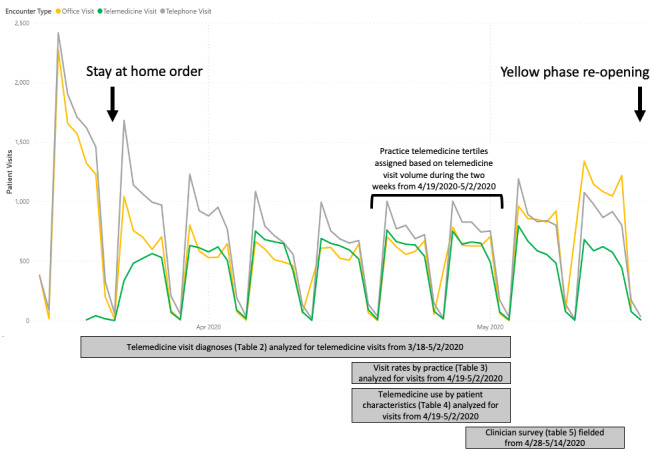
We analyzed electronic health record data from 45 primary care practices and administered a clinician survey to practice clinicians. Practices were stratified into tertiles based on rates of telemedicine use (low, intermediate, high) per 1000 patients per week during a two-week period (April 19 to May 2, 2020). By practice tertile, we compared (1) practice characteristics, (2) telemedicine visit diagnoses, (3) rates of in-person visits to the office, urgent care, and the emergency department, (4) child-level variation in telemedicine use, and (5) clinician attitudes toward telemedicine across these practices.
Across pediatric primary care practices, telemedicine visit rates ranged from 5 to 23 telemedicine visits per 1000 patients per week. Across all tertiles, the most frequent telemedicine visit diagnoses were mental health (28%-36% of visits) and dermatologic (15%-28%). Compared to low telemedicine use practices, high telemedicine use practices had fewer in-person office visits (10 vs 16 visits per 1000 patients per week, P=.005) but more total encounters overall (in-office and telemedicine: 28 vs 22 visits per 1000 patients per week, P=.006). Telemedicine use varied with child age, race and ethnicity, and recent preventive care; however, no significant interactions existed between these characteristics and practice-level telemedicine use. Finally, clinician attitudes regarding the usability and impact of telemedicine did not vary significantly across tertiles.
Across a network of pediatric practices, we identified significant practice-level variation in telemedicine use, with increased use associated with more varied telemedicine diagnoses, fewer in-person office visits, and increased overall primary care encounter volume. Thus, in the context of the pandemic, when underutilization of primary care was prevalent, higher practice-level telemedicine use supported pediatric primary care encounter volume closer to usual rates. Child-level telemedicine use differed by child age, race and ethnicity, and recent preventive care, building upon prior concerns about differences in access to telemedicine. However, increased practice-level use of telemedicine services was not associated with reduced or increased differences in use, suggesting that further work is needed to promote equitable access to primary care telemedicine.
远程医疗通过电信技术提供医疗保健,具有解决多个医疗系统问题的潜力。尽管有这种潜力,但截至 2016 年,只有 15%的儿科初级保健临床医生报告使用远程医疗,其中大多数人认为这些服务的报酬不足是其采用的最大障碍。COVID-19 大流行导致远程医疗的支付和法规迅速变化,使其能够融入儿科初级保健。
由于在 COVID-19 大流行之前在儿科初级保健中远程医疗的使用有限,因此对于远程医疗在儿科初级保健中的作用知之甚少。为了填补这一知识空白,我们研究了在大型儿科初级保健网络中,按实践水平使用远程医疗与实践特征、远程医疗就诊诊断、门诊就诊量、儿童远程医疗使用的个体差异以及临床医生对远程医疗的态度之间的关联。
我们分析了来自 45 个初级保健实践的电子健康记录数据,并对实践临床医生进行了临床医生调查。在两周期间(2020 年 4 月 19 日至 5 月 2 日),根据每周每千名患者 1000 名患者中远程医疗使用的比率(低、中、高),将实践分层为三个三分位数。按实践三分位数,我们比较了(1)实践特征,(2)远程医疗就诊诊断,(3)门诊就诊率,到办公室就诊、紧急护理和急诊,(4)儿童远程医疗使用的个体差异,以及(5)这些实践中的临床医生对远程医疗的态度。
在儿科初级保健实践中,远程医疗就诊率从每周每千名患者 5 到 23 次不等。在所有三分位数中,最常见的远程医疗就诊诊断是心理健康(28%-36%的就诊)和皮肤病学(15%-28%)。与低远程医疗使用实践相比,高远程医疗使用实践的门诊就诊次数较少(每周每千名患者 10 次与 16 次就诊,P=0.005),但总就诊次数更多(门诊和远程医疗:每周每千名患者 28 次与 22 次就诊,P=0.006)。远程医疗的使用因儿童年龄、种族和民族以及最近的预防保健而有所不同;然而,这些特征与实践水平的远程医疗使用之间没有显著的相互作用。最后,临床医生对远程医疗可用性和影响的态度在三分位数之间没有显著差异。
在一个儿科实践网络中,我们发现远程医疗的使用存在显著的实践水平差异,随着使用的增加,远程医疗诊断更加多样化,门诊就诊次数减少,整体初级保健就诊量增加。因此,在大流行期间,当初级保健服务利用不足普遍存在时,更高的实践水平的远程医疗使用支持了更接近正常水平的儿科初级保健就诊量。儿童的远程医疗使用因儿童年龄、种族和民族以及最近的预防保健而异,这增加了对远程医疗获取方面差异的关注。然而,远程医疗服务实践水平使用的增加与使用的减少或增加没有关联,这表明需要进一步努力促进公平获得初级保健远程医疗。