
DNA 错配修复及其在亨廷顿病中的作用。
DNA Mismatch Repair and its Role in Huntington's Disease.
机构信息
CHDI Management/CHDI Foundation, Princeton, NJ, USA.
Department of Biochemistry and Molecular Biology, Thomas Jefferson University, Philadelphia, PA, USA.
出版信息
J Huntingtons Dis. 2021;10(1):75-94. doi: 10.3233/JHD-200438.
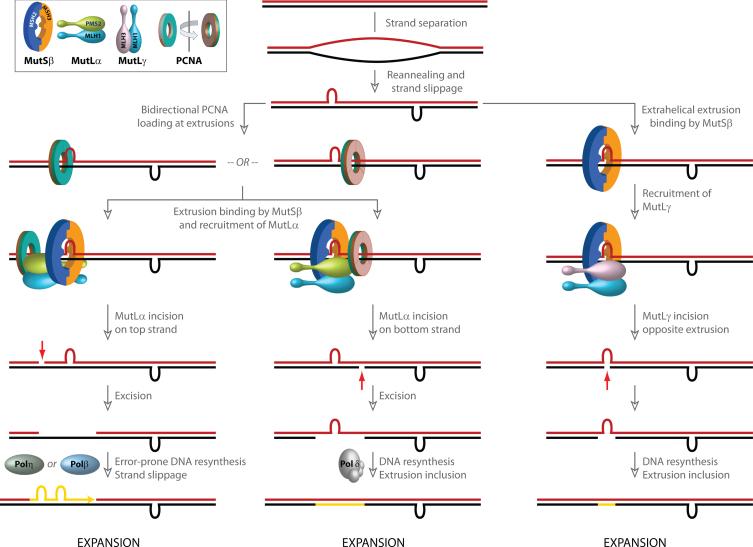
DNA mismatch repair (MMR) is a highly conserved genome stabilizing pathway that corrects DNA replication errors, limits chromosomal rearrangements, and mediates the cellular response to many types of DNA damage. Counterintuitively, MMR is also involved in the generation of mutations, as evidenced by its role in causing somatic triplet repeat expansion in Huntington's disease (HD) and other neurodegenerative disorders. In this review, we discuss the current state of mechanistic knowledge of MMR and review the roles of key enzymes in this pathway. We also present the evidence for mutagenic function of MMR in CAG repeat expansion and consider mechanistic hypotheses that have been proposed. Understanding the role of MMR in CAG expansion may shed light on potential avenues for therapeutic intervention in HD.
DNA 错配修复 (MMR) 是一种高度保守的基因组稳定途径,可纠正 DNA 复制错误、限制染色体重排,并介导细胞对多种类型的 DNA 损伤的反应。矛盾的是,MMR 也参与了突变的产生,这一点可以从其在亨廷顿病 (HD) 和其他神经退行性疾病中引起体细胞三核苷酸重复扩展的作用中得到证明。在这篇综述中,我们讨论了 MMR 的机制知识的现状,并回顾了该途径中关键酶的作用。我们还介绍了 MMR 在 CAG 重复扩展中的诱变功能的证据,并考虑了已经提出的机制假说。了解 MMR 在 CAG 扩展中的作用可能为 HD 的治疗干预提供潜在途径。

 Zotero 插件