Lambertini Matteo, Ceppi Marcello, Hamy Anne-Sophie, Caron Olivier, Poorvu Philip D, Carrasco Estela, Grinshpun Albert, Punie Kevin, Rousset-Jablonski Christine, Ferrari Alberta, Paluch-Shimon Shani, Toss Angela, Senechal Claire, Puglisi Fabio, Pogoda Katarzyna, Pérez-Fidalgo Jose Alejandro, De Marchis Laura, Ponzone Riccardo, Livraghi Luca, Estevez-Diz Maria Del Pilar, Villarreal-Garza Cynthia, Dieci Maria Vittoria, Clatot Florian, Duhoux Francois P, Graffeo Rossella, Teixeira Luis, Córdoba Octavi, Sonnenblick Amir, Ferreira Arlindo R, Partridge Ann H, Di Meglio Antonio, Saule Claire, Peccatori Fedro A, Bruzzone Marco, t'Kint de Roodenbeke Marie Daphne, Ameye Lieveke, Balmaña Judith, Del Mastro Lucia, Azim Hatem A
Department of Internal Medicine and Medical Specialties (DIMI), School of Medicine, University of Genova, Genova, Italy.
Department of Medical Oncology, U.O.C, Clinica di Oncologia Medica, IRCCS Ospedale Policlinico San Martino, Genova, Italy.
NPJ Breast Cancer. 2021 Feb 12;7(1):16. doi: 10.1038/s41523-021-00224-w.
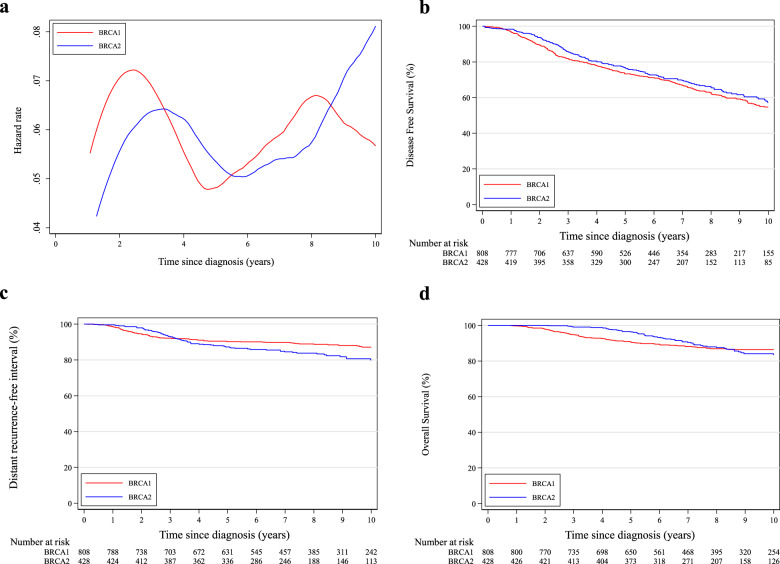
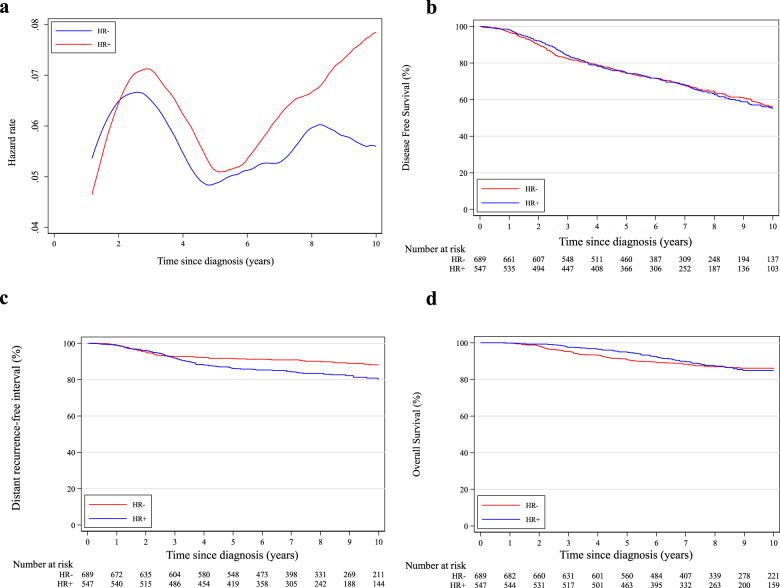
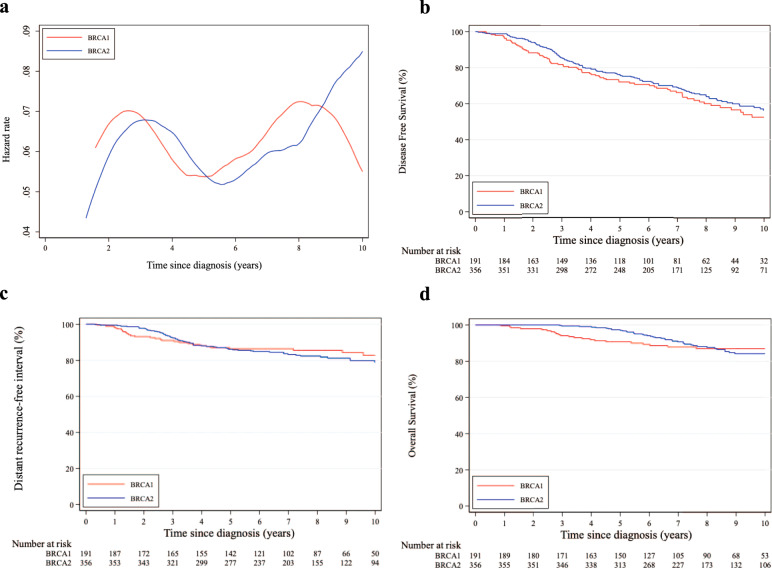
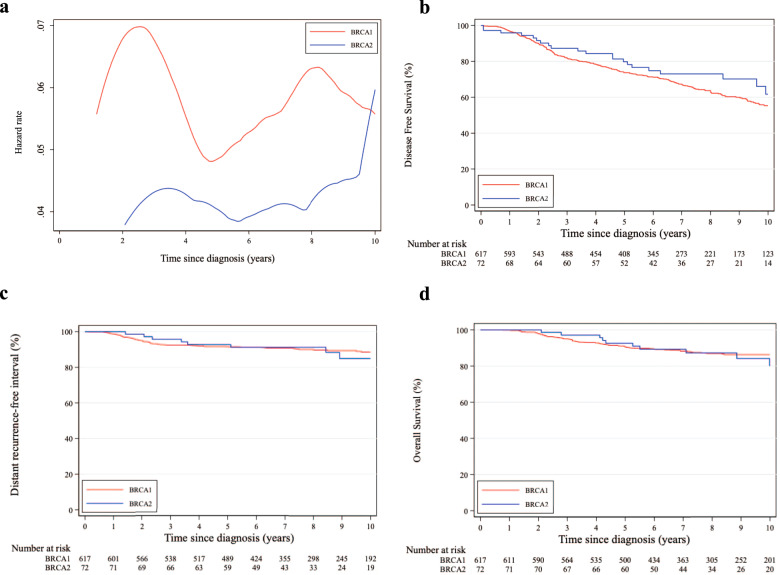
Young breast cancer (BC) patients carrying a germline BRCA pathogenic variant (mBRCA) have similar outcomes as non-carriers. However, the impact of the type of gene (BRCA1 vs. BRCA2) and hormone receptor status (positive [HR+] vs. negative [HR-]) on clinical behavior and outcomes of mBRCA BC remains largely unknown. This is an international, multicenter, hospital-based, retrospective cohort study that included mBRCA patients diagnosed, between January 2000 and December 2012, with stage I-III invasive early BC at age ≤40 years. From 30 centers worldwide, 1236 young mBRCA BC patients were included. Among 808 and 428 patients with mBRCA1 or mBRCA2, 191 (23.6%) and 356 (83.2%) had HR+tumors, respectively (P < 0.001). Median follow-up was 7.9 years. Second primary BC (P = 0.009) and non-BC malignancies (P = 0.02) were more frequent among mBRCA1 patients while distant recurrences were less frequent (P = 0.02). Irrespective of hormone receptor status, mBRCA1 patients had worse disease-free survival (DFS; adjusted HR = 0.76, 95% CI = 0.60-0.96), with no difference in distant recurrence-free interval (DRFI) and overall survival (OS). Patients with HR+ disease had more frequent distant recurrences (P < 0.001) and less frequent second primary malignancies (BC: P = 0.005; non-BC: P = 0.18). No differences in DFS and OS were observed according to hormone receptor status, with a tendency for worse DRFI (adjusted HR = 1.39, 95% CI = 0.94-2.05) in patients with HR+ BC. Type of mBRCA gene and hormone receptor status strongly impact BC clinical behavior and outcomes in mBRCA young patients. These results provide important information for patients' counseling on treatment, prevention, and surveillance strategies.
携带胚系BRCA致病变异(mBRCA)的年轻乳腺癌(BC)患者与非携带者的预后相似。然而,基因类型(BRCA1与BRCA2)和激素受体状态(阳性[HR+]与阴性[HR-])对mBRCA BC临床行为和预后的影响在很大程度上仍不清楚。这是一项基于医院的国际多中心回顾性队列研究,纳入了2000年1月至2012年12月期间诊断为年龄≤40岁的I-III期浸润性早期BC的mBRCA患者。来自全球30个中心,共纳入1236例年轻mBRCA BC患者。在808例mBRCA1患者和428例mBRCA2患者中,分别有191例(23.6%)和356例(83.2%)患有HR+肿瘤(P < 0.001)。中位随访时间为7.9年。mBRCA1患者中第二原发性BC(P = 0.009)和非BC恶性肿瘤(P = 0.02)更为常见,而远处复发较少见(P = 0.02)。无论激素受体状态如何,mBRCA1患者的无病生存期(DFS;调整后HR = 0.76,95%CI = 0.60-0.96)较差,远处无复发生存期(DRFI)和总生存期(OS)无差异。HR+疾病患者远处复发更常见(P < 0.001),第二原发性恶性肿瘤较少见(BC:P = 0.005;非BC:P = 0.18)。根据激素受体状态,DFS和OS未观察到差异,HR+ BC患者的DRFI有较差的趋势(调整后HR = 1.39,95%CI = 0.94-2.05)。mBRCA基因类型和激素受体状态强烈影响mBRCA年轻患者的BC临床行为和预后。这些结果为患者的治疗、预防和监测策略咨询提供了重要信息。