Arnaez Juan, Ochoa-Sangrador Carlos, Caserío Sonia, Gutiérrez Elena Pilar, Jiménez Maria Del Pilar, Castañón Leticia, Benito Marta, Peña Ana, Hernández Natalio, Hortelano Miryam, Schuffelmann Susana, Prada M Teresa, Diego Pablo, Villagómez F Joaquín, Garcia-Alix Alfredo
Departamento de Pediatría (Neonatología), Complejo Asistencial Universitario de Burgos, Burgos, Spain.
NeNe Foundation, Madrid, Spain.
Eur J Pediatr. 2021 Jun;180(6):1997-2002. doi: 10.1007/s00431-021-03984-6. Epub 2021 Feb 12.
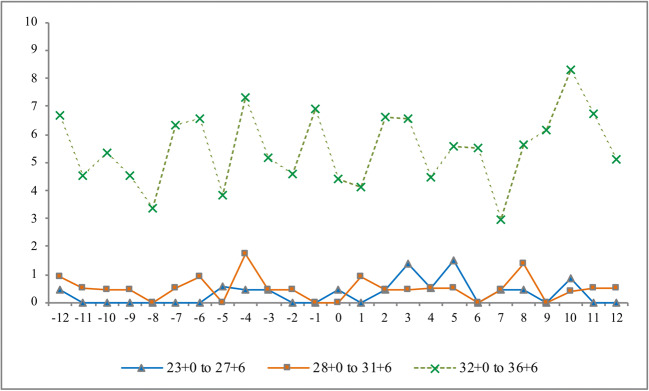
Preliminary data in Europe have suggested a reduction in prematurity rates during the COVID-19 pandemic, implying that contingency measures could have an impact on prematurity rates. We designed a population-based prevalence proportion study to explore the potential link between national lockdown measures and a change in preterm births and stillbirths. Adjusted multivariate analyses did not show any decrease in preterm proportions during the lockdown period with respect to the whole prelockdown period or to the prelockdown comparison periods (2015-2019): 6.5% (95%CI 5.6-7.4), 6.6% (95%CI 6.5-6.8), and 6.2% (95%CI 5.7-6.7), respectively. Proportions of preterm live births did not change during lockdown when different gestational age categories were analyzed, nor when birthweight categories were considered. No differences in stillbirth rates among the different study periods were found: 0.33% (95%CI 0.04-0.61) during the lockdown period vs. 0.34% (95%CI 0.22-0.46) during the prelockdown comparison period (2015-2019).Conclusion: We did not find any link between prematurity and lockdown, nor between stillbirths and lockdown. Collaborative efforts are desirable to gather more data and additional evidence on this global health issue. What is Known: • Prematurity is associated with increased risk of morbidity and mortality. • Contingency measures during the COVID-19 pandemic may have an impact on reducing prematurity rates. What is New: • Prematurity and stillbirth rates remained stable in Castilla-y-León, a Spanish region, during COVID-19 lockdown. • The role of behavioral patterns and sociocultural factors in the prevention of preterm birth as a result of lockdown measures remains a subject for debate.
欧洲的初步数据表明,在新冠疫情期间早产率有所下降,这意味着应急措施可能会对早产率产生影响。我们设计了一项基于人群的患病率比例研究,以探讨国家封锁措施与早产和死产变化之间的潜在联系。调整后的多变量分析显示,与整个封锁前时期或封锁前对比时期(2015 - 2019年)相比,封锁期间早产比例并未下降:分别为6.5%(95%置信区间5.6 - 7.4)、6.6%(95%置信区间6.5 - 6.8)和6.2%(95%置信区间5.7 - 6.7)。分析不同孕周类别时,封锁期间早产活产比例没有变化,考虑出生体重类别时也没有变化。不同研究时期的死产率没有差异:封锁期间为0.33%(95%置信区间0.04 - 0.61),封锁前对比时期(2015 - 2019年)为0.34%(95%置信区间0.22 - 0.46)。结论:我们没有发现早产与封锁之间、死产与封锁之间存在任何联系。需要共同努力收集更多关于这一全球健康问题的数据和额外证据。已知信息:• 早产与发病和死亡风险增加相关。• 新冠疫情期间的应急措施可能对降低早产率有影响。新发现:• 在西班牙卡斯蒂利亚 - 莱昂地区,新冠疫情封锁期间早产和死产率保持稳定。• 由于封锁措施,行为模式和社会文化因素在预防早产中的作用仍是一个有争议的话题。