Department of Behavioral Sciences and Learning, Linköping University, Linköping, Sweden; Department of Management and Engineering, JEDI-Lab, Linköping University, Linköping, Sweden.
Department of Behavioral Sciences and Learning, Linköping University, Linköping, Sweden; Department of Management and Engineering, JEDI-Lab, Linköping University, Linköping, Sweden; Center for Social and Affective Neuroscience (CSAN), Linköping University, Linköping, Sweden.
Dev Cogn Neurosci. 2021 Apr;48:100933. doi: 10.1016/j.dcn.2021.100933. Epub 2021 Feb 5.
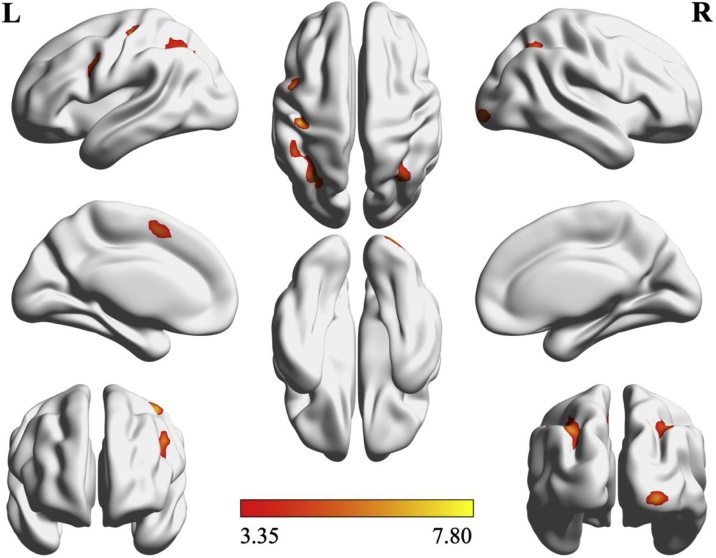
The triple code model of numerical cognition (TCM) details the neurocognitive mechanisms associated with perceiving and manipulating numerical information in exact symbolic (Arabic digits and number words) and approximate nonsymbolic numerical magnitude (e.g., dot arrays) representation codes. The current study provides a first empirical fMRI-based investigation into neurodevelopmental differences in 30 healthy children's and 44 healthy adults' recruitment of neural correlates associated with the Arabic digit, number word, and nonsymbolic magnitude codes. Differences between the two groups were found in cingulate regions commonly associated with domain-general aspects of cognitive control, as opposed to neural correlates of number processing per se. A primary developmental difference was identified in verbal number discrimination, where only adults recruited left-lateralized perisylvian language areas in accordance with the TCM. We therefore call for a revision of the verbal code and a formulation of separate child and adult-specific neurocognitive mechanisms associated with the discrimination of number words. Although further research is necessary, results indicate that numerical discrimination abilities in middle-school-aged children operate close to adult-level maturity. Neurodevelopmental differences may be more apparent in younger children, or on the level of functional network dynamics as opposed to a shift in recruited neural substrates.
三重数字认知模型(TCM)详细描述了与精确符号(阿拉伯数字和数字单词)和近似非符号数量大小(例如,点数组)表示代码中感知和操作数字信息相关的神经认知机制。本研究首次基于 fMRI 对 30 名健康儿童和 44 名健康成年人的神经发育差异进行了实证研究,以探讨与阿拉伯数字、数字单词和非符号数量大小代码相关的神经相关物的募集情况。与数量处理本身的神经相关物相反,在与认知控制的一般领域相关的扣带区域中发现了两组之间的差异。在言语数量辨别方面发现了一个主要的发育差异,只有成年人根据 TCM 募集了左侧的大脑语言区。因此,我们呼吁对言语代码进行修订,并制定与数字单词辨别相关的儿童和成人特定的神经认知机制。尽管还需要进一步的研究,但结果表明,中学生的数字辨别能力接近成人水平的成熟度。神经发育差异在年龄较小的儿童中可能更为明显,或者在功能网络动态的层面上,而不是在募集的神经基质的转变上。