Division of Psychology, Department of Clinical Neuroscience, Karolinska Institutet, Nobels väg 9, 171 77, Stockholm, Sweden.
Department of Social and Behavioral Sciences, Yale School of Public Health, New Haven, CT, USA.
Soc Psychiatry Psychiatr Epidemiol. 2021 Sep;56(9):1537-1545. doi: 10.1007/s00127-021-02036-6. Epub 2021 Feb 13.
Discriminatory laws, policies, and population attitudes, surrounding transgender people vary greatly across countries, from equal protection under the law and full acceptance to lack of legal recognition and open bias. The consequences of this substantial between-country variation on transgender people's health and well-being is poorly understood. We therefore examined the association between structural stigma and transgender people's life satisfaction across 28 countries.
Data from transgender participants (n = 6771) in the 2012 EU-LGBT-survey regarding identity concealment, day-to-day discrimination, and life satisfaction were assessed. Structural stigma was measured using publicly available data regarding each country's discriminatory laws, policies, and population attitudes towards transgender people.
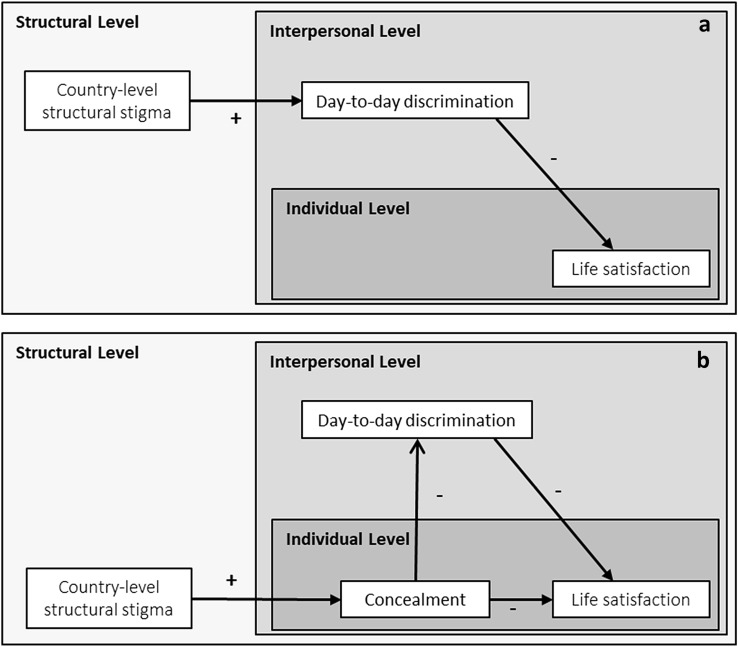
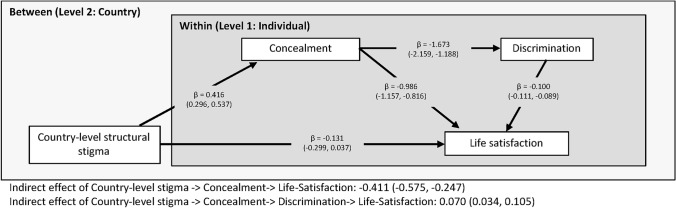
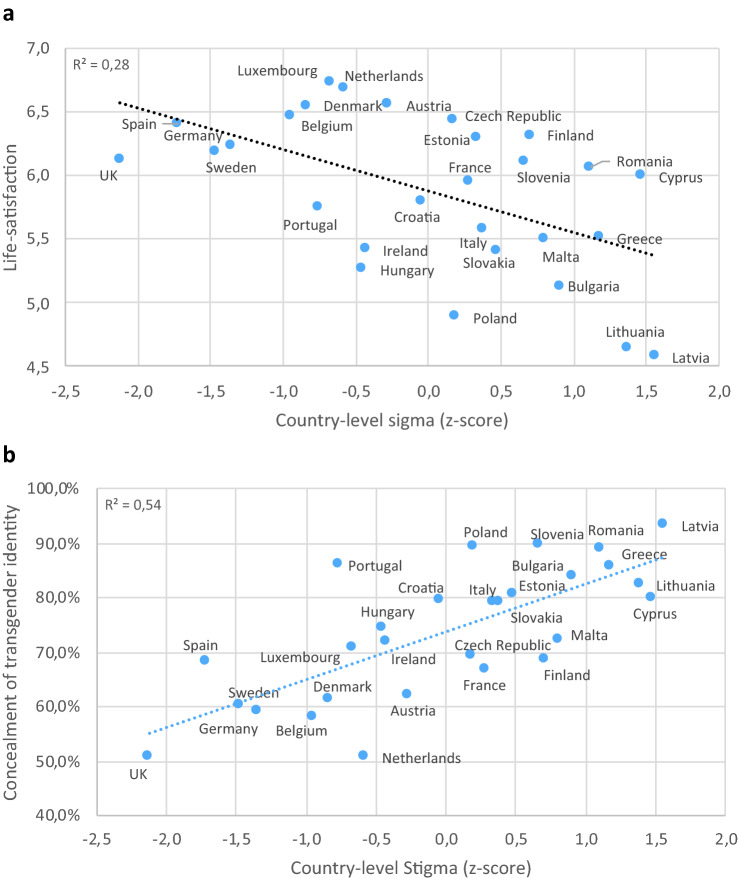
Multilevel models showed that country-level structural stigma was associated with lower life satisfaction, an association largely explained by higher levels of identity concealment in higher-structural-stigma countries. Yet identity concealment was also associated with lower day-to-day discrimination and therefore protected against even lower life satisfaction.
The results emphasize the importance of changing discriminatory legislation and negative population attitudes to improve transgender people's life satisfaction, and also highlight targets for intervention at interpersonal and individual levels.
围绕跨性别者的歧视性法律、政策和人口态度在各国之间存在很大差异,从法律下的平等保护和完全接受,到缺乏法律认可和公开偏见。这种国家间差异对跨性别者的健康和幸福的影响知之甚少。因此,我们研究了结构性耻辱感与 28 个国家跨性别者生活满意度之间的关联。
对 2012 年欧盟 LGBT 调查中跨性别者参与者(n=6771)的身份隐瞒、日常歧视和生活满意度数据进行了评估。使用有关各国歧视性法律、政策和人口对跨性别者态度的公开数据来衡量结构性耻辱感。
多层次模型表明,国家层面的结构性耻辱感与较低的生活满意度相关,这种关联主要归因于结构性耻辱感较高的国家中更高的身份隐瞒率。然而,身份隐瞒也与较低的日常歧视有关,因此可以防止生活满意度进一步降低。
研究结果强调了改变歧视性立法和负面人口态度以提高跨性别者生活满意度的重要性,同时也突出了在人际和个人层面进行干预的目标。