Department of Genetics and Biotechnology, Faculty of Biology, National and Kapodistrian University of Athens, Athens, Greece.
Center for Molecular Biology of Heidelberg University (ZMBH), Heidelberg, Germany.
Curr Genet. 2021 Jun;67(3):471-485. doi: 10.1007/s00294-021-01157-4. Epub 2021 Feb 13.
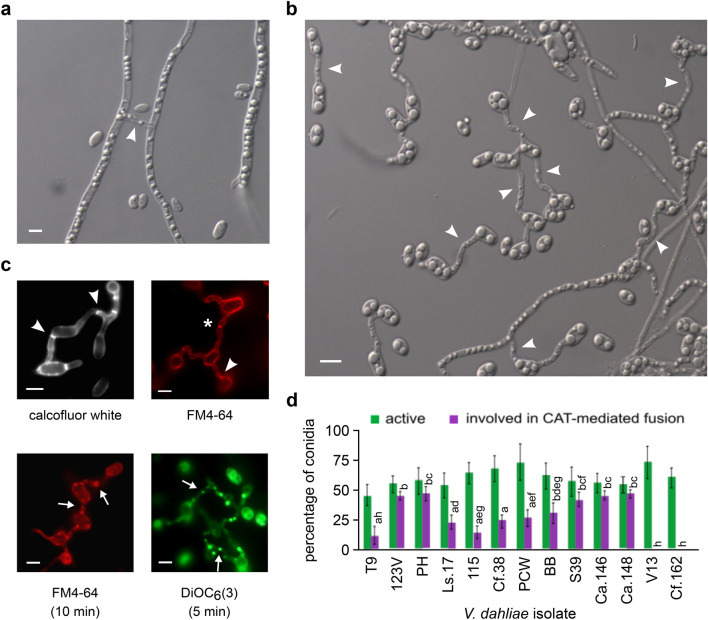
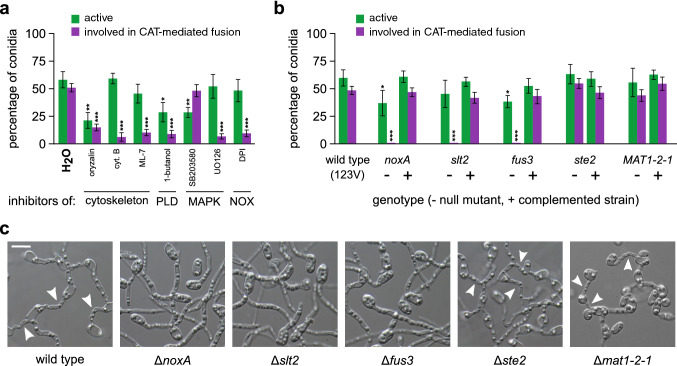
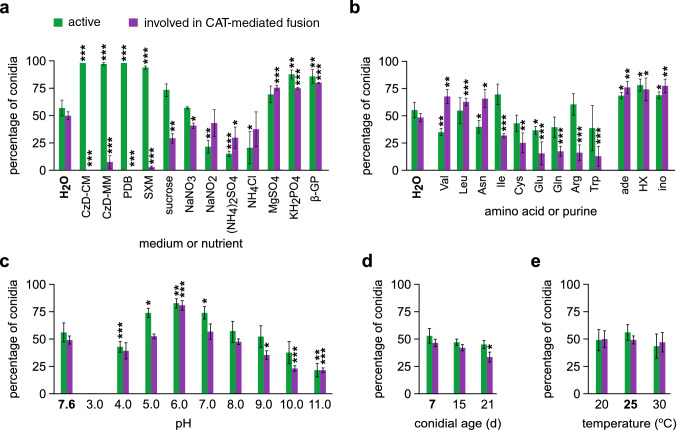
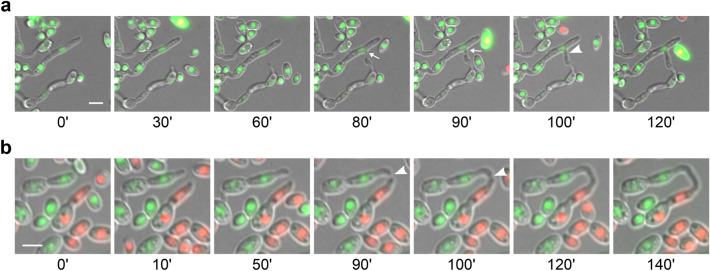
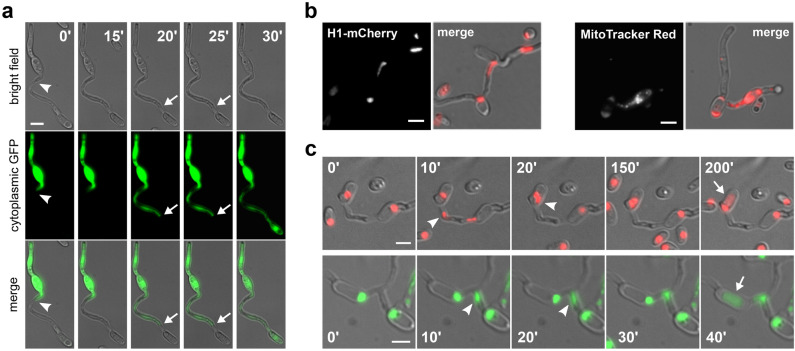
Cell-to-cell fusion is a fundamental biological process across the tree of life. In filamentous fungi, somatic fusion (or anastomosis) is required for the normal development of their syncytial hyphal networks, and it can initiate non-sexual genetic exchange processes, such as horizontal genetic transfer and the parasexual cycle. Although these could be important drivers of the evolution of asexual fungi, this remains a largely unexplored possibility due to the lack of suitable resources for their study in these puzzling organisms. We thus aimed at the characterization of cell fusion in the important asexual fungus Verticillium dahliae via Conidial Anastomosis Tubes (CATs), which can be useful for the analysis of parasexuality. We optimized appropriate procedures for their highly reproducible quantification and live-cell imaging, which were used to characterize their physiology and cell biology, and to start elucidating their underlying genetic machinery. Formation of CATs was shown to depend on growth conditions and require functional Fus3 and Slt2 MAP kinases, as well as the NADPH oxidase NoxA, whereas the GPCR Ste2 and the mating-type protein MAT1-2-1 were dispensable. We show that nuclei and other organelles can migrate through CATs, which often leads to the formation of transient dikaryons. Their nuclei have possible windows of opportunity for genetic interaction before degradation of one by a presumably homeostatic mechanism. We establish here CAT-mediated fusion in V. dahliae as an experimentally convenient system for the cytological analysis of fungal non-sexual genetic interactions. We expect that it will facilitate the dissection of sexual alternatives in asexual fungi.
细胞融合是生命之树中普遍存在的基本生物学过程。在丝状真菌中,体细胞融合(或吻合)是其合胞质菌丝网络正常发育所必需的,它可以启动非性遗传交换过程,如水平基因转移和准性循环。尽管这些过程可能是无性真菌进化的重要驱动力,但由于缺乏适合这些令人困惑的生物体研究的资源,这仍然是一个很大程度上未被探索的可能性。因此,我们旨在通过孢子吻合管 (CATs) 来表征重要的无性真菌轮枝孢属中的细胞融合,CATs 可用于分析准性生殖。我们优化了适用于其高度可重复定量和活细胞成像的程序,这些程序可用于表征其生理学和细胞生物学,并开始阐明其潜在的遗传机制。CATs 的形成依赖于生长条件,需要功能正常的 Fus3 和 Slt2 MAP 激酶,以及 NADPH 氧化酶 NoxA,而 GPCR Ste2 和交配型蛋白 MAT1-2-1 则是可有可无的。我们表明,核和其他细胞器可以通过 CATs 迁移,这通常导致短暂的双核体的形成。它们的核在一个可能通过同源平衡机制降解之前,有机会进行遗传相互作用。我们在这里建立了 V. dahliae 中的 CAT 介导融合,作为真菌非性遗传相互作用的细胞学分析的实验方便系统。我们预计它将有助于剖析无性真菌中的有性替代。