Tavassoli F A, Casey H W, Norris H J
Gynecologic and Breast Pathology Department, Armed Forces Institute of Pathology, Washington, DC 20306.
Am J Pathol. 1988 May;131(2):213-34.
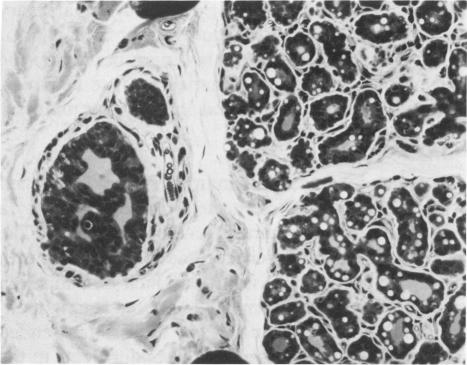
A total of 213 treated and 16 control monkeys comprising 12 experimental groups was evaluated for determination of the long-term (10 years) effects of various dosages of a variety of synthetic oral contraceptive steroids on the mammary glands of rhesus monkeys. The steroid hormones included mestranol, ethynerone, a combination of mestranol and ethynerone, chlorethynyl norgestrel plus mestranol, and anagestone acetate plus mestranol. Various degrees of physiologic lobular hyperplasia and lactational changes were observed in association with all of these steroid hormones; these changes appeared dose-dependent. Mestranol caused a proliferative atypia ranging from a minimal to a moderate degree in 8 of 34 (23%) animals, but it was not dose-related. Eleven of 15 monkeys (73%) administered ethynerone developed proliferative atypia, ranging in degree from minimal to severe, including one invasive carcinoma and 2 lesions resembling intraductal carcinoma in the human. The mestranol and ethynerone combination produced a proliferative atypia in 22 of 52 animals (42%), including five identical to intraductal carcinoma in the human and one identical to lobular neoplasia. Of the 40 monkeys administered anagestone acetate and mestranol, 20 (50%) developed proliferative atypias; the atypias ranged from mild to severe and included five resembling intraductal carcinoma in human breast. The chloroethynyl norgestrel and mestranol combination induced proliferative atypia in 25 of 52 monkeys (49%); six of these atypias were severe and indistinguishable from intraductal carcinoma of the human breast; and one, if in the human breast, would reflect a solid variant of an invasive carcinoma. Only 2 of the 16 control monkeys (12%) developed proliferative atypias, and these were of minimal to mild degree. The occurrence of severe degrees of atypia identical to intraductal carcinoma in the human breast and invasive carcinoma associated with hormone administration suggests a carcinogenic effect.
对总共213只接受治疗的猴子和16只对照猴子(分为12个实验组)进行了评估,以确定各种剂量的多种合成口服避孕甾体激素对恒河猴乳腺的长期(10年)影响。甾体激素包括炔雌醇甲醚、炔诺酮、炔雌醇甲醚与炔诺酮的组合、氯炔诺孕酮加炔雌醇甲醚以及醋酸甲羟孕酮加炔雌醇甲醚。观察到所有这些甾体激素都伴有不同程度的生理性小叶增生和泌乳变化;这些变化呈剂量依赖性。炔雌醇甲醚在34只动物中的8只(23%)引起了从轻度到中度的增生性异型性,但与剂量无关。给予炔诺酮的15只猴子中有11只(73%)出现了增生性异型性,程度从轻度到重度不等,包括1例浸润性癌和2例类似于人类导管内癌的病变。炔雌醇甲醚与炔诺酮的组合在52只动物中的22只(42%)产生了增生性异型性,包括5例与人类导管内癌相同的病变和1例与小叶肿瘤相同的病变。在给予醋酸甲羟孕酮和炔雌醇甲醚的40只猴子中,20只(50%)出现了增生性异型性;异型性从轻度到重度不等,包括5例类似于人类乳腺导管内癌的病变。氯炔诺孕酮与炔雌醇甲醚的组合在52只猴子中的25只(49%)诱导了增生性异型性;其中6例异型性严重,与人类乳腺导管内癌难以区分;还有1例,如果在人类乳腺中,将表现为浸润性癌的实性变体。16只对照猴子中只有2只(12%)出现了增生性异型性,且程度为轻度到中度。与激素给药相关的严重程度与人类乳腺导管内癌相同的异型性以及浸润性癌的出现提示了致癌作用。