Al-Hashel Jasem Youssef, Kh Ashkanani Hasan, Almutairi Ohood, Bokubar Fajer A, Mubarak Shahad, Alwazzan Sawsan, Alroughani Raed, Youssry Doaa, Farouk Ahmed Samar
Neurology Department, Ibn Sina Hospital, Kuwait, Kuwait.
Faculty of Medicine, Kuwait University, Kuwait, Kuwait.
Front Neurol. 2021 Jan 27;11:633355. doi: 10.3389/fneur.2020.633355. eCollection 2020.
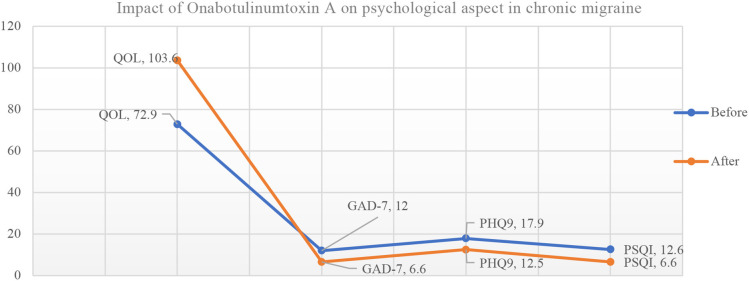
Chronic migraine (CM) affects 5.4% of the Kuwaiti population. It is associated with significant headache-related disability, psychiatric comorbidity and reduced quality of life. The aim of this study is to assess the efficacy of Onabotulinumtoxin A on psychological aspects of chronic migraine patients. This prospective study over 36 months included chronic migraine patients in a tertiary headache center. Eligible patients met International Classification of Headache Disorders disorders-third edition, beta version (ICHD-III) revision criteria for chronic migraine. Patients with history of psychiatric or medical problems other than migraine disorders were excluded. Patients who received less than 4 injections cycles of Onabotulinumtoxin A were excluded. Identified patients received 155 units of Onabotulinumtoxin A quarterly according to the Phase III Research Evaluating Migraine Prophylaxis Therapy Trail (PREEMPT) protocol. Quality of life, the seven-item Generalized Anxiety Disorder (GAD-7) scores, the nine-item Patient Health Questionnaire (PHQ9), and the Pittsburgh Sleep Quality Index (PSQI) were collected before injection and at the end of the study. Mean comparison tests were performed using the independent sample test to assess the effects of Onabotulinumtoxin A on quality of life and comorbid symptoms of anxiety, depression, and quality of sleep. The study identified 131 chronic migraine patients with a mean age of 44.92 years, mean disease duration of 12.20 years and a mean treatment sessions of 7.58. In their last visit, most of our sample showed improvement in quality of life (81%), GAD-7 (81%), PHQ9 (79%), and PSQ1 (76%). The mean score of patient satisfaction was 7.21. Onabotulinumtoxin A treatment for CM improved quality of life significantly (72.92 vs. 103.62 < 0.0001). It was also associated with significant reduction in anxiety [GAD-7 (12.00 vs. 6.61 < 0.0001)] and depression [PHQ-9 (17.91 vs. 12.52; < 0.0001)] scores, as well as reduced difficulty in sleeping [PSQI (12.60 vs. 6.66; < 0.0001)] at the last visit. Prophylactic Onabotulinumtoxin A treatment for CM was associated with significant improvement of quality of life, reduction in symptoms of anxiety and depression, as well as improved symptoms of poor sleep.
慢性偏头痛(CM)影响5.4%的科威特人口。它与严重的头痛相关残疾、精神共病以及生活质量下降有关。本研究的目的是评估A型肉毒毒素对慢性偏头痛患者心理方面的疗效。这项为期36个月的前瞻性研究纳入了一家三级头痛中心的慢性偏头痛患者。符合条件的患者符合《国际头痛疾病分类》第三版beta版(ICHD-III)慢性偏头痛的修订标准。排除有偏头痛障碍以外的精神或医疗问题史的患者。接受少于4个注射周期A型肉毒毒素的患者被排除。确定的患者根据偏头痛预防治疗评估三期试验(PREEMPT)方案每季度接受155单位A型肉毒毒素治疗。在注射前和研究结束时收集生活质量、七项广泛性焦虑障碍(GAD-7)评分、九项患者健康问卷(PHQ9)以及匹兹堡睡眠质量指数(PSQI)。使用独立样本检验进行均值比较测试,以评估A型肉毒毒素对生活质量以及焦虑、抑郁共病症状和睡眠质量的影响。该研究确定了131名慢性偏头痛患者,平均年龄44.92岁,平均病程12.20年,平均治疗疗程7.58次。在最后一次就诊时,我们的大多数样本在生活质量(81%)、GAD-7(81%)、PHQ9(79%)和PSQ1(76%)方面都有改善。患者满意度的平均评分为7.21。A型肉毒毒素治疗CM显著改善了生活质量(72.92对103.62;<0.0001)。它还与焦虑[GAD-7(12.00对6.61;<0.0001)]和抑郁[PHQ-9(17.91对12.52;<0.0001)]评分的显著降低以及最后一次就诊时睡眠困难的减轻[PSQI(12.60对6.66;<0.0001)]相关。预防性A型肉毒毒素治疗CM与生活质量的显著改善、焦虑和抑郁症状的减轻以及睡眠不佳症状的改善相关。