Haque Rashida, Kadir Muhammad Abdul, Rabbani K Siddique-E
Department of Biomedical Physics and Technology, University of Dhaka, Dhaka 1000, Bangladesh.
J Electr Bioimpedance. 2019 Dec 26;10(1):73-82. doi: 10.2478/joeb-2019-0011. eCollection 2019 Jan.
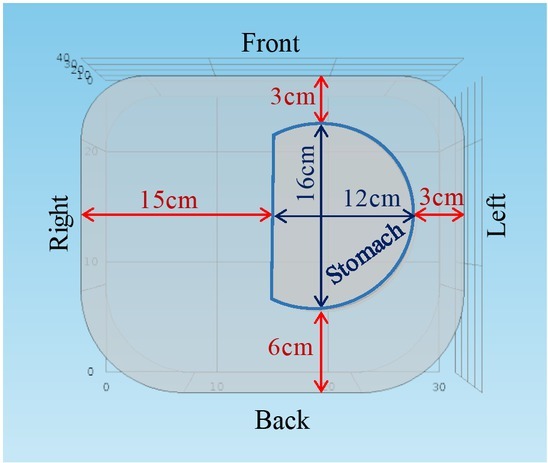
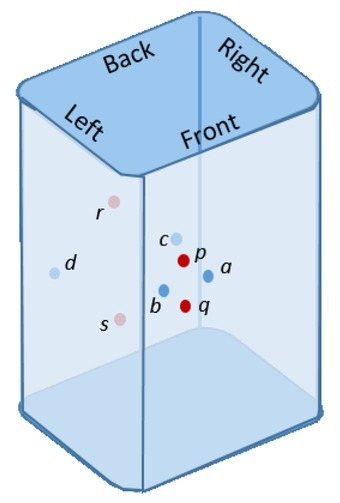
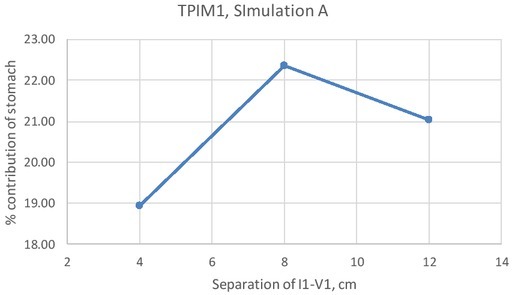
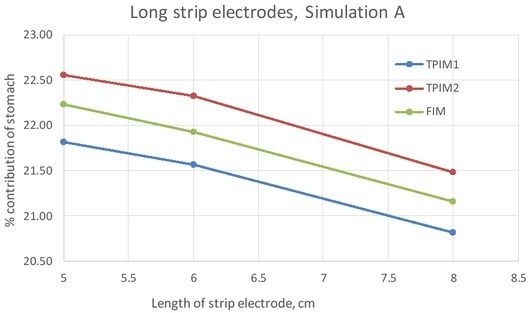
For probing deep organs of the body using electrical impedance, the conventional method is to use Electrical Impedance Tomography (EIT). However, this would be a sophisticated machine and will be very expensive when a full 3D EIT is developed in the future. Furthermore, for most low income countries such expensive devices may not deliver the benefits to a large number of people. Therefore, this paper suggests the use of simpler techniques like Tetrapolar Impedance Measurement (TPIM) or Focused Impedance Method (FIM) in probing deeper organs. Following a method suggested earlier by one of the authors, this paper studies the possibility of using TPIM and FIM for the stomach. Using a simplified model of the human trunk with an embedded stomach, a finite element simulation package, COMSOL, was used to obtain transfer impedance values and percentage contribution of the stomach region in the total impedance. For this work, judicious placement of electrodes through qualitative visualizations based on point sensitivity equations and equipotential concepts were made, which showed that reasonable contribution of the stomach region is possible through the use of TPIM and FIM. The contributions were a little over 20% which is of similar order of the cross-sectional area percentage of the stomach with respect to that of the trunk. For the case where the conductivity of the stomach region was assumed about 4 times higher, the contributions increased to about 38%. Through further studies this proposed methods may contribute greatly in the study of deeper organs of the body.
对于使用电阻抗探测身体深部器官,传统方法是采用电阻抗断层成像(EIT)。然而,这将是一台复杂的机器,并且在未来开发出完整的三维EIT时会非常昂贵。此外,对于大多数低收入国家而言,如此昂贵的设备可能无法使大量民众受益。因此,本文建议使用更简单的技术,如四极阻抗测量(TPIM)或聚焦阻抗法(FIM)来探测深部器官。遵循作者之一先前提出的方法,本文研究了使用TPIM和FIM探测胃部的可能性。利用带有嵌入式胃部的人体躯干简化模型,使用有限元模拟软件包COMSOL来获取转移阻抗值以及胃部区域在总阻抗中的贡献百分比。对于这项工作,基于点灵敏度方程和等电位概念通过定性可视化对电极进行了合理放置,结果表明通过使用TPIM和FIM,胃部区域有可能做出合理贡献。贡献略高于20%,这与胃部相对于躯干的横截面积百分比处于相似量级。对于胃部区域电导率假设约高4倍的情况,贡献增加到约38%。通过进一步研究,这种提出的方法可能会对身体深部器官的研究做出巨大贡献。