Sardaro Angela, Turi Barbara, Bardoscia Lilia, Ferrari Cristina, Rubini Giuseppe, Calabrese Angela, Ammirati Federica, Grillo Antonietta, Leo Annamaria, Lorusso Filomenamila, Santorsola Antonio, Stabile Ianora Antonio Amato, Scardapane Arnaldo
Interdisciplinary Department of Medicine, Section of Radiology and Radiation Oncology, University of Bari "Aldo Moro", Bari, Italy.
Radiation Oncology Unit, Azienda Ospedaliero-Universitaria Policlinico, Bari, Italy.
Front Oncol. 2021 Jan 8;10:603994. doi: 10.3389/fonc.2020.603994. eCollection 2020.
Volumetric modulated arc radiotherapy (RT) has become pivotal in the treatment of prostate cancer recurrence (RPC) to optimize dose distribution and minimize toxicity, thanks to the high-precision delineation of prostate bed contours and organs at risk (OARs) under multiparametric magnetic resonance (mpMRI) guidance. We aimed to assess the role of pre-treatment mpMRI in ensuring target volume coverage and normal tissue sparing.
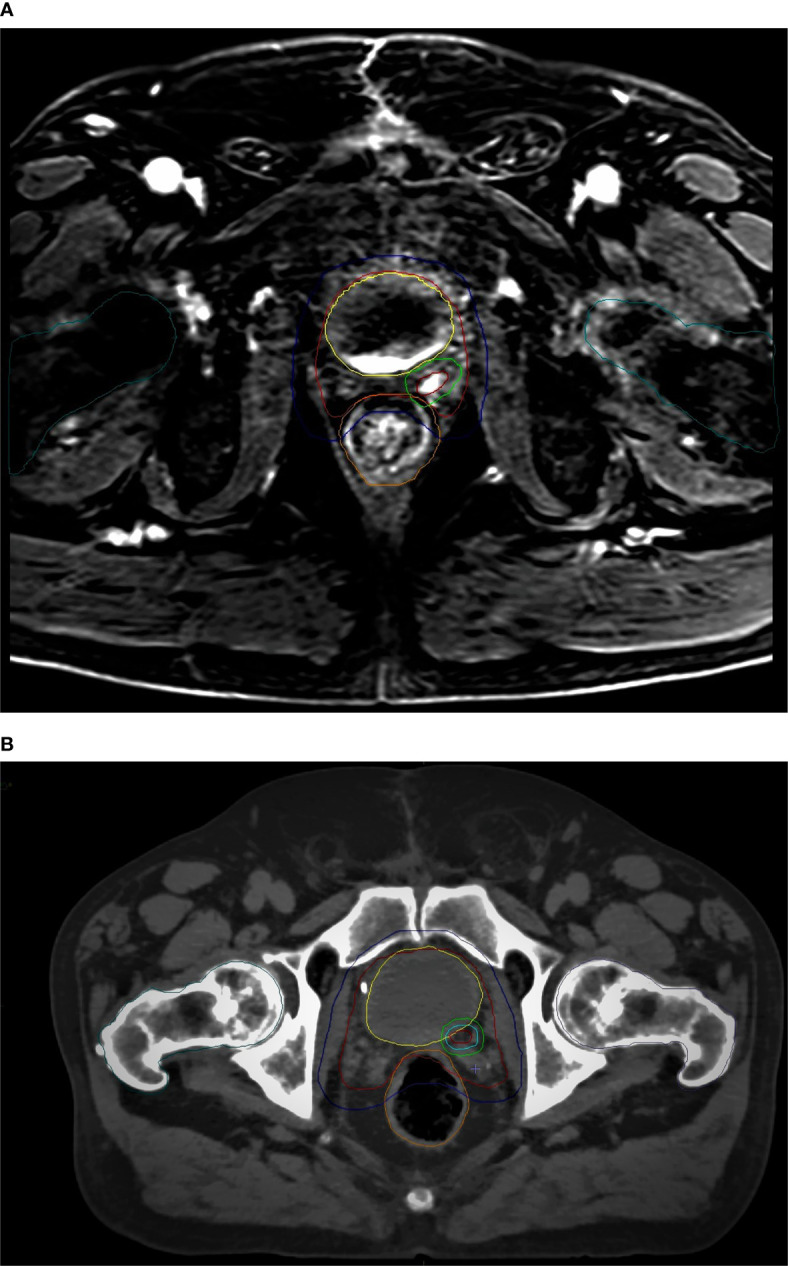
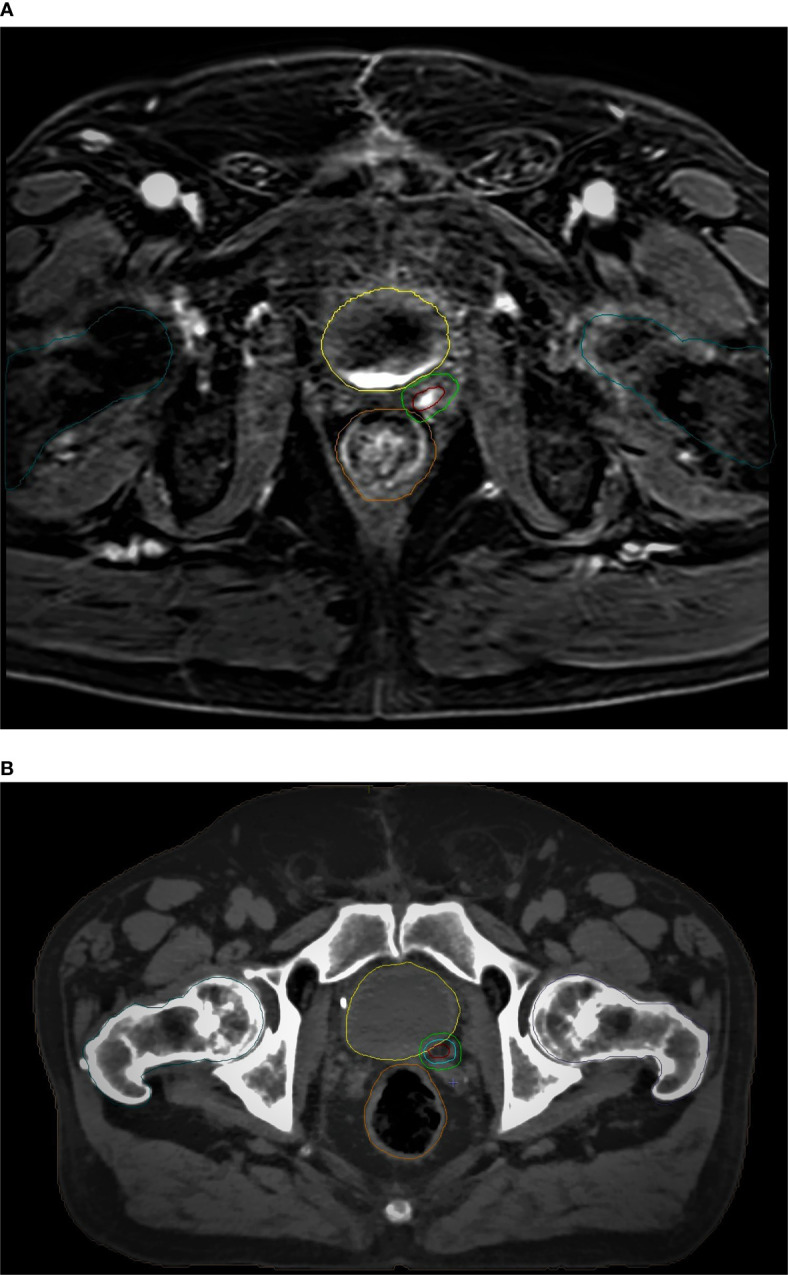
Patients with post-prostatectomy RPC eligible for salvage RT were prospectively recruited to this pilot study. Image registration between planning CT scan and T2w pre-treatment mpMRI was performed. Two sets of volumes were outlined, and DWI images/ADC maps were used to facilitate precise gross tumor volume (GTV) delineation on morphological MRI scans. Two rival plans (mpMRI-based or not) were drawn up.
Ten patients with evidence of RPC after prostatectomy were eligible. Preliminary data showed lower mpMRI-based clinical target volumes than CT-based RT planning ( = 0.0003): median volume difference 17.5 cm. There were no differences in the boost volume coverage nor the dose delivered to the femoral heads and penile bulb, but median rectal and bladder V was 4% less ( = 0.005 and = 0.210, respectively) for mpMRI-based segmentation.
mpMRI provides high-precision target delineation and improves the accuracy of RT planning for post-prostatectomy RPC, ensures better volume coverage with better OARs sparing and allows non-homogeneous dose distribution, with an aggressive dose escalation to the GTV. Randomized phase III trials and wider datasets are needed to fully assess the role of mpMRI in optimizing therapeutic strategies.
容积调强弧形放疗(RT)在前列腺癌复发(RPC)的治疗中已变得至关重要,这得益于在多参数磁共振(mpMRI)引导下对前列腺床轮廓和危及器官(OARs)的高精度勾画,从而优化剂量分布并将毒性降至最低。我们旨在评估治疗前mpMRI在确保靶区体积覆盖和保护正常组织方面的作用。
前瞻性招募符合挽救性放疗条件的前列腺切除术后RPC患者参与本前瞻性研究。在计划CT扫描和治疗前T2w mpMRI之间进行图像配准。勾勒出两组体积,并使用DWI图像/ADC图来辅助在形态学MRI扫描上精确勾画大体肿瘤体积(GTV)。制定了两个相互竞争的计划(基于mpMRI与否)。
10例前列腺切除术后有RPC证据的患者符合条件。初步数据显示,基于mpMRI的临床靶区体积低于基于CT的放疗计划( = 0.0003):中位体积差异为17.5 cm³。在追加剂量体积覆盖以及股骨头和阴茎球部所接受的剂量方面没有差异,但基于mpMRI的分割中直肠和膀胱的中位V₅₀分别减少了4%(分别为 = 0.005和 = 0.210)。
mpMRI提供高精度的靶区勾画,提高了前列腺切除术后RPC放疗计划的准确性,确保更好的体积覆盖并更好地保护OARs,允许非均匀剂量分布,并对GTV进行积极的剂量递增。需要随机III期试验和更广泛的数据集来全面评估mpMRI在优化治疗策略中的作用。