Division of Pulmonary and Critical Care Medicine, Department of Internal Medicine, Kyung Hee University Medical Center, Kyung Hee University College of Medicine, Seoul, South Korea.
Department of Internal Medicine, Chonnam National University Hwasun Hospital, Hwasun, South Korea.
Thorac Cancer. 2021 Apr;12(8):1264-1268. doi: 10.1111/1759-7714.13880. Epub 2021 Feb 14.
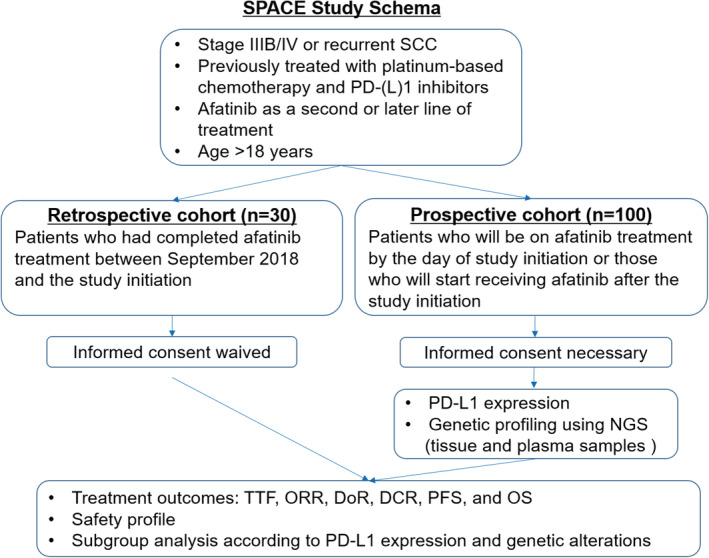
Afatinib is an ErbB family blocker approved for the treatment of epidermal growth factor receptor mutation-positive nonsmall-cell lung cancer. A pivotal trial demonstrated significant clinical benefits with manageable toxicity of afatinib as a second-line treatment option in squamous cell carcinoma of the lung (SCC) which led to approval in >60 countries. However, these results were derived from a controlled study conducted in selected patients and are not necessarily representative of the real-world use of this drug. In addition, data on afatinib use after immunotherapy in this clinical setting are lacking. The aim of this study is to evaluate the treatment outcomes and safety of afatinib as a second- or later-line treatment for SCC and to identify potential predictive biomarkers. As a real-world observational study, 130 eligible patients with advanced SCC, who progressed after platinum-based chemo- and immunotherapy, will be enrolled. Treatment outcomes and safety data will be collected for both the retrospective and prospective cohorts, and molecular profiling using tissue and plasma will be performed for the prospective cohort. The primary endpoint is time to treatment failure, and the secondary endpoints are objective response rate, progression-free survival, overall survival, and safety. Comparison of clinical outcomes with respect to the different programmed death-ligand 1 expression and molecular characteristics will also be carried out. This study will provide additional evidence on the usefulness of afatinib as a subsequent treatment, as well as feasible molecular biomarkers to predict its efficacy in this clinical setting.
阿法替尼是一种 ErbB 家族阻滞剂,已被批准用于治疗表皮生长因子受体突变阳性的非小细胞肺癌。一项关键试验表明,阿法替尼作为二线治疗选择在鳞状细胞癌(SCC)中具有显著的临床获益和可管理的毒性,这导致该药在超过 60 个国家获得批准。然而,这些结果来自于在选定患者中进行的对照研究,不一定代表该药在真实世界中的使用情况。此外,在这种临床情况下,关于阿法替尼在免疫治疗后的使用的数据也缺乏。本研究旨在评估阿法替尼作为 SCC 的二线或后续治疗的治疗结果和安全性,并确定潜在的预测生物标志物。作为一项真实世界的观察性研究,将招募 130 名符合条件的晚期 SCC 患者,这些患者在铂类化疗和免疫治疗后进展。将为回顾性和前瞻性队列收集治疗结果和安全性数据,并对前瞻性队列进行组织和血浆的分子谱分析。主要终点是治疗失败时间,次要终点是客观缓解率、无进展生存期、总生存期和安全性。还将比较不同程序性死亡配体 1 表达和分子特征的临床结果。这项研究将提供关于阿法替尼作为后续治疗的有效性的额外证据,以及在这种临床情况下预测其疗效的可行分子生物标志物。