Independence Blue Cross Cardiovascular Research Center and Department of Physiology (Y.Y., G.S., J.J., H.K., D.M.E., S.R.H.).
Center for Metabolic Disease Research and Department of Physiology (J.K., M.K.) at Temple University, Philadelphia, PA.
Circulation. 2021 Feb 16;143(7):699-712. doi: 10.1161/CIRCULATIONAHA.120.051264. Epub 2021 Feb 15.
The heart undergoes physiological hypertrophy during pregnancy in healthy individuals. Metabolic syndrome (MetS) is now prevalent in women of child-bearing age and might add risks of adverse cardiovascular events during pregnancy. The present study asks if cardiac remodeling during pregnancy in obese individuals with MetS is abnormal and whether this predisposes them to a higher risk for cardiovascular disorders.
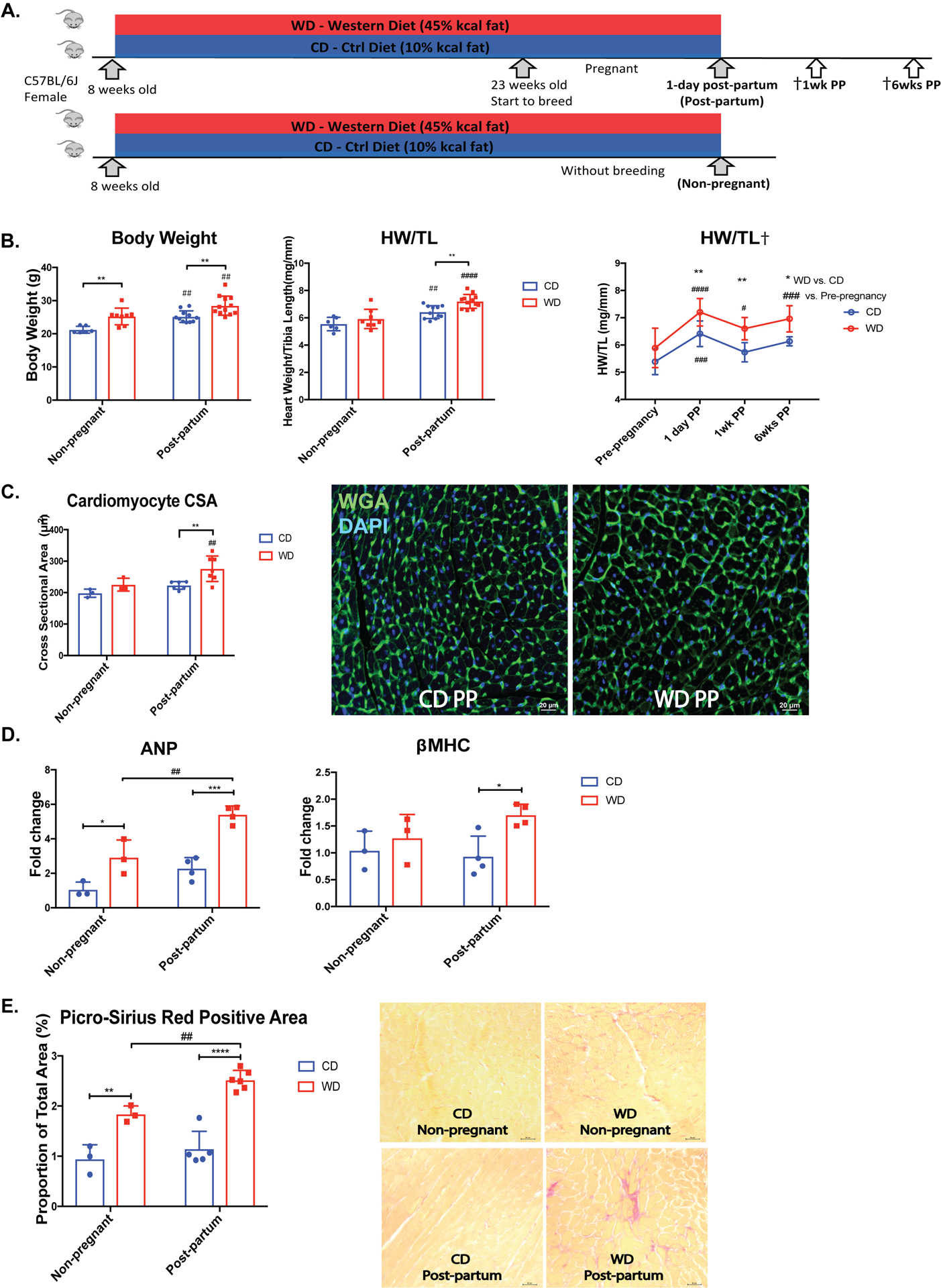
The idea that MetS induces pathological cardiac remodeling during pregnancy was studied in a long-term (15 weeks) Western diet-feeding animal model that recapitulated features of human MetS. Pregnant female mice with Western diet (45% kcal fat)-induced MetS were compared with pregnant and nonpregnant females fed a control diet (10% kcal fat).
Pregnant mice fed a Western diet had increased heart mass and exhibited key features of pathological hypertrophy, including fibrosis and upregulation of fetal genes associated with pathological hypertrophy. Hearts from pregnant animals with WD-induced MetS had a distinct gene expression profile that could underlie their pathological remodeling. Concurrently, pregnant female mice with MetS showed more severe cardiac hypertrophy and exacerbated cardiac dysfunction when challenged with angiotensin II/phenylephrine infusion after delivery.
These results suggest that preexisting MetS could disrupt physiological hypertrophy during pregnancy to produce pathological cardiac remodeling that could predispose the heart to chronic disorders.
健康个体在妊娠期间心脏会发生生理性肥大。代谢综合征(MetS)现在在育龄妇女中很普遍,并且可能会增加妊娠期间不良心血管事件的风险。本研究旨在探讨 MetS 是否会导致肥胖个体妊娠期间心脏重构异常,以及这是否会使她们更容易发生心血管疾病。
本研究在一种长期(15 周)的西方饮食喂养动物模型中研究了 MetS 在妊娠期间诱导病理性心脏重构的想法,该模型重现了人类 MetS 的特征。与食用对照饮食(10%kcal 脂肪)的妊娠和非妊娠雌性小鼠相比,用西方饮食(45%kcal 脂肪)诱导 MetS 的妊娠雌性小鼠被用于研究。
食用西方饮食的妊娠小鼠心脏质量增加,并表现出病理性肥大的关键特征,包括纤维化和与病理性肥大相关的胎儿基因上调。来自 WD 诱导 MetS 的妊娠动物的心脏具有独特的基因表达谱,这可能是其病理性重构的基础。同时,患有 MetS 的妊娠雌性小鼠在分娩后接受血管紧张素 II/苯肾上腺素输注时,表现出更严重的心脏肥大和心脏功能恶化。
这些结果表明,预先存在的 MetS 可能会破坏妊娠期间的生理性肥大,导致病理性心脏重构,从而使心脏容易发生慢性疾病。