Tulane School of Public Health and Tropical Medicine, New Orleans, LA, USA.
La Universidad Autónoma de Santo Domingo, Dominican Republic.
Health Place. 2021 Mar;68:102527. doi: 10.1016/j.healthplace.2021.102527. Epub 2021 Feb 13.
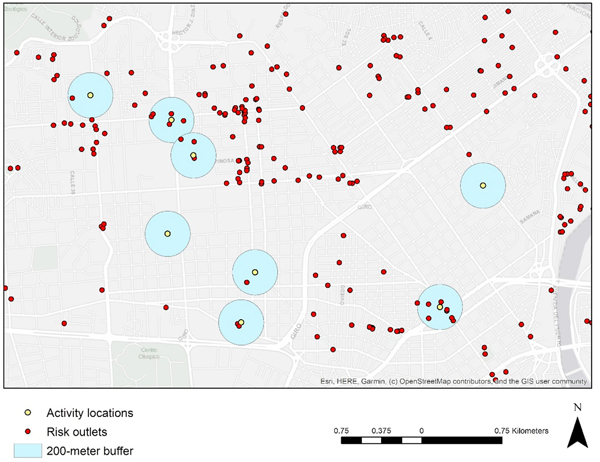
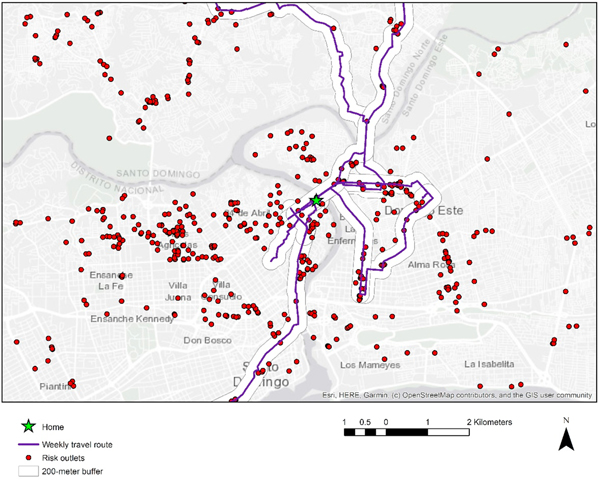
The purpose of this study was to explore the daily activity spaces of female sex workers living with HIV in the Dominican Republic and assess the relationship between activity path and location-based risk exposure measures and daily drug use. The study employed a micro-longitudinal observational study design using an innovative 7-day travel diary to capture daily activity routes and a 7-day mobile health (mHealth) daily diary to collect daily substance use behaviors among 51 female sex workers. To estimate between-subject variability, a series of crude and adjusted modified log-Poisson repeated measures regression models with generalized estimating equations, clustering by individual with a compound symmetry working correlation structure were fit to estimate the relative risks and 95% confidence intervals. Controlling for individual level factors, findings showed that female sex workers exposed to a higher number of risk outlets (e.g., liquor stores, bars, hotels, nightclubs, brothels, etc.) within 200 and 100-meters of sex work locations were at an increased risk of daily drug use (RR: 1.03, 95%CI: 1.01, 1.05, RR: 1.05, 95%CI: 1.01, 1.09). No association was detected between activity path exposure and daily drug use. These findings illustrate the importance of moving beyond static residential neighborhood boundaries for measuring risk exposures and highlight the significant role that daily work environments have on drug harms among a highly stigmatized and vulnerable population.
本研究旨在探索多米尼加共和国感染艾滋病毒的女性性工作者的日常活动空间,并评估活动路径与基于位置的风险暴露测量指标和日常药物使用之间的关系。该研究采用了一种微观纵向观察性研究设计,使用创新的 7 天旅行日记来捕捉日常活动路线,并使用 7 天移动健康 (mHealth) 日常日记来收集 51 名女性性工作者的日常药物使用行为。为了估计个体间的变异性,使用具有广义估计方程的粗和调整后的修正对数泊松重复测量回归模型,对个体进行聚类,使用复合对称工作相关结构,以估计相对风险和 95%置信区间。在控制个体水平因素的情况下,研究结果表明,在性工作地点 200 米和 100 米范围内暴露于更多风险场所(例如,酒类商店、酒吧、酒店、夜总会、妓院等)的女性性工作者,日常药物使用的风险增加(RR:1.03,95%CI:1.01,1.05,RR:1.05,95%CI:1.01,1.09)。活动路径暴露与日常药物使用之间没有关联。这些发现说明了超越静态居住社区边界来衡量风险暴露的重要性,并强调了日常工作环境对高度污名化和弱势人群药物危害的重要作用。