Head of the Department of Anesthesiolgy & Intensive Care Medicine, Emergency Medicine & Pain Management, Dresden Municipal Hospital - Academic Teaching Hospital of the Dresden University of Technology, Friedrichstrasse 41, 01067, Dresden, Germany.
Department of Otorhinolaryngology, Head and Neck Surgery, Plastic Surgery, Dresden Municipal Hospital - Academic Teaching Hospital of the Dresden University of Technology, Dresden, Germany.
BMC Anesthesiol. 2021 Feb 15;21(1):51. doi: 10.1186/s12871-021-01264-2.
The rigid tracheotomy endoscope (TED) was recently introduced to improve the fiberoptic technique during percutaneous dilatational tracheotomy (PDT) in critically ill patients. The aim was to evaluate the long-term complications of PDT using TED equipment in a prospective multicenter investigation.
One hundred eighty adult patients underwent PDT using TED in four German hospitals. Patients who were alive or their guardians were contacted via telephone and interviewed using a structured questionnaire 6 months following the tracheostomy procedure. Patients with airway complaints were invited for outpatient clinical ENT examination. The incidence of adverse events related to PDT was registered.
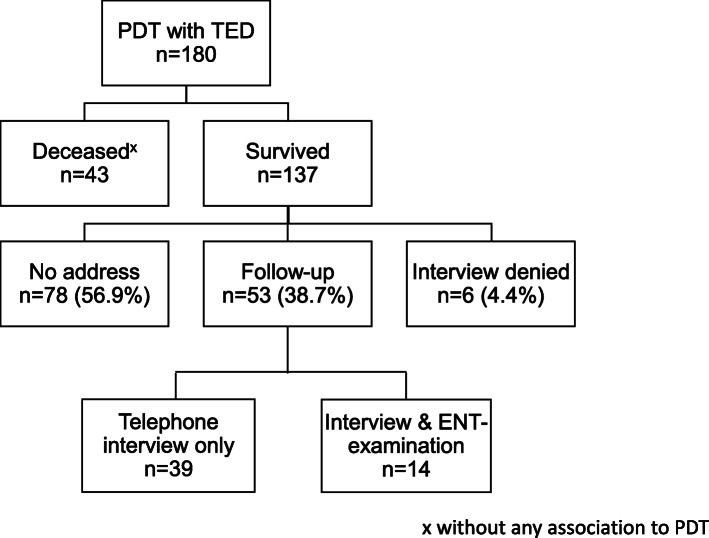
Of 180 patients who received tracheostomy, 137 (76.1%) were alive at the time of follow-up. None of the 43 lethal events was related to the PDT. Fifty-three (38.7%) patients were available for follow-up examination, whereas 14 (10.2%) were able to visit ENT physicians. Two (3.8%) out of 53 patients developed tracheocutaneous fistula with required surgical closure of tracheostoma. Dyspnea (7.5%), hoarseness (5.7%), stridor and swallowing difficulties (both with 3.8%) were the most common complaints. Tracheal stenosis was confirmed in 1 patient (1.88% [95% CI: 0.33; 9.93]).
The use of TED for PDT in the clinical setting is safe regarding adverse events at 6-month follow-up. The incidence of tracheal stenosis after PDT with TED is comparable with that of flexible bronchoscopy; however, its role for PDT at the intensive care unit should be clarified in further investigations.
刚性气管切开内窥镜(TED)最近被引入,以改善经皮扩张气管切开术(PDT)过程中的光纤技术。目的是通过前瞻性多中心研究评估使用 TED 设备进行 PDT 的长期并发症。
在德国的四家医院中,180 名成年患者使用 TED 进行 PDT。通过电话联系并使用结构化问卷对术后 6 个月的患者或其监护人进行访谈。对有气道投诉的患者邀请进行门诊耳鼻喉科临床检查。记录与 PDT 相关的不良事件的发生率。
在接受气管切开术的 180 名患者中,137 名(76.1%)在随访时存活。43 例致死事件均与 PDT 无关。53 名(38.7%)患者可进行随访检查,14 名(10.2%)患者可就诊耳鼻喉科医生。53 名患者中有 2 名(3.8%)发生气管切开瘘,需要手术关闭气管造口。呼吸困难(7.5%)、声音嘶哑(5.7%)、喘鸣和吞咽困难(均为 3.8%)是最常见的症状。1 名患者(1.88%[95%CI:0.33;9.93])确诊为气管狭窄。
在临床环境中使用 TED 进行 PDT 在 6 个月随访时不良事件的发生是安全的。TED 进行 PDT 后发生气管狭窄的发生率与使用软性支气管镜相似;然而,其在重症监护病房进行 PDT 的作用应在进一步的研究中阐明。