Department of Anesthesiology, Critical Care and Burn Center, Lariboisière - Saint-Louis Hospitals, DMU Parabol, AP-HP Nord, University of Paris, Paris, France.
Inserm UMR-S 942, Cardiovascular Markers in Stress Conditions (MASCOT), University of Paris, 2 rue Ambroise Paré, 75010, Paris, France.
Crit Care. 2021 Feb 15;25(1):61. doi: 10.1186/s13054-021-03471-2.
Dipeptidyl peptidase 3 (DPP3) is a cytosolic enzyme involved in the degradation of various cardiovascular and endorphin mediators. High levels of circulating DPP3 (cDPP3) indicate a high risk of organ dysfunction and mortality in cardiogenic shock patients.
The aim was to assess relationships between cDPP3 during the initial intensive care unit (ICU) stay and short-term outcome in the AdrenOSS-1, a prospective observational multinational study in twenty-four ICU centers in five countries. AdrenOSS-1 included 585 patients admitted to the ICU with severe sepsis or septic shock. The primary outcome was 28-day mortality. Secondary outcomes included organ failure as defined by the Sequential Organ Failure Assessment (SOFA) score, organ support with focus on vasopressor/inotropic use and need for renal replacement therapy. cDPP3 levels were measured upon admission and 24 h later.
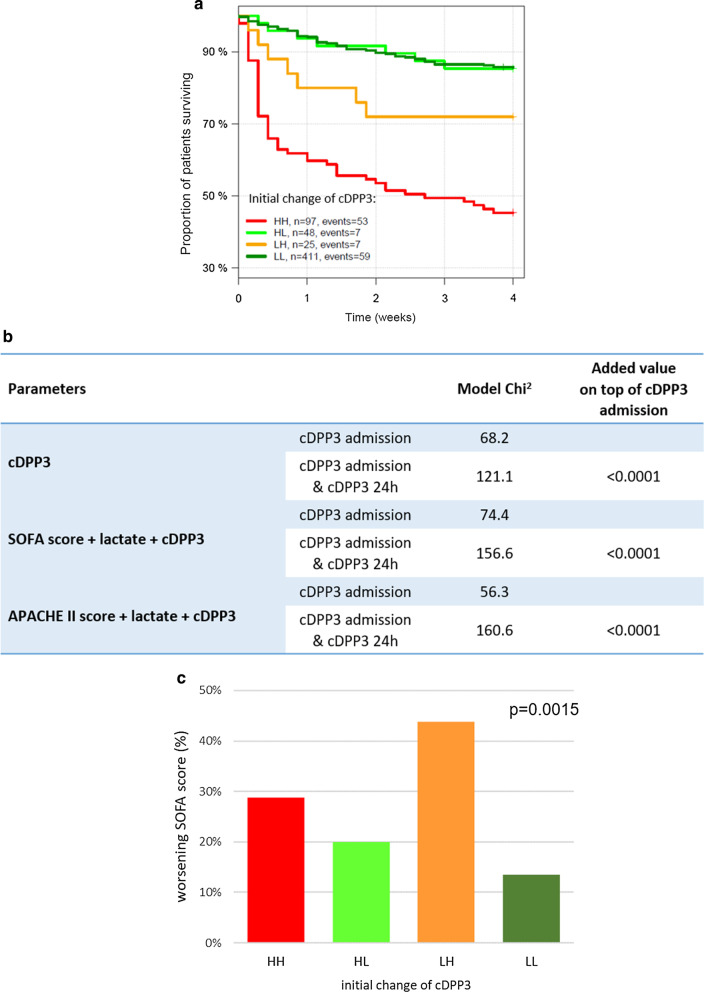
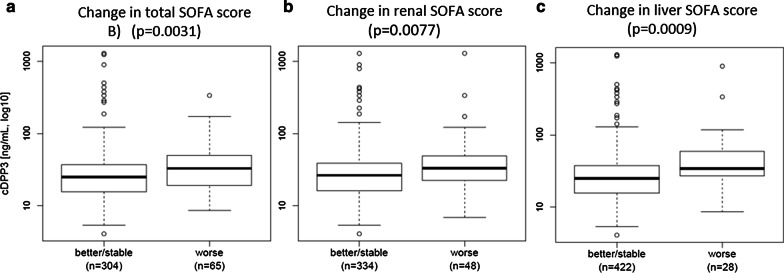
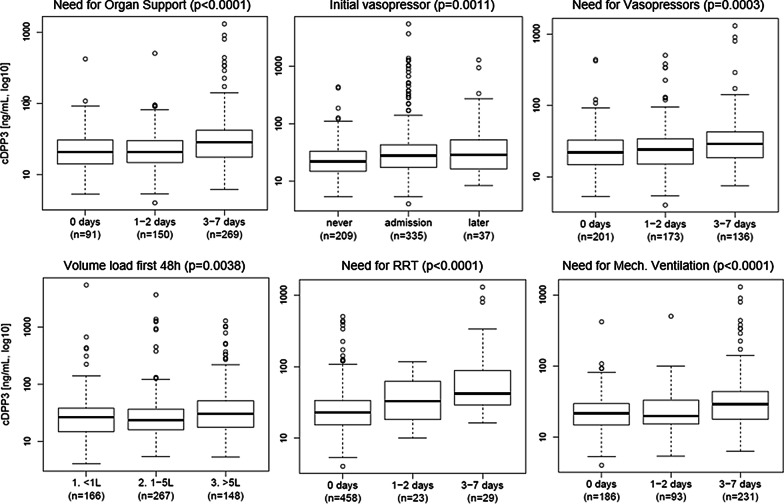
Median [IQR] cDPP3 concentration upon admission was 26.5 [16.2-40.4] ng/mL. Initial SOFA score was 7 [5-10], and 28-day mortality was 22%. We found marked associations between cDPP3 upon ICU admission and 28-day mortality (unadjusted standardized HR 1.8 [CI 1.6-2.1]; adjusted HR 1.5 [CI 1.3-1.8]) and between cDPP3 levels and change in renal and liver SOFA score (p = 0.0077 and 0.0009, respectively). The higher the initial cDPP3 was, the greater the need for organ support and vasopressors upon admission; the longer the need for vasopressor(s), mechanical ventilation or RRT and the higher the need for fluid load (all p < 0.005). In patients with cDPP3 > 40.4 ng/mL upon admission, a decrease in cDPP3 below 40.4 ng/mL after 24 h was associated with an improvement of organ function at 48 h and better 28-day outcome. By contrast, persistently elevated cDPP3 at 24 h was associated with worsening organ function and high 28-day mortality.
Admission levels and rapid changes in cDPP3 predict outcome during sepsis. Trial Registration ClinicalTrials.gov, NCT02393781. Registered on March 19, 2015.
二肽基肽酶 3(DPP3)是一种参与多种心血管和内啡肽介质降解的胞质酶。循环中二肽基肽酶 3(cDPP3)水平升高表明心源性休克患者发生器官功能障碍和死亡的风险较高。
本研究旨在评估在 AdrenOSS-1 中,患者在入住重症监护病房(ICU)初始阶段的 cDPP3 水平与短期预后之间的关系。这是一项在五个国家的 24 个 ICU 中心进行的前瞻性观察性多国研究。AdrenOSS-1 纳入了 585 例因严重败血症或感染性休克而入住 ICU 的患者。主要结局为 28 天死亡率。次要结局包括由序贯器官衰竭评估(SOFA)评分定义的器官衰竭、以升压/正性肌力药使用和肾脏替代治疗为重点的器官支持。在入住 ICU 时和 24 小时后测量 cDPP3 水平。
入住 ICU 时的中位(IQR)cDPP3 浓度为 26.5[16.2-40.4]ng/ml。初始 SOFA 评分为 7[5-10],28 天死亡率为 22%。我们发现,入住 ICU 时的 cDPP3 与 28 天死亡率之间存在显著关联(未调整的标准化 HR 1.8[1.6-2.1];调整后的 HR 1.5[1.3-1.8]),以及 cDPP3 水平与肾脏和肝脏 SOFA 评分变化之间存在显著关联(p=0.0077 和 0.0009)。初始 cDPP3 越高,入院时对器官支持和升压药的需求越大;升压药的使用时间越长、机械通气或 RRT 的需求越高,以及对液体负荷的需求越大(均 p<0.005)。在入院时 cDPP3>40.4ng/ml 的患者中,24 小时后 cDPP3 下降至 40.4ng/ml 以下与 48 小时时器官功能的改善和 28 天的良好预后相关。相比之下,24 小时时持续升高的 cDPP3 与器官功能恶化和 28 天死亡率高相关。
败血症期间,入院时的 cDPP3 水平和其快速变化可预测预后。
ClinicalTrials.gov,NCT02393781。注册于 2015 年 3 月 19 日。