Novo Nordisk Foundation Center for Basic Metabolic Research, Faculty of Health and Medical Sciences, University of Copenhagen, Copenhagen, Denmark.
Section of Molecular Physiology, Department of Nutrition, Exercise and Sports, Faculty of Science, University of Copenhagen, Copenhagen, Denmark.
Nat Commun. 2021 Feb 15;12(1):1041. doi: 10.1038/s41467-021-21309-x.
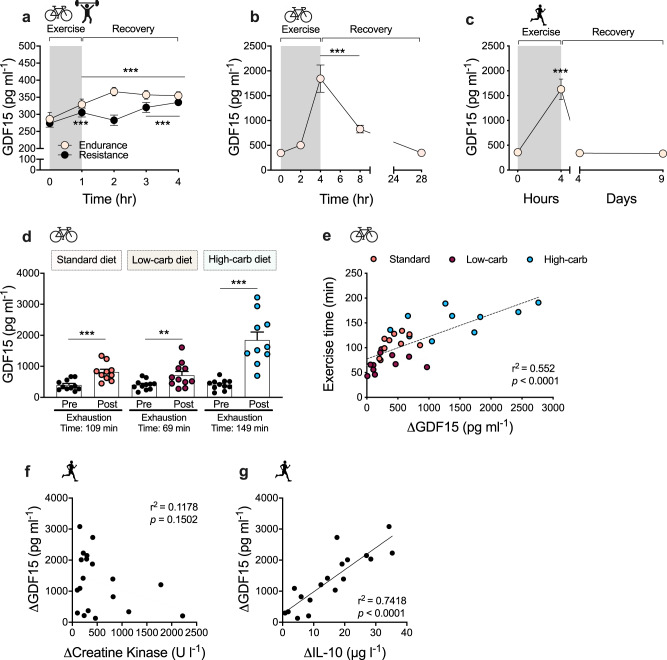
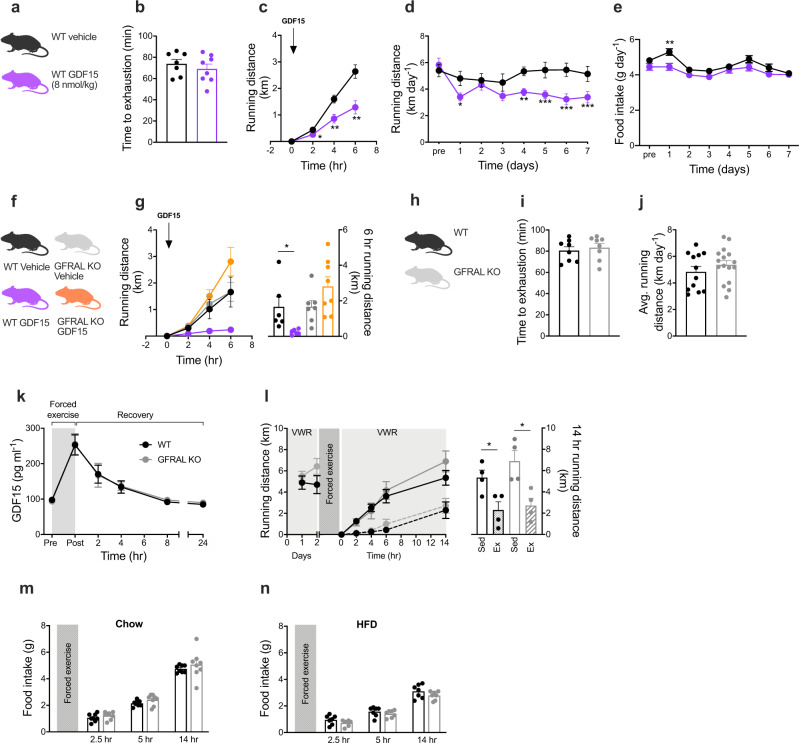
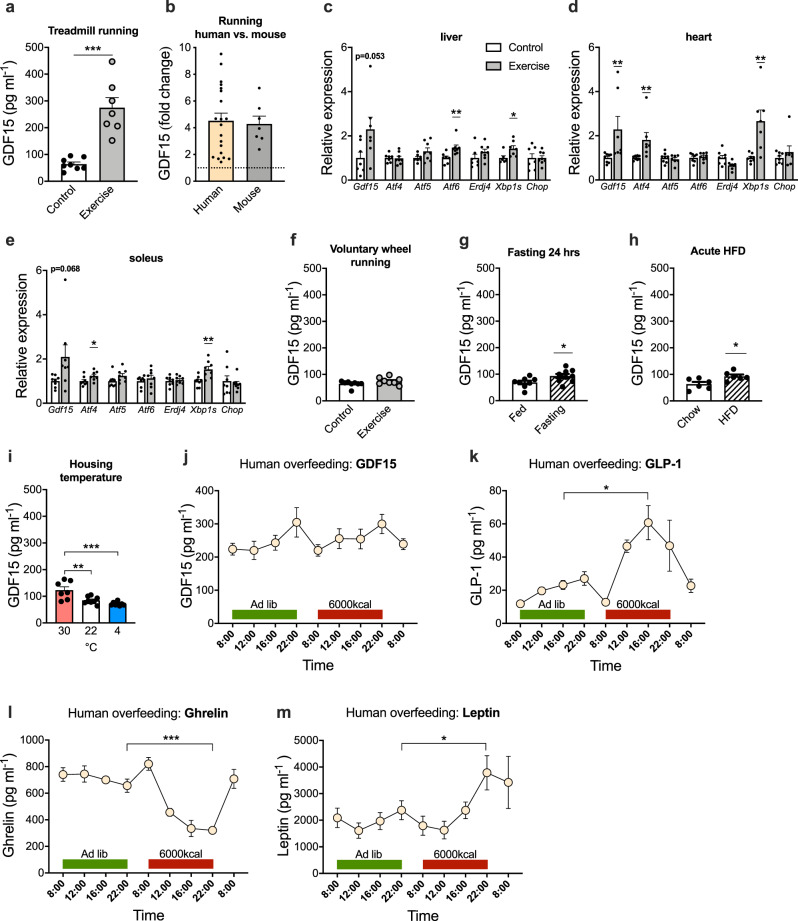
Growing evidence supports that pharmacological application of growth differentiation factor 15 (GDF15) suppresses appetite but also promotes sickness-like behaviors in rodents via GDNF family receptor α-like (GFRAL)-dependent mechanisms. Conversely, the endogenous regulation of GDF15 and its physiological effects on energy homeostasis and behavior remain elusive. Here we show, in four independent human studies that prolonged endurance exercise increases circulating GDF15 to levels otherwise only observed in pathophysiological conditions. This exercise-induced increase can be recapitulated in mice and is accompanied by increased Gdf15 expression in the liver, skeletal muscle, and heart muscle. However, whereas pharmacological GDF15 inhibits appetite and suppresses voluntary running activity via GFRAL, the physiological induction of GDF15 by exercise does not. In summary, exercise-induced circulating GDF15 correlates with the duration of endurance exercise. Yet, higher GDF15 levels after exercise are not sufficient to evoke canonical pharmacological GDF15 effects on appetite or responsible for diminishing exercise motivation.
越来越多的证据表明,生长分化因子 15(GDF15)的药理学应用通过 GDNF 家族受体 α 样(GFRAL)依赖性机制抑制食欲,但也促进了啮齿动物的类似疾病的行为。相反,GDF15 的内源性调节及其对能量平衡和行为的生理影响仍然难以捉摸。在这里,我们在四项独立的人类研究中表明,长时间的耐力运动可增加循环 GDF15 水平,而这种水平仅在病理生理条件下才能观察到。这种运动引起的增加可以在小鼠中重现,并伴有肝脏、骨骼肌和心肌中 Gdf15 表达的增加。然而,虽然 GDF15 可通过 GFRAL 抑制食欲并抑制自愿跑步活动,但运动引起的 GDF15 生理诱导却不能。总之,运动引起的循环 GDF15 与耐力运动的持续时间相关。然而,运动后 GDF15 水平升高不足以引起 GDF15 对食欲的经典药理学作用,也不足以减少运动动机。