Ecology and Evolutionary Biology, University of Colorado, Boulder, CO, USA.
UNM Biology, University of New Mexico, Albuquerque, NM, Mexico.
Nat Commun. 2021 Feb 15;12(1):1019. doi: 10.1038/s41467-021-21340-y.
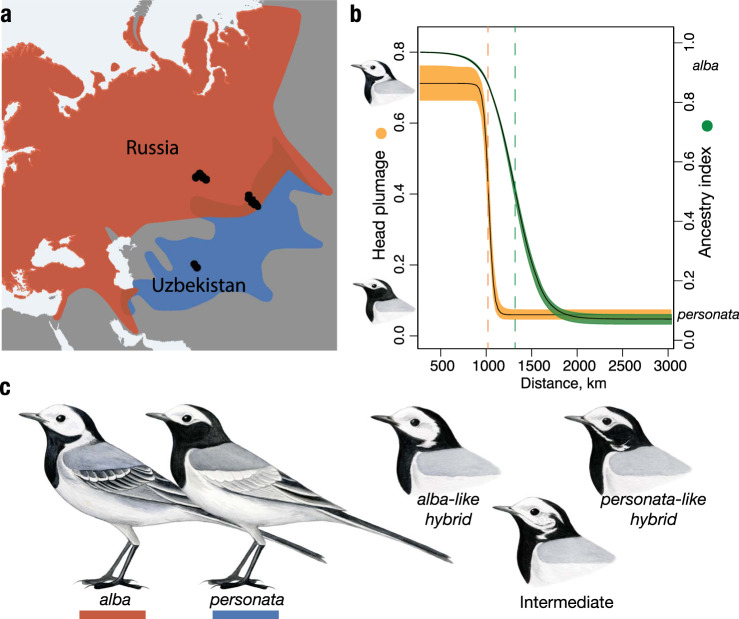
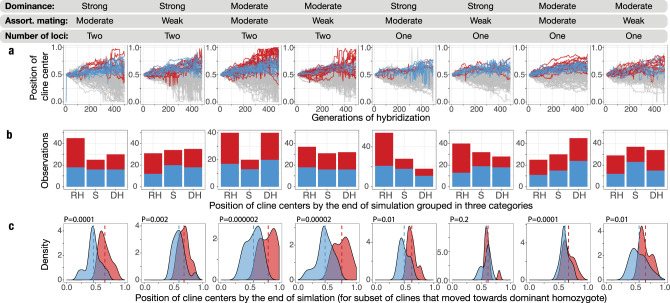
Genome-wide variation in introgression rates across hybrid zones offers a powerful opportunity for studying population differentiation. One poorly understood pattern of introgression is the geographic displacement of a trait implicated in lineage divergence from genome-wide population boundaries. While difficult to interpret, this pattern can facilitate the dissection of trait genetic architecture because traits become uncoupled from their ancestral genomic background. We studied an example of trait displacement generated by the introgression of head plumage coloration from personata to alba subspecies of the white wagtail. A previous study of their hybrid zone in Siberia revealed that the geographic transition in this sexual signal that mediates assortative mating was offset from other traits and genetic markers. Here we show that head plumage is associated with two small genetic regions. Despite having a simple genetic architecture, head plumage inheritance is consistent with partial dominance and epistasis, which could contribute to its asymmetric introgression.
基因组范围内的杂交区渗入率变化为研究种群分化提供了一个强有力的机会。一种未被充分理解的渗入模式是与谱系分化有关的特征从全基因组种群边界的地理位移。虽然难以解释,但这种模式可以促进特征遗传结构的剖析,因为特征与其祖先的基因组背景解耦。我们研究了一个特征位移的例子,该例子是由白头鹡鸰的 personata 亚种到 alba 亚种的头部羽毛颜色的渗入引起的。之前对它们在西伯利亚的杂交区的研究表明,这种介导交配选择的性信号的地理过渡与其他特征和遗传标记不同。在这里,我们表明头部羽毛与两个小的遗传区域有关。尽管遗传结构简单,但头部羽毛的遗传与部分显性和上位性一致,这可能导致其不对称的渗入。