Agroscope, Forage Production and Grassland Systems, Reckenholzstrasse 191, 8046, Zurich, Switzerland.
Sci Rep. 2021 Feb 15;11(1):3835. doi: 10.1038/s41598-021-82162-y.
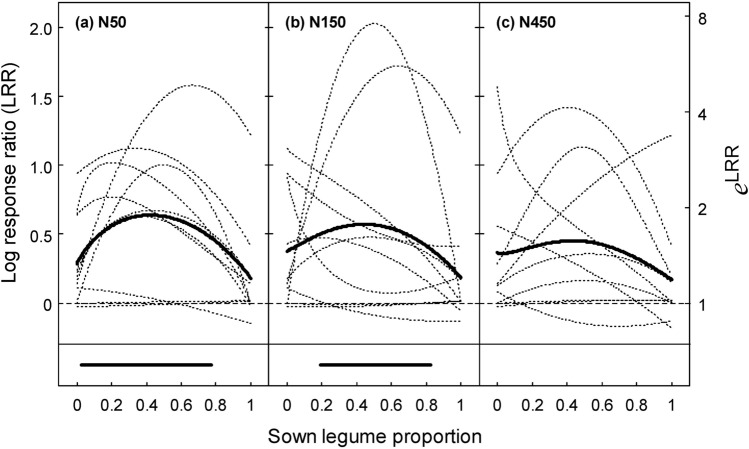
Assessing the overall performance of ecosystems requires a quantitative evaluation of multifunctionality. We investigated plant species diversity effects on individual functions and overall multifunctionality in a grassland experiment with sown monocultures and mixtures comprising four key grass and legume species. Nitrogen fertilisation rates were 50, 150, and 450 kg N ha yr (N50, N150, N450). Ten functions were measured representing forage production, N cycling, and forage quality, all being related to either productivity or environmental footprint. Multifunctionality was analysed by a novel approach using the mean log response ratio across functions. Over three experimental years, mixture effects benefited all forage production and N cycling functions, while sustaining high forage quality. Thus, mixture effects did not provoke any trade-off among the analysed functions. High N fertilisation rates generally diminished mixture benefits. Multifunctionality of four-species mixtures was considerably enhanced, and mixture overall performance was up to 1.9 (N50), 1.8 (N150), and 1.6 times (N450) higher than in averaged monocultures. Multifunctionality of four-species mixtures at N50 was at least as high as in grass monocultures at N450. Sown grass-legume mixtures combining few complementary species at low to moderate N fertilisation sustain high multifunctionality and are a 'ready-to-use' option for the sustainable intensification of agriculture.
评估生态系统的整体性能需要对多功能性进行定量评估。我们在一个草原实验中研究了播种的单种和包含四种关键草和豆科植物的混合物的植物物种多样性对单个功能和整体多功能性的影响。氮肥施用量分别为 50、150 和 450 kg N ha yr(N50、N150、N450)。测量了 10 种功能,代表饲料产量、氮循环和饲料质量,所有这些功能都与生产力或环境足迹有关。多功能性通过一种新的方法进行分析,该方法使用跨功能的平均对数响应比。在三个实验年中,混合物效应使所有饲料产量和氮循环功能受益,同时保持高饲料质量。因此,混合物效应没有在分析的功能之间产生任何权衡。高氮肥施用量通常会降低混合物的效益。四物种混合物的多功能性显著增强,混合物的整体性能高达 1.9(N50)、1.8(N150)和 1.6 倍(N450)高于平均单种培养物。在 N50 下,四物种混合物的多功能性至少与 N450 下的草单种培养物一样高。在低至中等氮肥施肥条件下播种的草-豆科混合物种结合了少数互补物种,维持了较高的多功能性,是可持续农业集约化的“即用型”选择。