Department of Extension Education, College of Agriculture, Benguet State University, Benguet, Philippines.
HPS Division, University of Cape Town, Cape Town, South Africa.
Int J Health Policy Manag. 2021 Jul 1;10(7):402-413. doi: 10.34172/ijhpm.2020.246.
Indigenous peoples are among the most marginalized groups in society. In the Philippines, a new policy aimed at ensuring equity and culture-sensitivity of health services for this population was introduced. The study aimed to determine how subnational health managers exercised power and with what consequences for how implementation unfolded. Power is manifested in the perception, decision and action of health system actors. The study also delved into the sources of power that health managers drew on and their reasons for exercising power.
The study was a qualitative case study employing in-depth semi-structured interviews with 26 health managers from the case region and analysis of 15 relevant documents. Data from both sources were thematically analyzed following the framework method. In the analysis and interpretation of data on power, VeneKlasen and Miller's categorization of the sources and expressions of power and Gilson, Schneider and Orgill's categorization of the sources and reasons for exercising power were utilized.
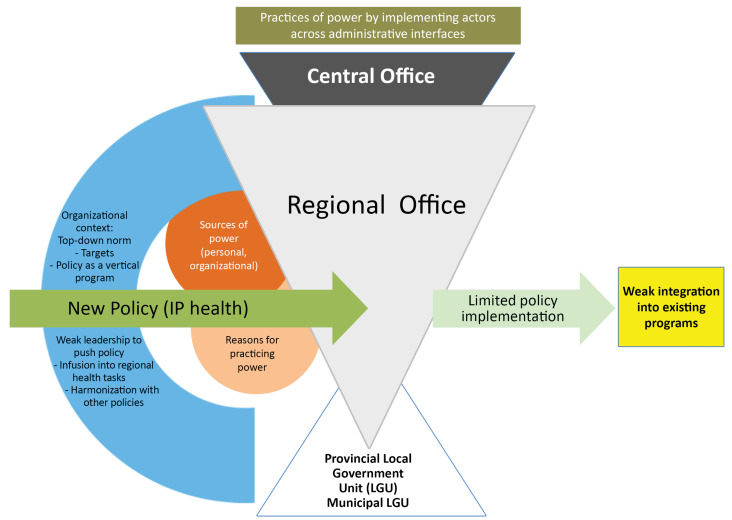
Key managers in the case region perceived the implementation of the new Indigenous health policy as limited and weakly integrated into health operations. The forms of power exercised by actors in key administrative interfaces were greatly influenced by organizational context and perceived weak leadership and their practices of power hindered policy implementation. However, some positive experiences showed that personal commitment and motivation rooted in one's indigeneity enabled program managers to mobilize their discretionary power to support policy implementation.
The way power is exercised by policy actors at key interfaces influences the implementation and uptake of the Indigenous policy by the health system. Middle managers are strategic actors in translating central directions to operational action down to frontlines. Indigenous program managers are most likely to support an Indigenous health policy but personal and organizational factors can also override this inclination.
土著人民是社会中最边缘化的群体之一。在菲律宾,出台了一项新政策,旨在确保为这一人群提供公平和文化敏感的卫生服务。本研究旨在确定国家以下各级卫生管理者如何行使权力,以及这对实施工作的展开产生了怎样的影响。权力体现在卫生系统行为者的感知、决策和行动中。本研究还深入探讨了卫生管理者利用的权力来源及其行使权力的原因。
本研究采用定性案例研究方法,对案例地区的 26 名卫生管理者进行了深入的半结构化访谈,并对 15 份相关文件进行了分析。对来自这两个来源的数据进行了主题分析,采用的是框架方法。在对权力相关数据进行分析和解释时,利用了 VeneKlasen 和 Miller 对权力来源和表现形式的分类,以及 Gilson、Schneider 和 Orgill 对行使权力的来源和原因的分类。
案例地区的主要管理者认为新的土著卫生政策的实施受到限制,且与卫生业务的结合程度较低。关键行政接口中的行为者行使的权力形式受到组织背景和领导力感知的强烈影响,他们的权力实践阻碍了政策的实施。然而,一些积极的经验表明,根植于个人土著身份的个人承诺和动力使方案管理者能够调动他们的自由裁量权来支持政策的实施。
政策行为者在关键接口行使权力的方式影响着卫生系统对土著政策的实施和采用。中层管理者是将中央指示转化为基层行动的战略行为者。土著方案管理者最有可能支持土著卫生政策,但个人和组织因素也可能会凌驾于这种倾向之上。