Department of Medicine, Faculty of Medicine, Chulalongkorn University, Bangkok, Thailand.
Excellence Center for Critical Care Nephrology, King Chulalongkorn Memorial Hospital, Thai Red Cross Society, Bangkok, Thailand.
J Clin Lab Anal. 2021 Apr;35(4):e23729. doi: 10.1002/jcla.23729. Epub 2021 Feb 16.
Chronic kidney disease (CKD) is a significant global health issue. As the prevalence of renal replacement therapy (RRT) in Thailand is increasing, early detection and management of CKD is the most important step to prevent CKD progression and the need for RRT. Current diagnostic tests for CKD are non-specific and expensive. We aimed to develop and validate antibody-based-albumin point-of-care testing (POCT) to detect patients with impaired kidney function at early stage.
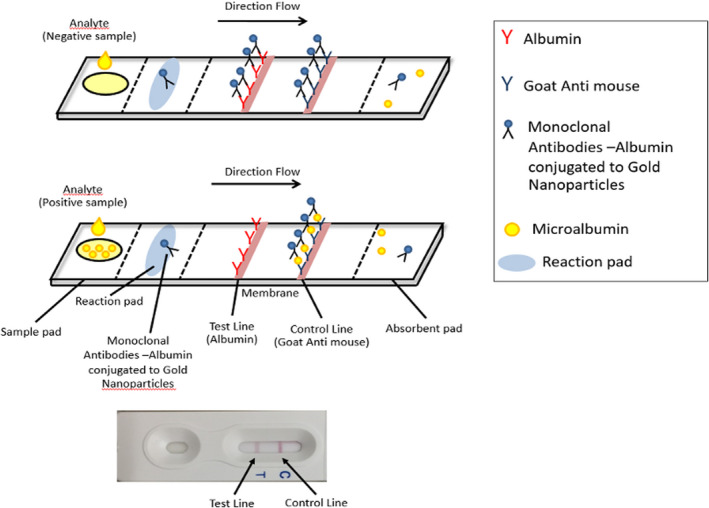
The prototype strip test was developed under the concept of competitive lateral flow immunochromatography assay, or strip test. Monoclonal antibodies (MAbs) to human serum albumin (HSA) were harvested from the hybridomas of spleen cells from immunized mice and mouse myeloma cells. Presence of MAbs was detected by enzyme-linked immunosorbent assay (ELISA). Spot urine was obtained from patients with kidney disease, type I, or type II Diabetes Mellitus upon their visit at King Chulalongkorn Memorial Hospital during 2018-2019. All samples were analyzed for urine albumin with our POCT (CU microalbumin) and the other two commercial POCTs (Microalbu PHAN and MICRAL). The results were validated against standard method for urine microalbumin measurement. A urine microalbumin concentration of less than 20 ug/ml was defined as normal. The sensitivity, specificity, and predictive values were calculated in comparison with the standard laboratory method.
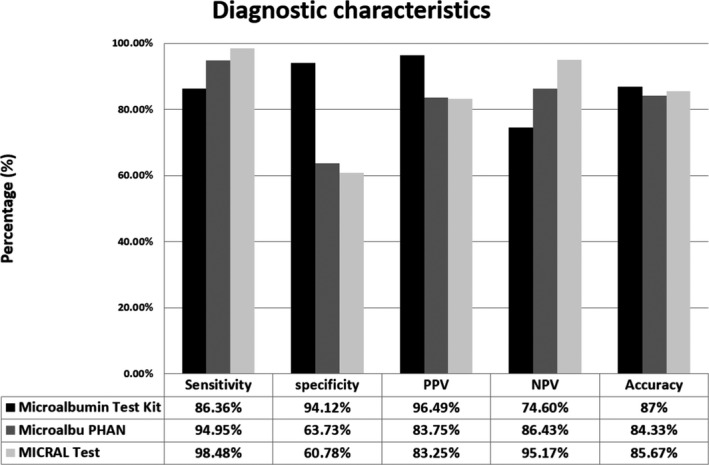
A total of 100 adult patients were included. CU microalbumin had a sensitivity of 86%, a specificity of 94%, and a positive predictive value of 96%. Our POCT showed good correlation with the laboratory results.
CU microalbumin correlated well with the standard method for quantitative measurement of urine albumin. Therefore, it has the potential for early screening of CKD, especially in primary health care facilities in resource limited settings.
慢性肾脏病(CKD)是一个重大的全球健康问题。随着泰国肾脏替代疗法(RRT)的患病率不断增加,早期发现和管理 CKD 是预防 CKD 进展和需要 RRT 的最重要步骤。目前用于 CKD 的诊断测试是非特异性且昂贵的。我们旨在开发和验证基于抗体的白蛋白即时检测(POCT),以在早期阶段检测肾功能受损的患者。
原型条带测试是根据竞争性侧向流动免疫层析测定或条带测试的概念开发的。从免疫小鼠脾细胞和骨髓瘤细胞的杂交瘤中收获针对人血清白蛋白(HSA)的单克隆抗体(MAb)。通过酶联免疫吸附试验(ELISA)检测 MAb 的存在。2018-2019 年,在朱拉隆功国王纪念医院就诊的肾病、1 型或 2 型糖尿病患者获得点尿样本。使用我们的 POCT(CU 微量白蛋白)和另外两种商业 POCT(Microalbu PHAN 和 MICRAL)分析所有样本的尿白蛋白。将结果与尿液微量白蛋白测量的标准方法进行验证。尿微量白蛋白浓度小于 20 ug/ml 定义为正常。与标准实验室方法相比,计算了敏感性、特异性和预测值。
共纳入 100 例成年患者。CU 微量白蛋白的敏感性为 86%,特异性为 94%,阳性预测值为 96%。我们的 POCT 与实验室结果相关性良好。
CU 微量白蛋白与尿液白蛋白定量测量的标准方法相关性良好。因此,它具有用于早期筛查 CKD 的潜力,尤其是在资源有限环境下的基层医疗保健设施中。