University of Jyväskylä, Jyväskylä, Finland.
University College Dublin, Dublin, Ireland.
Behav Modif. 2022 Jul;46(4):782-798. doi: 10.1177/0145445521994308. Epub 2021 Feb 16.
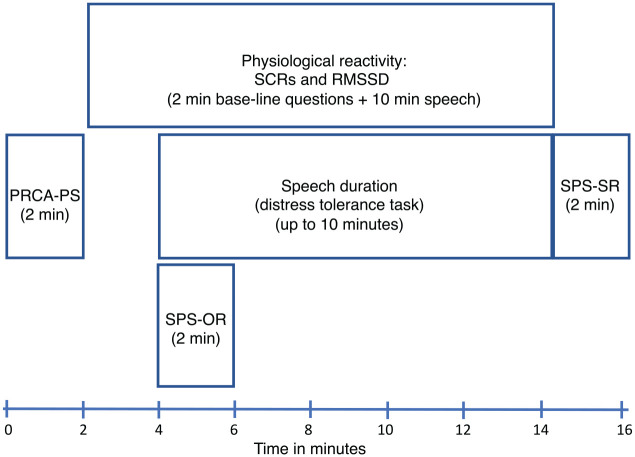
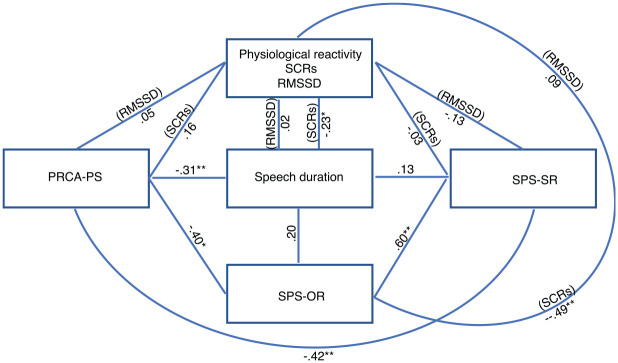
Self-reports are typically used to assess public speaking anxiety. In this study, we examined whether self-report, observer report, and behavioral and physiological reactivity were associated with each other during a speech challenge task. A total of 95 university students completed a self-report measure of public speaking anxiety before and after the speech challenge. Speech duration (i.e., behavioral measure), physiological reactivity, as well as speech performance evaluated by the participants and observers were also recorded. The results suggest that self-reported public speaking anxiety predicts speech duration, as well as speech quality, as rated by the participants themselves and observers. However, the physiological measures were not associated with self-reported anxiety during the speech task. Additionally, we observed that socially anxious participants underrate their speech performance in comparison to their observers' evaluations.
自我报告通常用于评估公众演讲焦虑。在这项研究中,我们研究了在演讲挑战任务期间,自我报告、观察者报告和行为及生理反应之间是否存在关联。共有 95 名大学生在演讲挑战前后完成了一份公众演讲焦虑的自我报告量表。演讲时长(即行为测量)、生理反应以及参与者和观察者评估的演讲表现也被记录下来。结果表明,自我报告的公众演讲焦虑预测了演讲时长,以及参与者自身和观察者评定的演讲质量。然而,在演讲任务期间,生理测量与自我报告的焦虑无关。此外,我们观察到,社交焦虑的参与者对自己的演讲表现的评价低于观察者的评价。