Department of Energy, Environmental and Chemical Engineering, Washington University, St. Louis, Missouri, USA.
Department of Biology, Washington University, St. Louis, Missouri, USA.
mBio. 2021 Feb 16;12(1):e03663-20. doi: 10.1128/mBio.03663-20.
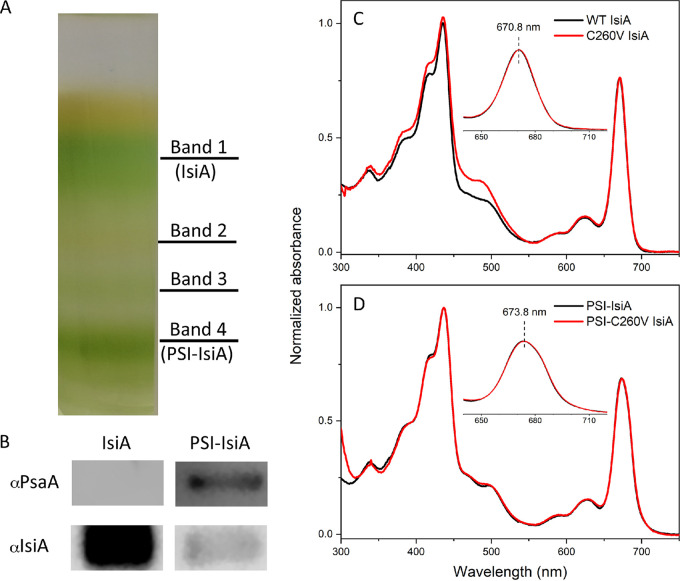
Oxygenic photosynthetic organisms have evolved a multitude of mechanisms for protection against high-light stress. IsiA, a chlorophyll -binding cyanobacterial protein, serves as an accessory antenna complex for photosystem I. Intriguingly, IsiA can also function as an independent pigment protein complex in the thylakoid membrane and facilitate the dissipation of excess energy, providing photoprotection. The molecular basis of the IsiA-mediated excitation quenching mechanism remains poorly understood. In this study, we demonstrate that IsiA uses a novel cysteine-mediated process to quench excitation energy. The single cysteine in IsiA in the cyanobacterium sp. strain PCC 6803 was converted to a valine. Ultrafast fluorescence spectroscopic analysis showed that this single change abolishes the excitation energy quenching ability of IsiA, thus providing direct evidence of the crucial role of this cysteine residue in energy dissipation from excited chlorophylls. Under stress conditions, the mutant cells exhibited enhanced light sensitivity, indicating that the cysteine-mediated quenching process is critically important for photoprotection. Cyanobacteria, oxygenic photosynthetic microbes, constantly experience varying light regimes. Light intensities higher than those that saturate the photosynthetic capacity of the organism often lead to redox damage to the photosynthetic apparatus and often cell death. To meet this challenge, cyanobacteria have developed a number of strategies to modulate light absorption and dissipation to ensure maximal photosynthetic productivity and minimal photodamage to cells under extreme light conditions. In this communication, we have determined the critical role of a novel cysteine-mediated mechanism for light energy dissipation in the chlorophyll protein IsiA.
好氧光合生物已经进化出多种机制来防止高光胁迫。IsiA 是一种结合叶绿素的蓝细菌蛋白,作为光系统 I 的辅助天线复合物。有趣的是,IsiA 也可以作为类囊体膜中的独立色素蛋白复合物发挥作用,并促进过剩能量的耗散,提供光保护。IsiA 介导的激发猝灭机制的分子基础仍知之甚少。在这项研究中,我们证明了 IsiA 使用一种新的半胱氨酸介导的过程来猝灭激发能。蓝藻 sp. PCC 6803 中的 IsiA 中的单个半胱氨酸被转化为缬氨酸。超快荧光光谱分析表明,这种单一变化会破坏 IsiA 的激发能猝灭能力,从而为该半胱氨酸残基在激发态叶绿素能量耗散中的关键作用提供了直接证据。在应激条件下,突变细胞表现出增强的光敏感性,表明半胱氨酸介导的猝灭过程对光保护至关重要。蓝细菌是进行需氧光合作用的微生物,它们经常面临着不同的光照条件。高于使生物体光合作用能力饱和的光强通常会导致光合作用装置的氧化还原损伤,并且经常导致细胞死亡。为了应对这一挑战,蓝细菌已经开发了多种策略来调节光吸收和耗散,以确保在极端光照条件下最大限度地提高光合作用生产力和最小化细胞的光损伤。在本通讯中,我们确定了一种新型半胱氨酸介导的机制在叶绿素蛋白 IsiA 中的光能耗散中起关键作用。