Department of Livestock and One Health, Institute of Infection, Veterinary & Ecological Sciences, University of Liverpool, Liverpool, UK.
Department of Mathematical Sciences, University of Liverpool, Liverpool, UK.
Nat Commun. 2021 Feb 16;12(1):780. doi: 10.1038/s41467-021-21034-5.
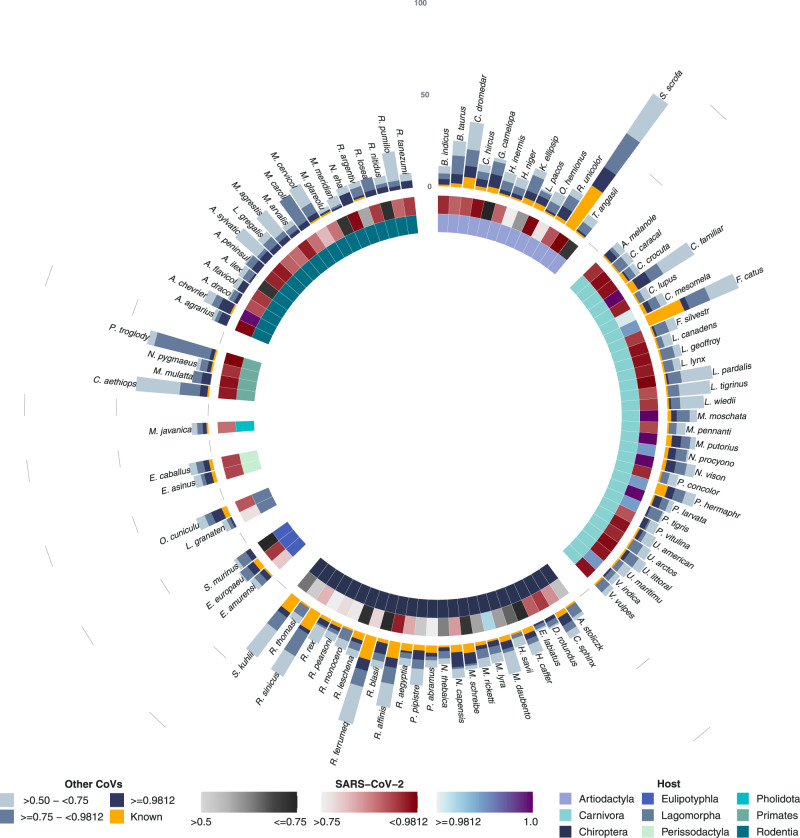
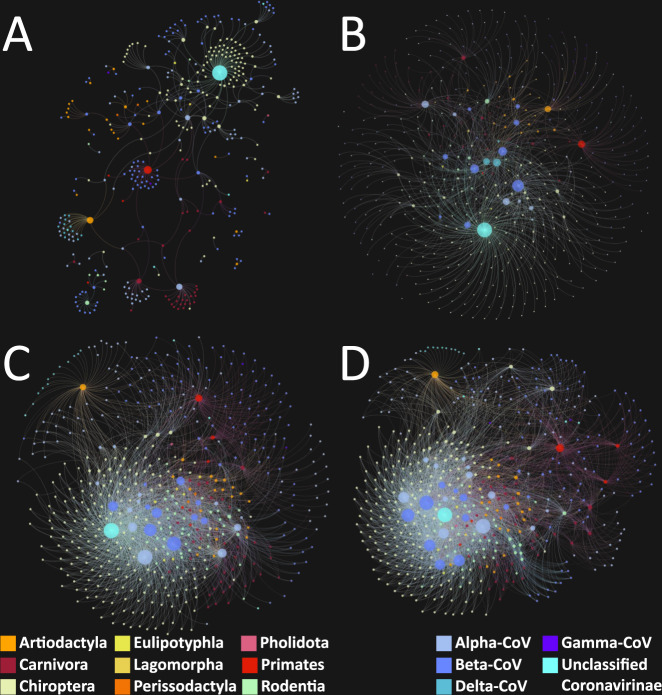
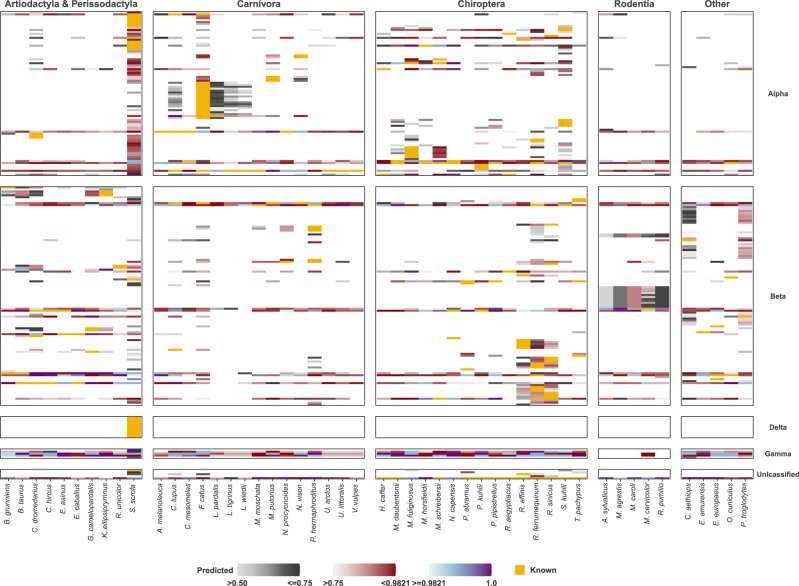
Novel pathogenic coronaviruses - such as SARS-CoV and probably SARS-CoV-2 - arise by homologous recombination between co-infecting viruses in a single cell. Identifying possible sources of novel coronaviruses therefore requires identifying hosts of multiple coronaviruses; however, most coronavirus-host interactions remain unknown. Here, by deploying a meta-ensemble of similarity learners from three complementary perspectives (viral, mammalian and network), we predict which mammals are hosts of multiple coronaviruses. We predict that there are 11.5-fold more coronavirus-host associations, over 30-fold more potential SARS-CoV-2 recombination hosts, and over 40-fold more host species with four or more different subgenera of coronaviruses than have been observed to date at >0.5 mean probability cut-off (2.4-, 4.25- and 9-fold, respectively, at >0.9821). Our results demonstrate the large underappreciation of the potential scale of novel coronavirus generation in wild and domesticated animals. We identify high-risk species for coronavirus surveillance.
新型致病性冠状病毒——如 SARS-CoV 和可能的 SARS-CoV-2——是由同一细胞中感染的病毒之间的同源重组产生的。因此,确定新型冠状病毒的可能来源需要确定多种冠状病毒的宿主;然而,大多数冠状病毒-宿主相互作用仍然未知。在这里,我们通过部署来自三个互补视角(病毒、哺乳动物和网络)的相似性学习者的元集合,预测哪些哺乳动物是多种冠状病毒的宿主。我们预测,与迄今为止观察到的 >0.5 平均概率截止值相比,冠状病毒-宿主关联的数量增加了 11.5 倍,SARS-CoV-2 重组宿主的数量增加了 30 多倍,具有 4 种或更多不同亚属冠状病毒的宿主物种的数量增加了 40 多倍(分别为 2.4、4.25 和 9 倍,>0.9821)。我们的研究结果表明,在野生动物和驯养动物中,新型冠状病毒产生的潜在规模被严重低估。我们确定了需要进行冠状病毒监测的高风险物种。