Dadkhah-Tirani Heidar, Salari Arsalan, Ashouri Asieh, Nouri-Saeed Azam, Javadzadeh-Moghtader Arezoo
Associate Professor, Cardiovascular Diseases Research Center AND Department of Cardiology, Heshmat Hospital, School of Medicine, Guilan University of Medical Sciences, Rasht, Iran.
Professor, Cardiovascular Diseases Research Center AND Department of Cardiology, Heshmat Hospital, School of Medicine, Guilan University of Medical Sciences, Rasht, Iran.
ARYA Atheroscler. 2020 Jul;16(4):185-191. doi: 10.22122/arya.v16i4.1955.
Depression is closely related to coronary artery disease (CAD). However, the association of depression before angiography with major adverse cardiovascular event (MACE) is still unknown.
In a prospective cohort study, 410 patients underwent angiography for the first time between 2016 and 2017 in Dr. Heshmat Hospital, Rasht, Iran. Demographic and medical information were collected and depressive symptoms were assessed using Beck Depression Inventory-II (BDI-II). The patients were followed for one year after angiography. Chi-square test and analysis of variance (ANOVA) were performed to compare demographic and clinical characteristics of patients between different levels of depressive symptoms. Multiple Cox regression analysis was performed to assess the association between depression symptoms before angiography and MACE rate controlled for the effect of confounders.
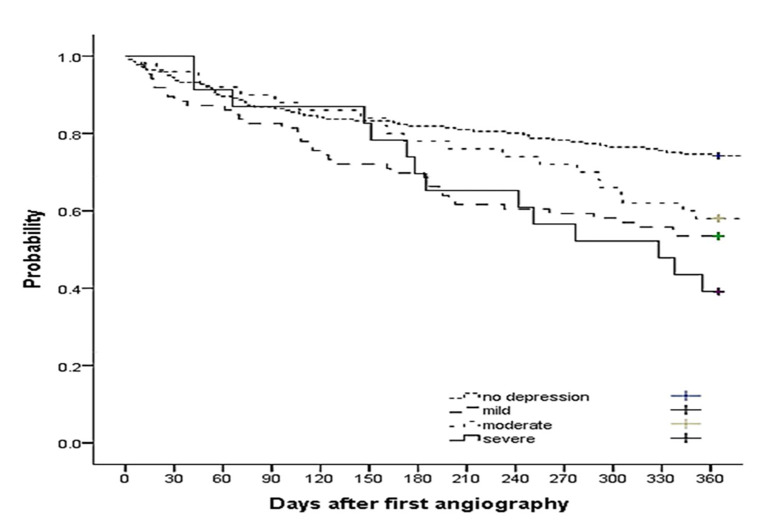
Of 410 patients, follow-up data were available for 380 (95%) patients. the MACE occurred in 134 (35%) patients. Depressive symptoms were observed in 42% of patients. Based on multivariable Cox regression analysis, adjusted for CAD severity, the risk of one-year MACE occurrence in patients with mild, moderate, and severe depressive symptoms was 1.96 [95% confidence interval (CI) for hazard ratio (HR): 1.30-2.94], 1.88 (95% CI for HR: 1.15-3.09), and 2.81 (95% CI for HR: 1.56-5.06) times that of patients without depressive symptoms, respectively. Depression in patients before angiography increased the risk of MACE up to 2.045 times.
The results showed that MACE in patients with depression was more than patients without depression. MACE in different levels of depression (mild, moderate, severe) was not significantly different.
抑郁症与冠状动脉疾病(CAD)密切相关。然而,血管造影术前抑郁症与主要不良心血管事件(MACE)之间的关联仍不清楚。
在一项前瞻性队列研究中,2016年至2017年期间,410例患者首次在伊朗拉什特市的赫什马特医院接受血管造影。收集人口统计学和医学信息,并使用贝克抑郁量表第二版(BDI-II)评估抑郁症状。血管造影术后对患者进行了一年的随访。采用卡方检验和方差分析(ANOVA)比较不同抑郁症状水平患者的人口统计学和临床特征。进行多因素Cox回归分析,以评估血管造影术前抑郁症状与控制混杂因素影响后的MACE发生率之间的关联。
410例患者中,380例(95%)患者有随访数据。134例(35%)患者发生了MACE。42%的患者观察到抑郁症状。基于多因素Cox回归分析,在调整CAD严重程度后,轻度、中度和重度抑郁症状患者发生一年MACE的风险分别是无抑郁症状患者的1.96倍[风险比(HR)的95%置信区间(CI):1.30 - 2.94]、1.88倍(HR的95% CI:1.15 - 3.09)和2.81倍(HR的95% CI:1.56 - 5.06)。血管造影术前患者的抑郁症使MACE风险增加至2.045倍。
结果表明,抑郁症患者发生MACE的情况比无抑郁症患者更多。不同抑郁水平(轻度、中度、重度)的患者发生MACE的情况无显著差异。