Department of Molecular Life Sciences, University of Zurich, Winterthurerstrase 190, CH - 8057, Zürich, Switzerland.
Pflugers Arch. 2021 Sep;473(9):1569-1585. doi: 10.1007/s00424-021-02528-z. Epub 2021 Feb 17.
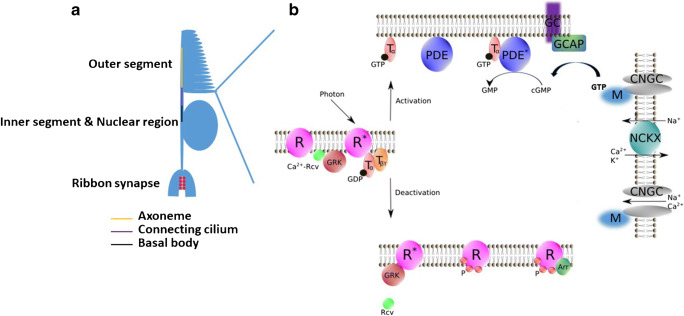
All vertebrates share a canonical retina with light-sensitive photoreceptors in the outer retina. These photoreceptors are of two kinds: rods and cones, adapted to low and bright light conditions, respectively. They both show a peculiar morphology, with long outer segments, comprised of ordered stacks of disc-shaped membranes. These discs host numerous proteins, many of which contribute to the visual transduction cascade. This pathway converts the light stimulus into a biological signal, ultimately modulating synaptic transmission. Recently, the zebrafish (Danio rerio) has gained popularity for studying the function of vertebrate photoreceptors. In this review, we introduce this model system and its contribution to our understanding of photoreception with a focus on the cone visual transduction cascade.
所有脊椎动物的视网膜都具有相同的结构,在外层视网膜中都有光敏感的光感受器。这些光感受器有两种类型:视杆细胞和视锥细胞,分别适应于低光和高光条件。它们都具有一种特殊的形态,具有由有序堆叠的盘状膜组成的长外节。这些盘状膜中含有许多蛋白质,其中许多蛋白质参与视觉转导级联反应。该途径将光刺激转化为生物信号,最终调节突触传递。最近,斑马鱼(Danio rerio)因其研究脊椎动物光感受器功能而受到关注。在这篇综述中,我们将介绍这个模型系统及其对我们理解光感受的贡献,重点介绍视锥视觉转导级联。