Blood and Marrow Transplant Program and.
Department of Medicine, University of Minnesota, Minneapolis, MN.
Blood Adv. 2021 Feb 23;5(4):1069-1080. doi: 10.1182/bloodadvances.2019001110.
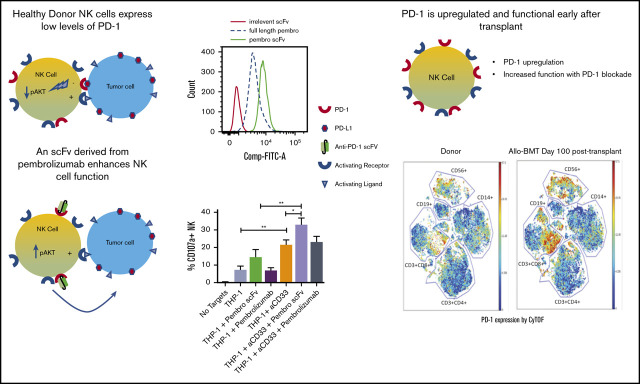
Expression of programmed cell death protein 1 (PD-1) on natural killer (NK) cells has been difficult to analyze on human NK cells. By testing commercial clones and novel anti-PD-1 reagents, we found expression of functional PD-1 on resting human NK cells in healthy individuals and reconstituting NK cells early after allogeneic hematopoietic stem cell transplantation (allo-HSCT). Peripheral blood samples from healthy individuals and transplant recipients were stained for PD-1 expression using the commercial anti-PD-1 clone PD1.3.1.3, fluorescein isothiocyanate (FITC)-labeled pembrolizumab, or an FITC-labeled single-chain variable fragment (scFv) reagent made from pembrolizumab. These reagents identified low yet consistent basal PD-1 expression on resting NK cells, a finding verified by finding lower PD-1 transcripts in sorted NK cells compared with those in resting or activated T cells. An increase in PD-1 expression was identified on paired resting NK cells after allo-HSCT. Blockade of PD-1 on resting NK cells from healthy donors with pembrolizumab did not enhance NK function against programmed death-ligand 1 (PD-L1)-expressing tumor lines, but blocking with its scFv derivative resulted in a twofold increase in NK cell degranulation and up to a fourfold increase in cytokine production. In support of this mechanism, PD-L1 overexpression of K562 targets suppressed NK cell function. Interleukin-15 (IL-15) activity was potent and could not be further enhanced by PD-1 blockade. A similar increase in function was observed with scFv PD-1 blockade on resting blood NK cells after allo-HSCT. We identify the functional importance of the PD-1/PD-L1 axis on human NK cells in which blockade or activation to overcome inhibition will enhance NK cell-mediated antitumor control.
程序性细胞死亡蛋白 1(PD-1)在自然杀伤(NK)细胞上的表达一直难以在人类 NK 细胞上进行分析。通过测试商业克隆和新型抗 PD-1 试剂,我们发现健康个体和异基因造血干细胞移植(allo-HSCT)后早期重建的 NK 细胞上存在静息状态下人类 NK 细胞上的功能性 PD-1 表达。使用商业抗 PD-1 克隆 PD1.3.1.3、异硫氰酸荧光素(FITC)标记的 pembrolizumab 或源自 pembrolizumab 的 FITC 标记的单链可变片段(scFv)试剂对健康个体和移植受者的外周血样本进行 PD-1 表达染色。这些试剂鉴定出静息 NK 细胞上存在低但一致的基础 PD-1 表达,通过比较分选的 NK 细胞与静息或激活的 T 细胞中的 PD-1 转录本,验证了这一发现。在 allo-HSCT 后,配对的静息 NK 细胞上鉴定出 PD-1 表达增加。用 pembrolizumab 阻断健康供体静息 NK 细胞上的 PD-1 不会增强 NK 细胞对表达程序性死亡配体 1(PD-L1)的肿瘤系的功能,但用其 scFv 衍生物阻断会导致 NK 细胞脱颗粒增加两倍,细胞因子产生增加高达四倍。支持这一机制的是,K562 靶细胞上的 PD-L1 过表达抑制 NK 细胞功能。白细胞介素-15(IL-15)活性很强,不能通过 PD-1 阻断进一步增强。在 allo-HSCT 后,静息血液 NK 细胞上的 scFv PD-1 阻断也观察到类似的功能增加。我们确定了 PD-1/PD-L1 轴在人类 NK 细胞中的功能重要性,其中阻断或激活以克服抑制将增强 NK 细胞介导的抗肿瘤控制。